• CREATE AN ACCOUNT
  • LOG.IN
  • CONTENTS
  • CLASSIFIEDS
  • ARCHIVE
  • INFO | ADVERTISING | CONTACT US

  • Home
  • News
    • News Main Page
    • NewsFlash
  • A&E
    • A&E Main Page
    • Movie Times
    • TV Listings
    • A&E Blog
    • Art Galleries
    • Best Bets
  • Opinion
    • Opinion Main Page
    • Columns
    • Voices
    • Letters
    • In Memoriam
    • Obituaries
  • Events
    • Today
    • Search
    • Submit
    • Best Bets
  • Living
    • Living Main Page
    • Outdoors
    • Travel
    • Sports
    • Peeps
  • Food & Drink
    • Food & Drink Main Page
    • All Restaurants
    • Delivery
    • All Bars & Clubs
    • Drink Specials
    • Open Now
  • Outdoors
    • Outdoors Main Page
    • Outside Insider
    • Spotlight On
    • Features
  • Classifieds
    • Real Estate
    • Jobs
    • Autos
  • Personals
  • Obits

Kelley Close

The Fire and the Wild

The Zaca Fire, and the measures needed to stop it, spreads real destruction beyond trees and scrubs, effecting both lives and habitat.

Thursday, August 16, 2007
By Ray Ford (Contact)
Article Tools
Print friendly
E-mail story
Contact an Editor
iPod friendly
Comments
Bookmark This
del.icio.us. del.icio.us.
Digg! Digg!
furl furl
google google
newsvine newsvine
reddit reddit
technorati technorati
Facebook Facebook
Yahoo! My Web 2.0 Yahoo!

Just off Highway 33, as you enter the upper Cuyama Valley, a dirt road cuts across the river leading to the Tinta OHV (off-highway vehicle) route and Rancho Nuevo Canyon, a part of the Dick Smith Wilderness. In a few days, this area will be fired out along the Cuyama River northwest to Santa Barbara Canyon. The fire is getting that close.

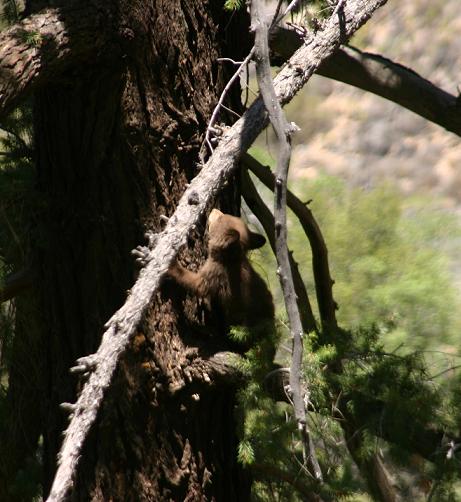
In early June, when I visited Rancho Nuevo Canyon, I spotted a mother bear and her three cubs. Eyeing me almost immediately, the bears scooted down the hill where the mother herded the cubs up a tall fir tree just below the trail.
A bear cub in Rancho Nuevo Canyon, an area effected by the Zaca Fire.
Click to enlarge photo

Jasonn Beckstrand

A bear cub in Rancho Nuevo Canyon, an area effected by the Zaca Fire.

At that moment, we were more concerned about getting by safely than what our impact might be once we’d moved on. Little did we realize that two months later, the bears would be threatened by a more imposing force: the Zaca Fire. The blaze has left those fighting it no choice but to initiate back-firing operations in its path. When completed, 70 percent of the vegetation could burn, possibly even the fir the bears climbed. As the fire consumes precious habitat, less and less remains for forest creatures. Even the neighboring Ventura backcountry lost a chunk of its own inhabitable territory in the Day Fire last year.

Though no one has seen any of the fire damage to other parts of the forest yet, reports of major loss of habitat are alarming. Though the top of Little Pine is silhouetted with pines, rangers say no living trees remain in the area. Indian Creek may lose almost its entire vegetative cover, as will much of the upper Santa Cruz drainage. This loss will not only be devastating to the wildlife but also could also cause erosion, sedimentation, and the loss of critical water storage. The impacts, both good and bad, will be with us for a long time.

For now, however, I am most concerned about the fate of that mother bear and her cubs.

Mama bear protects her cubs in Rancho Nuevo Canyon.
Click to enlarge photo

Jasonn Beckstrand

Mama bear protects her cubs in Rancho Nuevo Canyon.

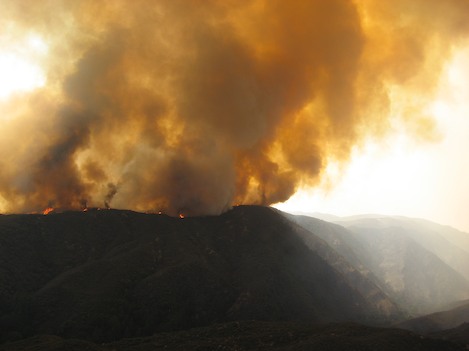
Taken from a helicopter earlier this week, the top photo shows the very much alive and uncontrolled northeastern perimeter of the Zaca Fire, which is still burning strong near the Sisquoc River. As of press time, the fire had eaten up an area of wilderness nearly two-and-a-half times the size of Washington, D.C. – a loss of habitat that has critters big and small running for cover. The bottom photo shows a bear in the Dick Smith Wilderness taken just a few months ago near Rancho Nuevo Canyon. In the coming days, in a move designed to stop the fire’s advance toward Highway 33, this very region will be methodically set on fire by U.S. Forest Service firefighters in an attempt to starve the fire.


Story Help (Click-ability)
Double-clicking on any word or phrase in this story will open a reference window with definitions and links to other reference material.

Comments

Discussion Guidelines

Ray, good work on the fire reporting and the aftermath of the fire damage. It's too bad that there isn't a program to burn out parts of the brush on an annual basis. That would lessen the impact on a human caused event. My wife and I are very sadden to know that our backcountry will not look the same in our lifetimes.

twbaker (anonymous profile)
August 16, 2007 at 7:41 a.m. (Suggest removal)

I'm with you, Ray. Can't stop thinking about the homeless animals, let alone those that haven't survived.

I'm looking forward to the re-birth, but very sad that all my favorite places are essentially gone. I try to look on the bright side, but I'm having trouble finding one. It will be interesting to see the rock formations, as we can now do in Gaviota Pass, but that's small compensation for a denuded landscape. The best spin I can put on this fire is that ticks won't be a problem for awhile.

Den (anonymous profile)
August 16, 2007 at 7:59 a.m. (Suggest removal)

Ray, Any word on what is happening on the SE flank of the fire? There have been no map updates since Tues and the firefighters I have talked to in the front country say that is the most active area right now, and has been since Tues.
Thanks

torotoro (anonymous profile)
August 16, 2007 at 8:37 a.m. (Suggest removal)

torotoro, try the county fire website for more detail between Ray's updates
http://www.sbcfire.com/

mtndriver (anonymous profile)
August 16, 2007 at 10:08 a.m. (Suggest removal)

FROM A READER:

If 105,000 acres have burned, and -let's say- there's one bird per acre in the forest (obviously a low number), then there are at least 105,000 displaced birds.

Your care of them in your yard will be appreciated by each evacuating bird who chooses your hospitality to survive. A good place to get advice on birdseed is Island Seed and Feed in Goleta. Or, try Le Cumbre Feed on Calle Real in Santa Barbara. I use Hawaiian No Waste Songbird seed for scrub jays, woodpeckers, and smaller birds. I use thistle for goldfinches. For hummingbirds and orioles, I use sugar water, 4 parts water to 1 part sugar. Many birds love hulled sunflower, or black oil sunflower seeds.

Maggie at Le Cumbre Feed, told me about her ranch in Buellton. She has evacuating wild turkey hens landing on her chicken coop, looking for food and water. And, she is gladly helping them out!

Birds are evacuating from the Zaca fire, and from the smoke. They cannot go inside and shut the door, they are outside breathing day and night. Like all animals, they have territories where they live and feed. Now displaced, they are traveling into adjacent communties. Have a heart, and put out clean water in your back yard, or on your deck. It's hot and dry. They are thirsty, too. They have ash on their feathers, so your kindness in providing spraying water during the morning, or late afternoon, would be helpful for them to clean their wings so they can keep flying. A water fountain is very helpful, and you can enjoy watching them take "showers" these days.

As for bigger animals, try not to shoot them if they venture into your community. The shocking report that a hapless bobcat had hidden in a county owned shed in New Cuyama, only to have Animal Control shoot it, because it "seemed disoriented and unhealthy" was a travesty. How would you be if you were run out of your home, and out of your territory for hunting your next meal?

When you drive a bobcat, or any other predator, from its territory you are effectively giving it a death sentence, since it is being displaced into the territory of other bobcats.

The other death sentence is going into human habitat, only to be killed.

Please remember that your backyard is the wildlife's wilderness, or was. Please show your compassion, and share whenever you can.

Matt (Matt Kettmann)
August 16, 2007 at 11:02 a.m. (Suggest removal)

Ray,

Is there a wildlife expert (in addition to you) that could give us an estimate on the number of bears and mountain lions that were living in the burned area? We have been wondering how surviving animals reallocate remaining territory, and are concerned about the fate of those that may (or have already) wandered onto surrounding ranchlands. Are we wrong in thinking almost all of the best habitats in the county have burned?

We share your concern for the mother and her cubs. We have been thinking of “our” special Judell bear. We generally saw fresh sign any trip through Judell Canyon and one morning saw him/her returning down canyon from dinner in the Cuyama Valley, smelling but not seeing us lying in the grass on Santa Barbara Potrero in the pre-dawn hours.

This is so sad.

(Hi Tom!)

Madulce (anonymous profile)
August 16, 2007 at 11:34 a.m. (Suggest removal)

Yes, wildlife looking for new habitats is a great concern for all of us that care about our forests. My personal guess, as a VWR (volunteer wilderness ranger) is that the unburned areas on either sides of the Santa Ynez River, up the backside to SB, and in Blue Canyon, will offer some respite for fleeing animals on the southern side. Some word has been circulating that a rancher over near the Santa Cruz drainage has already counted 11 bears trekking out over the last 3 weeks, but I can't confirm this. Hopefully they will all be given a wide berth by humans in order to have the chance to exist. There will probably be some "survival-of-the-fittest" that will go on, but that is life.

LRaf (anonymous profile)
August 16, 2007 at 12:30 p.m. (Suggest removal)

Post a comment

Username:
Password: (Forgotten your password?)

Comment:

EVENT CALENDAR

Previous Month | Next Month

Today's Events Best Bets Submit an Event

Local Weather

Currently:
Mist
Temperature:
53.1°
Wind:
3 NNE

Surf Report
  • Specials
  • InPrint
  • Top Emails
  • Blue Green Guide 2008
  • Summer Camp Guide 2008
  • Wedding Guide 2008
  • SBIFF 2008 All Access
  • 2008 Election Coverage
  • Best of Reader's Poll 2007
  • Calendar of Fundraisers
  • Local Bands
  • Kid's Mother's Day Issue
  • Made in Santa Barbara
  • Tea Fire 2008
  • Local Heroes 2008
  • VADA Project at SBMA
  • Reprieve for Modoc Road Evictees
  • Which Canyon Will Burn Next?
  • Zach Gill’s Timely Tidings
  • Thanksgiving Turkey
  1. Wendy McCaw Shuts Down Goleta Valley Voice
  2. Hannah-Beth Jackson Concedes to Tony Strickland
  3. Embers to Ashes
  4. From Black Friday to Blessed Friday
  5. The Tea Fire Devastates the Bohemia of Mountain Drive
  6. I.V. Eatery Branches Into Downtown
  • CREATE AN ACCOUNT
  • LOG.IN
  • CONTENTS
  • CLASSIFIEDS
  • ARCHIVE
  • INFO | ADVERTISING | CONTACT US
Google
 
Independent.com Web
Copyright ©2008 Santa Barbara Independent, Inc. Reproduction of material from any Independent.com pages without written permission is strictly prohibited. If you believe an Independent.com user or any material appearing on Independent.com is copyrighted material used without proper permission, please click here.
This is our Privacy Policy.