Turkish Writer Orhan Pamuk Discusses His Love of Literature
Fragments of Humanity

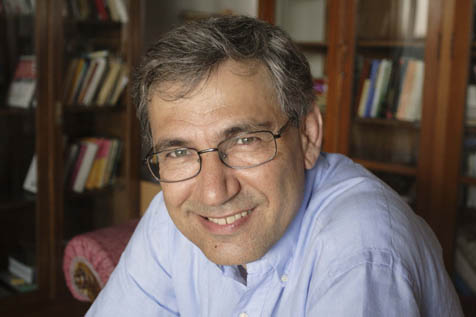
Orhan Pamuk is Turkey’s most well-known author, and his works have been published worldwide in more than 50 languages. Last year, he won the Nobel Prize for literature; in announcing the award, the Swedish Academy cited his devotion to “the study of mixture and plurality.” A secular-minded Turk, Pamuk’s novels-which include The Black Book, My Name Is Red, and Snow-are haunting, multilayered explorations of the nature of Turkish identity and the tension between East and West, modernity and Islam.
Pamuk currently resides in New York City, where he is a professor of literature at Columbia University. On October 19, Pamuk will appear at UCSB’s Campbell Hall to deliver a commentary and a reading from his new book, Other Colors: Essays and a Story. He spoke to The Independent by telephone from New York.
What does the title of your new book, Other Colors, signify? These are fragments: slices of life that I find important, interesting, literarily inspiring-things that have stayed with me, but have never found a place in any of my novels. I put it all together and tried to carve out a continuous autobiographical narrative. I wanted the title of this book to mean, “these are the other fragments, the other colors.”
You have often described yourself as a compulsive writer, who shuts himself in a room for 10 hours a day to write. Yes, I am a person who compulsively writes, but I don’t necessarily publish everything. Italo Calvino came up with the term “graphomaniac,” which he used to refer to himself in a positive way. I am also a graphomaniac. I handwrite, and I have notebooks with me always and I am always filling them. But filling notebooks is one thing; publishing pages is another. [Laughs.]
Has writing prose gotten easier for you over time? No. It’s still hard. I still find myself in a situation where there is a very simple thing I want my character to do, like enter a room, and I cannot make them do it. Of course you can make them do it crudely, but it should be elegant, it should be harmonious. : This is one of the important qualities of good fiction; it’s not the events that count, but the continuity, the harmony, of the narrative.
You write in Other Colors about how much emotional impact a day of writing well, or writing poorly, has on you. Yes. In Other Colors I wrote about my friendship with my daughter. I wrote about how she didn’t want to go to school, about how upset I was when she was sad-so on and so forth. These were little essays I wrote 10 years ago. Now she is 16, and a great friend of mine. And now, at the end of the day, if I have written well, I am happy, smiley, and my daughter says, “Oh, it’s gone well. How many pages?” or, “Poor daddy. You’ll write better tomorrow.” [Laughs.]

Of course, in a way I am an artist, a person who writes fiction all the time. But I am also a craftsman. I am like a carpenter-I am doing a table, and if the table doesn’t come out well, I’m upset. That’s normal.
In your Nobel Prize acceptance speech [included in Other Colors] you wrote, “I believe literature to be the most valuable hoard that humanity has gathered in its quest to understand itself.” Why is that? I think the details of human experience are best captured, discussed, understood, and preserved in the tradition of literature. It is not just that texts are national treasures and each nation develops their great authors. That’s one thing. That I understand. But forget about nations. Recording the human experience with literature is an immensely valuable thing, because we are informed by a person who is as fragile and vulnerable as ourselves. And his subjectivity is also valuable. Humanity began to develop a sense of its existence-a continuity of its existence-and it began sharing the whole human experience with others through literature, and through the translation of literature.
This is something you’ve written about in the context of [Marcel] Proust, about the detail that literature can furnish on the quotidian aspect of our lives. How has Proust influenced you? Proust taught me something about life that is much more important than literary influence. I don’t think I’m much of a Proustian writer, but he taught me to pay attention to little, minor human sentiments. He taught me how to pay attention to human vanity, to expectations, to human smallness. He did not look down on these failings as bad things. He paid very disciplined, civilized attention to these human follies, so to speak, and put them in a new light. He understood them. And once he understood them, we also understood them. I understood them. We can understand anything through literature. That’s what counts.
Your writing has become heavily associated with contemporary geopolitical issues, in particular with the so-called clash of civilizations-the supposed clash between Western secular democracy and Islamic fundamentalism. Is this something you sought out, especially with Snow-your last novel-and the most overtly political of your books? When I planned Snow, I didn’t much consider it as East versus West, Islam versus modernity. Of course these are eternal Turkish questions. When I began writing Snow, there was no 9/11. I wrote the book as a Turkish political book. At that time I was widely translated, and I knew it would be translated. But I never thought it would have such international recognition. Some of it of course is 9/11, and the war in Iraq, and so on. Some of it is that this is the nature of Turkish politics. I wrote it without considering a bigger frame, so to speak. Let’s put it more simply: After 9/11, the kinds of problems Turkey has faced for years turned out to be problems of the world.
Many people would like you to be the interpreter of where the West and the East meet. Is this a role you are comfortable with? I’m not comfortable with it. That’s a role that journalists and social commentators put to me all the time. I understand why they say it. There is content to what they say. But then I am a little bit upset because I am an artist. I am not that kind of person. These people do not realize I don’t write my novels thinking [about geopolitics], especially in the early periods. I just write my novels paying attention to the slices of life I want to write about. But since Turkish culture and Turkey’s political position somehow turned out to be a very global situation, sort of an example for the world, then this question pops up, sometimes making people forget that my instincts are purely literary, purely artistic.
Your books are resistant to big ideas, though your characters have a passion for them. Yes. Good point. In fact, in Other Colors you may sense my suspicious attitude toward strong opinions. Strong opinions are okay if they’re about minor subjects. But strong opinions about general subjects, or what they call great ideas, I don’t like. I don’t like political agendas. I don’t like people with formulas that are applicable to everything-people who advance easy moralistic judgments. These are things I do not like. In fact, that’s why I was never in politics in my life. In Turkey, where there is so much communal feeling, political or not, I chose to be solitary-a writer.
Not long after 9/11, you wrote a very moving essay that was in large part about what you called “the problem facing the West.” What is that problem? In that article, which is in Other Colors, I wrote about the sensibility of a Turkish man who was not religious. He didn’t have a political or Islamist agenda. And his reaction to 9/11 was a sort of happiness, because he resented the West. Why did this guy have resentment toward Europe and America? In my part of the world, it’s the resentment of the person who thinks he is living a second-rate or third-rate life. Western civilization, which is [dominating] global history, constitutes a minority of the world. The majority of the world is non-Western people leading much lesser lives economically and politically, but on the other hand bombarded by Western culture, Hollywood movies, Western media. They more or less see that the world is governed by other nations, other civilizations, and that they are looked down upon. There is an immense reaction in the non-Western world to this. But unfortunately, the Western media does not address this. Instead they teach us Islam is bad; Muslims are terrorists.
What did winning the Nobel Prize mean for you, and what is your hope for the art of the novel? The Nobel Prize of course made me happy. I sometimes joke I am the kind of superficial person who the Nobel Prize would make happy. But leaving aside the joke, the trends of global culture are developing in such a way that more and more, the art of the novel-literature-is a high art. People, unfortunately, are looking more at TV, and young people are getting their education less from books and more from visual culture. These are facts. But I am optimistic about the future of the art of the novel, to which I consider myself a humble servant. One thing about literature is this: A person, alone in a room with paper and pen, has so much power because if he or she writes something interesting, humanity may read it. If this person feels upset, angry, dissatisfied, has melancholy, sadness, and closes himself or herself in a room and writes, he or she may find an audience. That will never diminish. That is eternal. The cultural industry is moving toward films, television-that’s a fact. But good writing will always serve us. I don’t need a Nobel Prize to believe in that, and I am so sure that there are so many people all over the world who believe the same. That is the enduring quality of humanity, and literature.
4•1•1
Orhan Pamuk will speak at UCSB’s Campbell Hall on Friday, October 19, at 8 p.m. Pamuk’s books will be available for purchase and signing. For more information, call 893-3535 or visit artsandlectures.ucsb.edu.