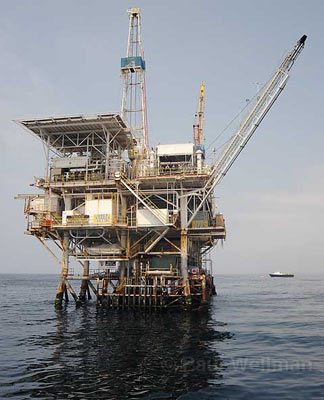
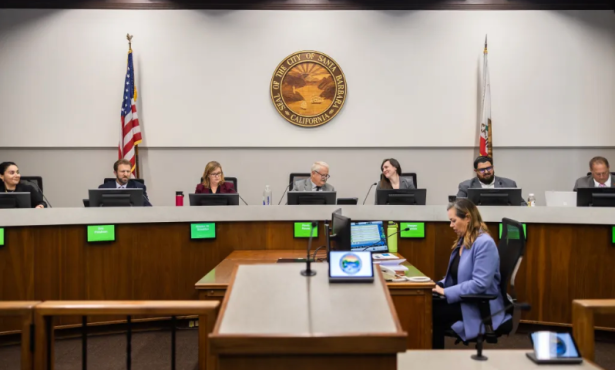
The American energy crisis continued to dominate headlines this week, with oil tycoon T. Boone Pickens and his plan to end foreign oil dependence, the bipartisan “Gang of 10” Senators and their plan for offshore oil drilling, and Democratic presidential candidate Barack Obama’s softening his statements about offshore drilling in light of a seeming shift in national perspective.
Obama’s comments — that he may be open to offshore oil drilling if it coincides with development of other energy sources — come as Americans continue to feel the pain at the pump. John McCain, a strong supporter of offshore oil drilling, has picked up steam recently, while for the first time since 2003 — the year the Public Policy Institute of California initially started posing offshore drilling questions to residents — more Californians indicated in a survey they favored drilling (51 percent) than were opposed to it (45 percent). Republican Matt Kokkonen, who is challenging Representative Lois Capps for her 23rd District seat this fall, said that 86 percent of the people in the district support more drilling. He argues that drilling in the Santa Barbara Channel would benefit the economy, energy, and the environment. “The world market is demanding huge amounts of oil,” he said. Capps, however, opposes further offshore drilling, as do Governor Arnold Schwarzenegger and many coastal politicians.
Linda Krop, lead counsel for the Environmental Defense Center, cautioned that if the moratorium were lifted, it would take roughly 20 years for drilling to be permitted and conducted. She called Bush’s move a “gift to the oil industry before he leaves office.”
Citing high gas prices as his motive, President George W. Bush last month lifted a presidential moratorium on offshore drilling. But the move means nothing unless Congress votes to lift its ban, which is part of an appropriations bill that should be addressed this September. Linda Krop, lead counsel for the Environmental Defense Center, cautioned that if the moratorium were lifted, it would take roughly 20 years for drilling to be permitted and conducted. She called Bush’s move a “gift to the oil industry before he leaves office.”
Last week, some Republican members of Congress refused to leave the House floor going into an August recess, instead protesting Speaker Nancy Pelosi’s refusal to put energy on the table for discussion. Their protest — which Capps, back on the Central Coast for the month, called a “gimmick” — was expected to continue as long as there were people who were listening.
In the meantime, Capps has joined with Obama and Pelosi in calling for the president to release roughly 70 million barrels of oil from the Strategic Petroleum Reserve (SPR), currently 97 percent full. Rather than having a years-long wait for drilling to happen, the release could cause an immediate price drop, they say. Bush saw prices drop from releasing SPR oil after Hurricane Katrina in 2005, as have his predecessors Bill Clinton in 2000 and his father George H.W. Bush in 1991, when prices subsequently dropped $8 a barrel. While that is happening and while Congress works on a comprehensive renewable energy policy using wind and solar technologies, the Democrats say oil companies should drill in the 68 million acres of federal land and water already leased to them. Capps said that despite his recent comments suggesting he was open to the idea of drilling, Obama has remained consistent in calling for comprehensive energy reform, including the announcement Monday in Michigan that he would guarantee the auto industry $4 billion in tax credits and loans for fuel-efficient vehicles. These strategies need to be the focus, Capps and fellow Democrats argue, not opening up more protected land and water.
The per-barrel price dropped below $119 this week, a three-month low, but $4 plus some change per gallon at the pump stings many in comparison to what they paid eight years ago. “These record profit announcements, record high energy prices, and insistence of the President to continue pushing more of the same failed strategy that got us here in the first place amply demonstrate the bankruptcy of the Bush Administration’s energy policies,” Capps said in a statement last week after Exxon Mobil announced its $11.68-billion second-quarter earnings — the largest quarterly profit ever by any U.S. corporation.

Double-clicking on any word or phrase in this story will open a reference window with definitions and links to other reference material.

Print friendly
E-mail story
Tip Us Off
iPod friendly
Comments
Bookmark This
Previous Month


Comments
Discussion Guidelines
We have an oil shortage and a water shortage. More offshore drilling platforms are just around the corner. While oil and water do not normally mix, I would like to propose an instance where they just might do so. I propose that any new offshore drilling platforms be mandated to also include an ocean water desalination plant, using either reverse osmosis or distillation to turn salt water into drinking water. Now, here is the catch. Since offshore oil rigs bring oil and gas to the surface, it should be quite easy to siphon off some of the gas (methane) to directly power the desalinator. Voila! We now have an offshore rig that provides oil, gas and drinking water. It is a fully self-contained desalination plant that is completely self-powered, each sized to produce hundreds of thousands of gallons of inexhaustible drinking water for residents of the communities that have to look at the ugly structures. When the new rigs are installed, water pipes would be added along with the oil and gas pipes from the platform to shore, whereby the water can be added to our present water supply. The deal with the oil companies would be to provide the water at cost (or free) in exchange for drilling rights. While $5/gallon for gas is no fun, I would feel a little better knowing the oil companies were underwriting part of my water bill and, of course, making our community drought-resistant. Perhaps we should have them throw in enough methane to also power the sixteen year old land-based and mothballed Santa Barbara desalination facility. This really is not rocket science. As a retired rocket scientist I feel comfortable that all of the technology to accomplish this is in place. In fact, Santa Maria has just unveiled an electric generating system for powering a medical center which uses previously wasted methane gas siphoned from a landfill, and unused offshore platforms have been used to house desal facilities in several foreign countries. By placing the facilities offshore, the ecological issues of marine life disturbance and brine discharge are substantially reduced.
Readers say: Thumbs Up: 0 of 0 • Thumbs Down: 0 of 0
Researcher (anonymous profile)
August 7, 2008 at 9:36 a.m. (Suggest removal)
Progressives prattle endlessly about "diversity." In the interest of diversity, they should support Matt Kokkonen, who if elected would probably be the only Republican among our representatives from the Assembly to US Senate level. (Assuming Jackson wins the State Senate.) Kokkonen at least has some new, "diverse" ideas about energy and immigration, in comparison with the ossified no oil/open borders Progressives.
Readers say: Thumbs Up: 0 of 0 • Thumbs Down: 0 of 0
revisionist (anonymous profile)
August 8, 2008 at 6:20 p.m. (Suggest removal)
While China and India account for over one-third of the global population, their combined oil consumption is less than one-eighth of that of California. Ever heard the expression "dog in the manger"? California should be apologizing to the world for its overconsumption of oil and be scrambling to develop its own supplies, instead of blocking domestic efforts and exporting exploration, production, and associated environmental issues to NIMBY. If anyone should be impeached, it's Pelosi.
Readers say: Thumbs Up: 0 of 0 • Thumbs Down: 0 of 0
RCMeltzer (anonymous profile)
August 11, 2008 at 7:23 p.m. (Suggest removal)
A new Environmentally sound Santa Barbara Energy plan;
See; www.strategicnine.com
The Santa Barbara OCS-State petroleum development project would have a daily send-out capacity of 100,000 BBL/day oil-gas. Enough to supply the daily needs of the entire Santa Barbara County as well as reduce imported oil needs for Southern California.
PRIMARY BENEFITS OFFERED TO SANTA BARBARA COUNTY RESIDENTS
1. $2.50 GASOLINE for all registered Santa Barbara County residents and County vehicles from local oil production.
2. $2.50 GASOLINE for all registered hotel guests in Santa Barbara County.
3. County-wide Clean-Air, Compressed Natural Gas (CNG) car conversions facilities.
4. $1.50 CNG for Santa Barbara and Coast residents for flexi-fuel vehicles.
5. Substantial Annual Grants to local environmental study groups and renewable energy programs.
6. Significant decrease in County-wide Air pollution from lower natural reservoir seepage.
7. Much lower C02 emissions for the County and State of California.
8. Significantly reduce potent greenhouse gas methane emissions from offshore gas seeps.
9. Much cleaner Santa Barbara beaches and oceans by reduction in beach tar balls.
10. Large new natural gas supplies from Bering Sea, landing via Santa Barbara County, to lower America’s C02 emissions from out of State coal-fired power plants, which will no longer be needed.
11. Increased local, State and National energy income streams, with monies all staying inside the County and America.
12. Provide Complete Santa Barbara energy self reliance and improve America’s energy security.
13. Significant high-paying local jobs boost.
14. Significant increased cash energy royalties to County of approximately $250-500 million p.a will improve the quality of life for all Santa Barbara County staff and local residents.
15. Special Proposed Community royalty payment from Bering Sea Gas imports landings to fund FREE County-Wide clinics and a new FREE County Hospital.
16. Lower-cost CNG for public transport-busses and vans, will enable disadvantaged and senior citizens to travel more freely.
17. Natural Gas for County home heating and cooking at a 30% discount to the prevailing rate.
18. Significant Increase in Local Property Values due to many of the above benefits.
Readers say: Thumbs Up: 0 of 0 • Thumbs Down: 0 of 0
petersterling (anonymous profile)
August 13, 2008 at 5:34 p.m. (Suggest removal)
Post a comment