Rabbit Cake and the Rabbi’s Tarot
The Best of The Book Den

Book lovers come in many varieties. There are those who merely glance through the occasional paperback, those who own many books, and those who parlay their love of the literary into actually owning and operating a bookstore. Eric Kelley, owner of The Book Den on Anapamu Street, is one of the latter, and the store’s shelves are a testimony to the fact that no book is too outre to escape his notice.
While many perfectly normal books are on sale at The Book Den, there’s also a plethora of weird gems, perched quietly on shelves, awaiting the attention of the avid collector with a taste for the strange. This week’s Weird SB offers a survey of the best, worst, and weirdest volumes available.
Brain surgery is typically best left to the well-trained. However, Advances in Stereotactic and Functional Neurosurgery 10 contains thousands of handy tips for operating on the brain of your choice – articles like “Clinical Evaluation of Computed Tomography-Guided versus Ventriculography-Guided Thalamotomy for Movement Disorders” spell out techniques quite well, even for the layman. Try it at home!
There are also options for the less adventurous. The Book Den has an excellent selection of cookbooks, including 88 Danish Dishes. This slim little volume contains recipes for authentic and possibly even delicious Danish foods such as grilled lamb’s head or liverpaste and tongue – after you’re done with those, you probably won’t need an 89th dish. A good companion purchase might be Wurst You Were Here: The Choice Cuisine of Germany, which offers easy-to-follow instructions on the making of rabbit cake, pig’s knuckles and sauerkraut, and eel soup.
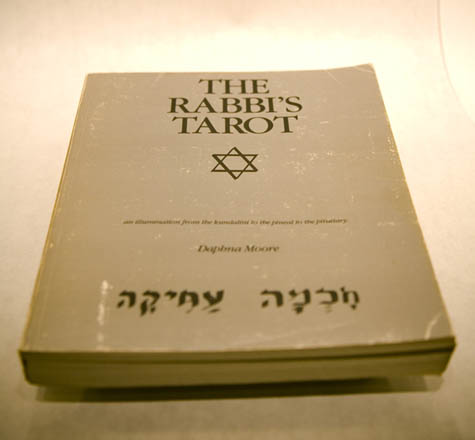
And that brings us to after-dinner entertainment. Forget the ouija board – the occult has much more to offer. One option might be The Rabbi’s Tarot, an illumination from the kundalini to the pineal to the pituitary, by Daphna Moore. While there are more tarot sets than you can shake a wand at available in every bookstore, The Rabbi’s Tarot is special. According to Ms. Moore, it “reveals how the practical occultist develops the pineal and pituitary glands by energized currents coming through the seven centers or Chakras . . . When the pineal gland is energized by the transmuted sex force (THE MAGICIAN’s wand), the sex force is then turned into the White Light.”
Who knew that the tarot could be so spicy? I can only assume that this book was written with Reform rabbis in mind – energized pineal and pituitary glands can’t possibly be kosher enough for the Orthodox.
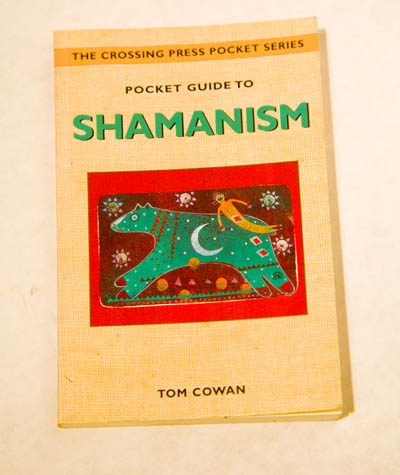
For anyone who prefers to stay away from organized religion, even in the form of tarot, there is also the Pocket Guide to Shamanism, by Tom Cowan. The book really is pocket-sized, and would be the perfect gift for a person on the go who has everything except the ability to contact animal spirits.
And of course, The Book Den has a section on living animals, too. Perhaps the strangest book from this section is Des btes et des homes, a French book of portrait photographs. That doesn’t sound all that weird, until you realize that each of the French people pictured are posing happily with their favorite livestock animals, from well-groomed cows to extraordinarily large pigs. The back of the book suggests that Yann Arthus-Bernard, the photographer, wanted to show that humans and animals can and do live in harmony. It’s a noble effort, but there are only so many pictures one can look at of a Frenchman and his favorite sheep before the experience becomes unsettling.
If one were to try to think of the polar opposite of a book about friendship between humans and cows, a book on leather tanning might very well be at the top of the list. The Book Den has such a volume, entitled Roser: A Tradition in Tanning: A narrative concerning the art of tanning as practiced by nine consecutive generations of Rosers, together with an account of the 100th anniversary of the establishment of the Roser tannery in America. It’s bound, predictably, in extremely high quality leather and the book itself is thankfully only slightly longer than its title.
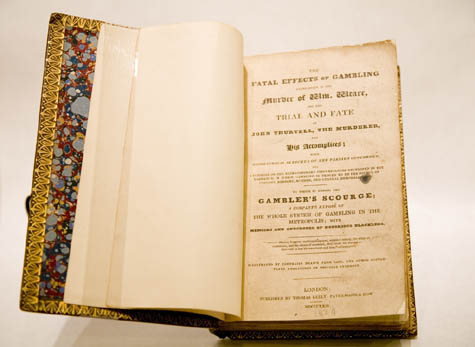
However, Roser: A Tradition in Tanning doesn’t even come close to winning the prize for longest book title. For that, one has to go back further in time, in this case to 1824, when Thomas Kelly, a publisher in Paternoster Row, London, decided to break all previous records and compose the longest title in history. At least, I have to assume that he did it on purpose, as it’s almost inconceivable that anyone could have titled a book like this by accident. Stamped on the spine in gold lettering are the words Thurtell’s Trial, which would seem to be sufficient.
Not so. The title page contains the full and complete version, which reads: “The Fatal Effects of Gambling Exemplified in the Murder of Wm. Weare, and the Trial and Fate of John Thurtell, the Murderer, and His Accomplices; with Biographical Sketches of the Parties Concerned, and a Comment of the Extraordinary Circumstances Developed in the Narrative, in Which Gambling is Proved to be the Source of Forgery, Robbery, Murder and General Demoralization. To which is added, the Gambler’s Scourge; a complete expose of The Whole System of Gambling in the Metropolis; with Memoirs and Anecdotes of Notorious Blacklegs.” Now that’s a title.
As an antidote to Thurtell’s Trial, which has an extraordinary title and very little of interest within, The Book Den has the opposite: books with somewhat silly titles but surprisingly entertaining content. Last but not least, here’s an excerpt from Saucy Limericks & Christmas Cheer, a small book by Kenneth Rexroth, the well-known poet. Published privately in Santa Barbara by Bradford Morrow, only 299 copies were printed and it’s too bad, as Rexroth’s limericks are saucy indeed. One of the best is this one, which provides a new spin on the famous German writers Johann Wolfgang von Goethe and Johann Cristoph Friedrich von Schiller:
Said Schiller while buggering Goethe
“Tell me dear if it hoethe.”
Said Goethe to Schiller
“It’s an absolute killer.”
Said Schiller to Goethe, “It’s doethe.”
That just about says it all even Weird SB couldn’t have said it better.