Testing the Test
Should Santa Barbara High Pass the Exit Exam?

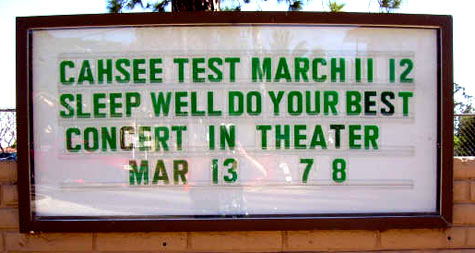
Last week, the sophomore class was subjected to yet another standardized test-only this time, the outcomes are severe. Over the course of two mornings, students took the California High School Exit Exam (CAHSEE) , a test currently necessary to receive a high school diploma.
While the test was approved by the state in 1999, passing it was not required for a diploma until the class of 2006. In May 2006, a lawsuit was filed against the CAHSEE graduation requirement on the terms that students from low-income and minority backgrounds have unequal access to preparatory resources. As a result of Valenzuela v. O’Connell, students who fail the exam are entitled to receive two additional years of education to pass the exam. In addition, Governor Arnold Schwarzenegger allocated funds to low-performing schools to provide extra education for the test.
Santa Barbara High was one of these schools. Assistant Principal David Hodges explained that the funding received from the state was used in two ways: to provide additional English and math instruction for those who did not pass the first time, and extra classes for at-risk students identified through previous state standards exams outside of the normal school day. The curriculum covers main concepts that “parallels the content of the test.”
Generally speaking, 82 percent of students pass the English-Language Arts test the first time, and 78-80 percent pass the mathematics portion. Around 70 percent of students pass math the second time around, with only 40 percent of re-takes passing English. Hodges explained that the success of English-Language Arts declines because most students retaking the test are English language learners. He was careful to explain the broad range of students classified as English learners, from those who moved to the U.S. last week to those who have lived here most of their lives and only have trouble with reading, writing or grammar. Students have their first opportunity to test in March of their sophomore year, with two chances in junior year and three chances in senior year. Hodges said that if students do not pass the exam, very few, if any, accept the extra two years of preparation provided by the state. To prevent drop-outs, the school attempts to channel students into Adult Education, where students can take courses to receive their high school diploma without being required to pass the CAHSEE.
Hodges said that for a new foreign-speaking immigrant, “It is not unusual to have a seven-period day.” Classes include two to three hours of English language development and a class devoted to the CAHSEE in addition to the normal course load of history, science and math. Hodges admitted that it is not realistic for new students to pass the first time, “but we are mandated to give them the test, even if their chances are slim.” He praised English learners for their hard work and their “high level of dedication and effort.” While most students finish the test before noon, English learners are often found working on the test late into the afternoon.
Also among those struggling with the test are students with disabilities. Hodges explained that there are two variations that students may take: accommodations, such as extra time, or modifications, such as a calculator or having the test read aloud. Students who pass the test with accommodations receive their diploma, since these variations do not change the nature of the test. If students pass the test with modifications, they receive a waiver, which counts as equivalent to a diploma. Other exemptions are listed on the California Department of Education website.
The very nature of the CAHSEE graduation requirement continues to be debated today. It would not come as a surprise for more changes to occur in the near future.