• CREATE AN ACCOUNT
  • LOG.IN
  • CONTENTS
  • CLASSIFIEDS
  • ARCHIVE
  • INFO | ADVERTISING | CONTACT US

  • Home
  • News
    • News Main Page
    • NewsFlash
  • A&E
    • A&E Main Page
    • Movie Times
    • TV Listings
    • A&E Blog
    • Art Galleries
    • Best Bets
  • Opinion
    • Opinion Main Page
    • Endorsements
    • Blogs
    • Columns
    • Voices
    • Letters
    • In Memoriam
    • Obituaries
  • Events
    • Today
    • Search
    • Submit
    • Best Bets
  • Living
    • Living Main Page
    • Outdoors
    • Travel
    • Sports
    • Peeps
  • Food & Drink
    • Food & Drink Main Page
    • All Restaurants
    • Delivery
    • All Bars & Clubs
    • Drink Specials
    • Open Now
  • Sports
  • Outdoors
    • Outdoors Main Page
    • Outside Insider
    • Spotlight On
    • Features
  • Classifieds
    • Real Estate
    • Jobs
    • Autos
  • Obits

    UCSB

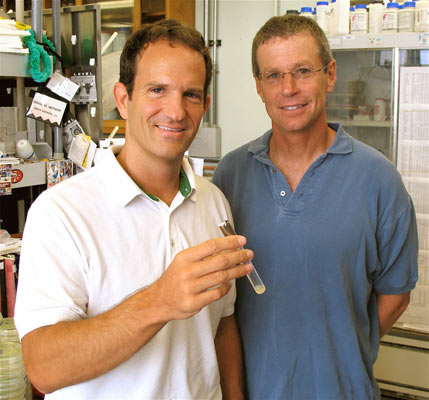
    Douglas Heithoff (left) and Michael Mahan (right)


    Super Vaccine Could Save Lives

    Bacteria Beware: UCSB Scientists Are After You


    Thursday, October 23, 2008
    By Shannon Switzer
    Article Tools
    Print friendly
    E-mail story
    Tip Us Off
    iPod friendly
    Comments
    Bookmark This
    del.icio.us. del.icio.us.
    Digg! Digg!
    furl furl
    google google
    newsvine newsvine
    reddit reddit
    technorati technorati
    Facebook Facebook
    Yahoo! My Web 2.0 Yahoo!

    The discovery of a virtual scientific miracle is close at hand and UCSB researchers Douglas Heithoff and Michael Mahan are the masterminds behind it. They have, in collaboration with University of Utah scientists Elena Enioutina, Diana Bareyan, and Raymond Daynes, produced a single vaccine that can protect against multiple strains of bacteria.

    The current state of vaccination can only protect against a restricted number of closely related strains, for instance, as in flu vaccines. As Mahan put it, the reason “flu vaccines need to be administered every year [is] because different flu strains arise every year.” If the new breed of vaccine continues to perform as it has in studies thus far, it will put the medical field perpetually one step ahead of evolving bacteria rather than in a constant arms race. Mahan and Heithoff cite their desire to find a broad-spectrum vaccine as motivation behind their research.

    The key discovery made by the group was how to flip off a “genetic switch” that had allowed the bacteria to attack the body's immune system. After the switch is disabled, the bacteria also become more visible to the immune system and can be targeted. Another advantage of the new vaccine is that it does not induce a certain group of inhibitory immune cells, as current vaccines often do, that are known to dampen cancer patients’ immune systems and increase their susceptibility to disease.

    Salmonella is the first bacteria the researchers decided to tackle because, in Mahan’s words, “It’s endemic worldwide. It’s not a carnivore issue — it’s everybody’s issue since fruits and vegetables are often the source of infection.” More than 1.5 million cases per year of Salmonella infection—which causes food and blood poisoning—occur in the U.S. alone; a vaccine that attacks a wider range of bacteria strains could prove life saving.

    The research findings on the suppression of inhibitory immune cells may shine a light on the immune declines in cancer patients and those naturally occurring during the aging process. The presence of inhibitory cells, Mahan conjectured, “may explain why the elderly are more susceptible to infection and why they are more difficult to effectively vaccinate.”

    The research is still in its preliminary stages and is being funded by the National Institutes of Health, the United States Department of Agriculture, and the Mathers Research Foundation. Currently the vaccine is being tested on livestock, the main source of human infection.

    Look for a detailed description of the study, including how the research team finessed their way to the new vaccine, in a paper they will publish in the November issue of the scientific journal Infection and Immunity.

    Story Help (Click-ability)
    Double-clicking on any word or phrase in this story will open a reference window with definitions and links to other reference material.

    Comments

    Discussion Guidelines

    Post a comment

    Username:
    Password: (Forgotten your password?)

    Comment:

    EVENT CALENDAR

    Previous Month | Next Month

    Today's Events Best Bets Submit an Event

    Local Weather

    Currently:
    Clear Sky
    Temperature:
    63.0°
    Wind:
    13 W

    Surf Report
    • Specials
    • InPrint
    • Top Emails
    • Best Of 2009
    • 2009 Election Coverage
    • Wedding Guide 2009
    • Blue Green Guide 2009
    • SBIFF 2009
    • Tea Fire 2008
    • Local Heroes 2008
    • Calendar of Fundraisers
    • Local Bands
    • Within the Syuxtun Story Circle
    • Camellia Sasanqua
    • Whole New Ballgame
    • Gratuitous Gore on Highway 154
    • Saul Williams Brings Afro-Punk Tour to Velvet Jones
    • Where There’s a Dill, There’s a Way
    1. Travis Armstrong Is Outta There
    2. S.B. Bank & Trust's Rocky Year
    3. UC Campuses Dominate Rankings
    4. What buildings did architect Julia Morgan design in Santa Barbara?
    5. Sexile
    6. Rattlesnake and San Roque Side of Jesusita Trails to Re-Open Friday
    • CREATE AN ACCOUNT
    • LOG.IN
    • CONTENTS
    • CLASSIFIEDS
    • ARCHIVE
    • INFO | ADVERTISING | CONTACT US
    Google
     
    Independent.com Web
    Copyright ©2009 Santa Barbara Independent, Inc. Reproduction of material from any Independent.com pages without written permission is strictly prohibited. If you believe an Independent.com user or any material appearing on Independent.com is copyrighted material used without proper permission, please click here.
    This is our Privacy Policy.