Venoco Drilling Looms Large
Carp City Council to Decide When Paredon Initiative Goes to Vote
With Venoco Energy recently gathering enough citizen signatures in support of the Paredon slant-drilling initiative to bypass Carpinteria’s traditional review process, the City Council called an emergency meeting on the subject this week. At the meeting, councilmembers and concerned citizens alike heard a city staff analysis of the proposal that examined the project’s potential financial and environmental impacts.
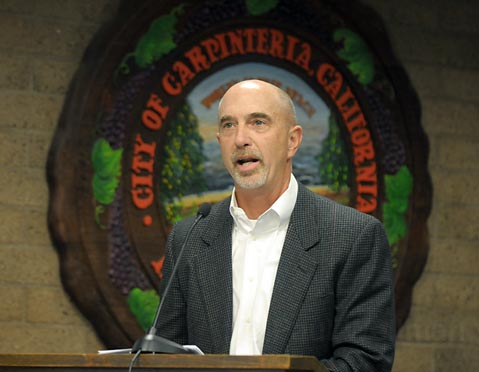
The staff report found the initiative unsatisfactory and unclear on dozens of points, including many that could result in litigation should voters approve it. And while the pronouncement of these faults was greeted with audible approval from attendees, the report was criticized by Steve Greig-Venoco government relations liaison and the only person at Monday’s meeting to speak in favor of the project.
Greig called the staff report partial and claimed that many of the faults it found echoed concerns that City Attorney Peter Brown had voiced in his legal challenge to the initiative. (Brown’s suit-made on grounds that the proposal was unconstitutional and legally defective-was rejected by the County Superior Court in July, and he has since appealed.)
Among the extensive list of problems Brown and his team found with the proposal were many that could ultimately cost Carpinteria legal fees, such as legal tussles related to zoning discrepancies, permit technicalities, and the lack of the California Coastal Commission’s review of the Paredon Initiative. The city’s challenge of the initiative alone has cost around $260,000. Furthermore, staff found that the project violates the Carpinteria General Plan and attempts to circumvent General Plan guidelines either by “amending some but not all of the mandatory policies, thereby creating internally conflicting policies,” or by simply exempting the project from the policies. (Examples of the violations include allowing 140- to 175-foot oil rigs, which would illegally obstruct views from the bluffs, and also disturbing harbor seals, despite regulations to protect them, with noise from working rigs.) A point of concern that drew especially strong reaction from attendees was a proposal to allow future developments and modifications without the consent of the city, whose issuance of coastal development permits would be rendered only ministerial.
In responding to the report, Greig cited a perceived anti-Venoco bias. He explained that the document omitted the project’s positive aspects and ultimately did not serve the voters’ interests. “Would this help you make an informed decision?” he asked rhetorically. Greig also claimed that the report’s assertion that the Paredon Initiative would have a 30-year lifespan was incorrect; he said the proposal is for 20 years, with the additional 10 included only if Carpinteria opts for them. He also claimed the report’s assertion of a 10- to 15-percent drop in the value of real estate near the project site-between City Hall, the Arbol Verde neighborhood, the Pacific Ocean, and the Carpinteria Bluffs-was not necessarily correct and that the money flowing back to the city, which Venoco predicts to be between $15 million and $108 million, could ultimately raise property values.
Former Carpinteria mayor Donna Jordan, however, called the Paredon Initiative “fatally flawed” and cautioned the city against allowing itself to become subservient to a corporation. “After reviewing this report, I cannot imagine how anyone who loves the city could support the Paredon project,” she said. Indeed, the councilmembers themselves seemed wary, with Al Clark and Kathleen Reddington aggressively questioning Greig, and Brad Stein and Mayor Greg Carty saying little in favor. And Councilmember Joe Armendariz-who in August cast the sole vote against Brown’s appeal-seemed troubled by the prospect of litigation and resulting financial burdens to Carpinteria residents.
In addition to discussing whether the ballot measure might appear on the June primary ballot, councilmembers at the December 14 meeting will also mull over the possibility of taking an official stance for or against the Paredon Initiative.