To Repair a Brain
How One Disabled Kid Sent His Mom on a Cell Hunt

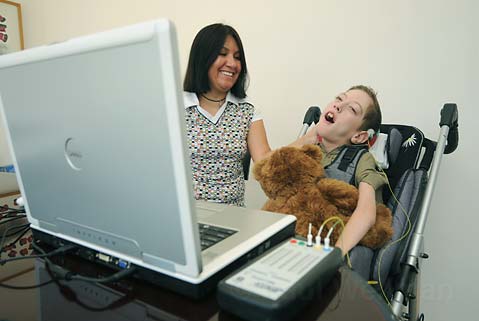
Palmer Richmond may lack the gift of speech, but he’s got the art of making people laugh down pat. And don’t imagine that his disability keeps him from putting one over on his mother from time to time either. Take the morning she went to prepare him for a session with a therapist and found him slumped and lethargic in his chair. Thinking he was sick, when the therapist arrived, his mom sent her away. Meanwhile, back in his room, Palmer was bright-eyed and bushy-tailed once again.
Though he turned 13 last fall, Palmer hasn’t achieved the most basic developmental milestones expected of children in the early years of life, things like standing and walking and talking. No one knows exactly why. What is known is that he began having seizures two-and-a-half days after birth. Then, a week later in the Neonatal Intensive Care Unit (NICU) at Cottage, he contracted necrotizing enterocolitis (NEC), a disease in which the intestinal tissue basically dies. Palmer underwent emergency surgery to remove two thirds of his intestines. With two conditions now, doctors began looking for a syndrome, but never found one. At 10 weeks of age, he was released from Cottage with a diagnosis of “we don’t know.”
At home with Palmer, his mother, Fia Richmond, began to navigate an ocean of questions. He was having myriad health issues but wasn’t reaching developmental targets. She soon discovered a vast underground network of parents of developmentally disabled children on the Internet; basically, a population of worn-out moms like herself. She also began a regimen of reading; not your typical night table fare, but medical journals, neurology textbooks-anything and everything she could find on the developing brain. Most parents would likely have focused on getting a definitive diagnosis, but Richmond channeled her frustration into the hunt for a treatment. By 1998, the same year Wisconsin researcher James Thomson isolated human embryonic stem cells in his university laboratory, Richmond embarked on a cell hunt of her own, doggedly pursuing a treatment that would allow Palmer’s brain to repair itself, even if only partially.
That’s how this former graphic designer with a master’s degree in depth psychology ended up in the neurosciences department of Harvard Medical School, dialoging with brain researchers on the subject of regenerative medicine and the pediatric brain. Richmond soon discovered that 99 percent of brain research today is being done on the adult brain, on diseases like Parkinson’s and Alzheimer’s. She kept wondering, “What about the kids?”
There are at least 14 million children in this country with a brain disorder for which there is no treatment or cure. According to a decade old Centers for Disease Control and Prevention (CDC) report, that’s 17 percent of American children between zero and 19. These disorders include things like cerebral palsy, autism, epilepsy, Tay-Sachs, Sandhoff’s, plus millions of youngsters who, like Palmer, have a diagnosis of “we don’t know.” Actually, a diagnosis of cerebral palsy technically is an “I don’t know” disease, too, as more than half the cases aren’t associated with a specific known cause or risk factor. It still remains mainly a collection of symptoms, doctors say.
Not long after embarking on this quest to cure Palmer, Richmond and her husband Phil started Children’s Neurobiological Solutions (CNS), a foundation dedicated to advancing research in children’s brain disorders. They were thinking not just of Palmer, but of the other thousands of kids and their families, and how much even the very small, incremental improvements enhance their quality of life.
“[This] parent population is so tired,” Richmond said. “They don’t have the Michael J. Foxes or the Christopher Reeves out there pounding the pavement for them. : Just getting through the day with these kids [is an accomplishment]. I mean, any moment I could call a friend and they could be in the hospital with their kid.”
Richmond started out by writing letters to other families and holding fundraisers in different parts of the country. Today, the hard work of CNS goes into organizing and hosting scientific workshops, gatherings in which scientists from around the country come to address a particular question or aspect of neurological impairment together; lysosomal storage disorders, for example, or spinal cord problems. Experts agree there’s enormous crossover between adult and pediatric brain disorders, so getting neuroscientists into the same room to share ideas and knowledge and look at problems from a new perspective accelerates the process exponentially.
Ken Kosik, MD, is codirector of UCSB’s Neuroscience Research Institute and currently is leading a $2 million multidisciplinary research project into the neurofibrillary tangles that are characteristic of Alzheimer’s disease. He also cochaired last year’s Young Neuroscientists’ Workshop for CNS. According to Kosik, kids with a disease called Niemann-Pick have a protein that collects in their brain that is identical to the neurofibrillary tangles of Alzheimer’s. “So you can imagine how much you can learn by putting together these different areas,” he said. “In Alzheimer’s, you have senile plaques and neurofibrillary tangles. These kids [with Niemann-Pick] don’t have the plaques, but they have those tangles.”
Needless to say, stem cells are playing a big role in the majority of CNS’s research. They are, in fact, the biological foundation of not just the brain but all the other organs in the body. At the very least, they can explain how diseases like Tay-Sachs or Sandoff’s evolve, or serve as a vehicle for delivering certain missing enzymes or proteins.
And there are signs that the Richmonds’ work is paying off. Two neuroscientists attending the 2004 CNS workshop are now on their way to clinical trial on a project they came up with there. Another CNS project that originated at that workshop is inching closer to clinical trial, too. And one of the scientists at last year’s young scientists’ workshop changed his entire research path from adult stroke to pediatric stroke.
“Medicine has always been trickle-down, research wise,” said Richmond. “So many drugs and different kinds of clinical trials are done in adults before they’re done in kids. We’re trying to say it needs to be trickle-up.”
The difficulty with children’s neurological disorders has always been that so many of them are rare diseases. There are as few as 1,200 diagnosed cases of Niemann-Pick worldwide, for example. That makes the job of funding research even harder. Bringing all the pediatric neurological disorders under one umbrella by researching their commonalities gets around that problem.
At Palmer’s house in the hills above Santa Barbara, weekdays are workdays. He pretty much goes from one therapy session to another. But weekends are totally therapy-free. No exercise bike, no bio-feedback, no stander. He gets to just kick back and hang with his parents. He and his dad watch sports together on TV.
From the little time I spent with him, it’s clear Palmer is a people person. He can’t communicate orally, but Richmond said he manages to make really strong connections with people regardless. Take the time one of his caregivers left because she needed to have extensive surgery. When it was all over, she told Richmond that before the procedure, Palmer came to her in a dream. In it, he’d said, “If I can do it, you can.”
“He’s our little shaman,” Richmond said.