ECO:nomics Conference Concludes at Bacara
Clean Energy Funding, Carbon Emissions, and Obama's Policies Discussed; European Union President Talk Ends Event
The second annual ECO:nomics conference came to a close at the Bacara on Friday, March 6, after conversations about clean energy funding, Obama’s energy policies, carbon emissions, and an assessment of how realistic the global green push is amid a crumbling world economy.
The morning began with “CEO briefings” about the future of everything from biofuels and solar to buildings, marketing, water, and oil – but those were off-limits to the press – and ended with a talk by European Union President V¡clav Klaus, who was relatively scathing in his criticism of Americans’ reliance on the government to solve problems rather than the free market. Klaus, a loud opponent of environmentalism at large, also proved critical of the conference in general, and expressed disappointment that he was not allowed to debate Al Gore on stage, as was initially promised by conference organizers. (The organizers have since denied that debate was ever offered.)
Money for Eco-Projects?
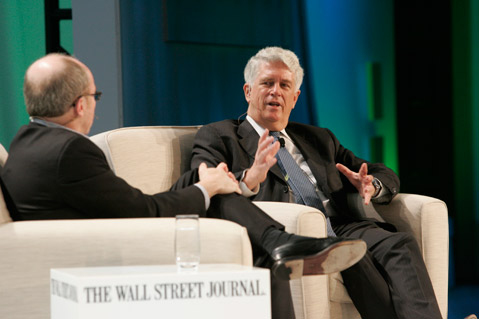
The first open-to-the-press conversation was billed as “Financing the Future,” and featured Caio Koch-Weser, the vice chairman of Deutsche Bank, relating how the green movement in Germany has created jobs and fostered growth in their economy. Explaining that he is “absolutely delighted to see policies forming in Washington,” Koch-Weser said that going green will be a major factor in pulling the world out of the recession. “Leading us out of this crisis [eco-minded industry] is one of the major future sources of growth,” he said. He also said that all of Europe is happy to have the United States “being the leader and not the lagger anymore on the global climate front.”
The Wall Street Journal‘s Alan Murray, who interviewed Koch-Weser on stage, asked the banker about the cap-and-trade system of emissions trading, which is currently used in Europe and has been proposed in the United States by the Barack Obama administration. Koch-Weser admitted that the system has well-documented problems and needs reform, but that it still seems to be the best way to reduce carbon emissions in a fair way. “I believe cap and trade is right,” he said. “There are things we have to fix, but it is right.”
Repeating a notion that’s been reiterated a few times during the conference, Murray asked whether this economic crisis is actually going to make moving toward a greener world easier because people respond more quickly and decisively to acute challenges. Koch-Weser was realistic, explaining, “I would obviously not say that it gets easier” due to the tightening of credit markets, but that this crisis will naturally push people to “build expectations for what future growth and employment opportunities are.”
The Obama Solution
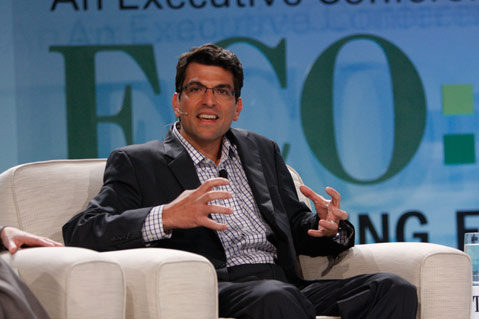
Friday’s second conversation was designed to help attendees understand the intent of President Barack Obama’s emerging energy policies, and featured Matt Rogers, a senior advisor to the U.S Secretary of Energy, and Jason Grumet, the president and founder of the Bipartisan Policy Center and an energy advisor to Obama during the president’s campaign. (Grumet also spoke at the conference last year, during the campaign, and you can see a report of that conversation, which also included reps from the John McCain and Hilary Clinton campaigns, here.)
Both Grumet and Rogers stressed the need to build a new nationwide energy generation portfolio that’s serious and properly funded to produce real world solutions, but one that remains experimental enough to allow for failures. “In order to have a possibility for real success, we have to expect real humiliation,” said Grumet. He also believes that Obama could put together a cohesive policy rather quickly, but joked that “we have this thing called a Constitution and a federal republic. Democracy is a messy process,” Grumet continued. “If Barack Obama was a benevolent dictator, we would have a coherent set of policies.”
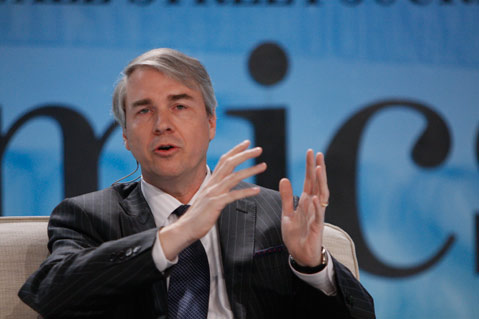
Rogers kept an optimistic tone during his comments. “The great news is that the market is bringing forward a set of really exciting projects,” he explained, but noted that the challenge is to convince Congress that the country is getting good value for the money. “This is a real opportunity for the government to show that the government can work,” said Rogers, explaining that with the right projects and transparency, confidence can be restored and progress can be made. “Then the government can take a step back and doesn’t have to be the primary funder.”
At one point, as the conversation turned toward Obama’s proposed cap-and-trade plan to combat carbon emissions, interviewer Kimberley Strassel asked Grumet if he thought the economy would get better, whether it was a situation of “if” rather than “when.” Grumet responded, “I hope it’s a question of ‘when’ because otherwise, we’ll be having this conference next year at the Holiday Inn in Teaneck [New Jersey].” After the crowd’s laughter ceased, Grumet when on to explain that the Obama administration’s solutions do assume that the economy will turn around. He said that putting forward a variety of economically productive proposals will be key to successfully protecting the environment. “They don’t all have to work,” said Grumet, “but a couple of them have to work in a very big way or we’re not going to bend the curve on carbon emissions.” He also explained that while “energy efficiency has never been very cool,” he believes that Obama has the ability to make people realize this is a “shared opportunity” and that such a realization is “starting to foment.”
Cap & Trade Realism
One of the big discussions at both this year’s and last year’s conferences has been what the United States and the world should do about carbon emissions, which the majority of scientists across the world have said are causing an increase in global warming. The cap-and-trade system – in which governments put a limit on companies’ allowable carbon emissions, and companies who use less than that cap are able to sell off credits to companies that need more – seems to dominate these discussions, as it’s been in place in Europe for some time and is also used in the United States for sulfur dioxide, or S02, emissions.
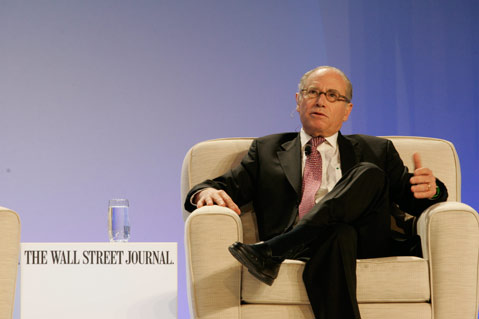
Coming to address cap-and-trade at the conference were James Rogers, the CEO of Duke Energy, and Richard Sandor, chairman of the Climate Exchange. Sandor said of U.S.’s SO2 program, “I think it may be one of the most successful programs in government history.” And the success came despite initial concerns, said Sandor, that it would never work. He admitted that it did take time to kick in, but explained, “You can’t judge a program that has a 20- to 30-year goal in the first two years.”
Rogers said he prefers the 100 percent auction cap-and-trade system – as compared to government allowances and other proposals – because that won’t negatively affect consumers. He went over the history of coal power plant development, explaining that when the U.S. moved away from oil-powered plants in the 1970s, coal “was the lowest cost alternative, and in fact, it was the only alternative.” He explained, “To come back today and to punish consumers who are using those plants is, in my judgment, unfair and wrong.” He said that the 100 percent auction model deals properly with those consumers.
A Presidential Scathing
It was perhaps an odd end to a conference all about eco-friendliness to bring in one of the environmental movement’s loudest, most prominent critics. But that’s what was served up in the form of V¡clav Klaus, who is president of both the Czech Republic and the European Union as well as the author of a book called Blue Planet in Green Shackles: What Is Endangered: Climate or Freedom?. A proud disbeliever in human-caused global warming and ardent supporter of the free market system, Klaus once called environmentalism the “biggest threat to freedom, democracy, the market economy, and prosperity.” On Friday, he also said that his “motivation” for coming to the conference was the promised chance to debate Al Gore on stage, but that opportunity was rescinded when Gore decided to speak at the conference alone on Thursday instead. (Organizers denied such a promise ever existed, but did say Klaus was supposed to go back-to-back with Gore on Friday, until Gore had to reschedule for Thursday.)
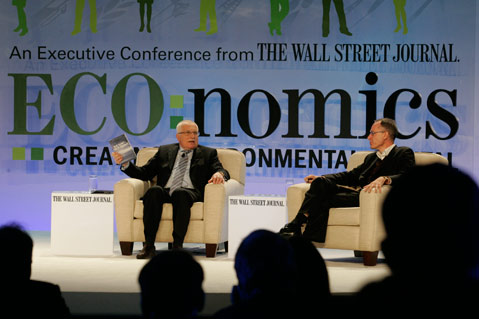
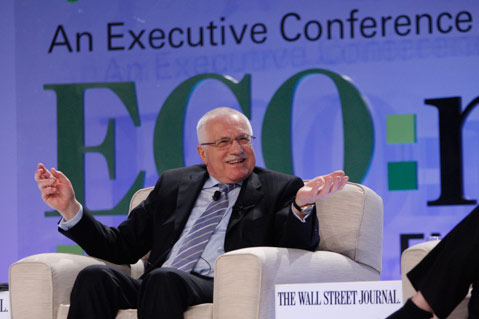
Interviewed by Wall Street Journal editor-in-chief Robert Thomson, who introduced him as “the most powerful man in the world,” President Klaus immediately jumped into criticism of the conference and its attendees. “I almost don’t believe my eyes how much you here believe in government and how much you don’t believe in the free market,” Klaus, who lived under Communism until age 48, said, to much applause from the crowd. “This is, for me, a shocking experience. I have to say that very loudly.” He inspired more applause by continuing, “I know how damaging it is to introduce schemes like cap-and-trade, how damaging that is for the economy : I am rather frustrated – to fight for the freedom of the free market is still the task of the day.”
Klaus went on to belittle the current economic crisis in the United States, saying that it could not compare to bringing the Czech Republic out of Communism, when it lost one-fifth of its gross domestic product. Klaus, who was that country’s first post-Communist minister of finance, focused on balancing the budget and said he was dismayed to see the Obama administration’s new budget has 50 percent more expenditures than revenue. Thomson asked whether the current global economic crisis was not evidence that the market had failed. Klaus immediately retorted that the crisis was caused instead by government failure. “I am not one to say you should blame the market,” he said. “Blame the politicians.”
Klaus said that he makes a distinction between the fight against global warming and the protection of the environment, explaining that he supports the latter. When asked by Thomson whether he’s already lost the debate on global warming, Klaus said, “To win an argument, you must have a potential place to argue, but I am afraid it does not exist anymore.” The forum for such a debate, he suggested, has disappeared because of the overwhelming support for global warming as truth, even though he knows scientists who are skeptics. The multiple episodes of applause from the crowd during his conversation suggested that many ECO:nomics attendees also shared his views.
Klaus continued his attack on Al Gore with a bit of humor later on, pointing to the conference’s large “ECO:nomics” sign behind him, and suggesting that the colon was the former vice president. “This is Al Gore,” he said, “between those two parts of the word.” Klaus argued that the word should be put back together as simply “economics.” Thomson defused the tension with a joke, explaining that Al Gore “didn’t invent the colon.”
When asked about his concerns for Europe, Klaus had a laundry list of worries. “I am afraid that Europe is moving in the wrong direction,” he said. “I simply don’t believe in, to use American terminology, an ever closer union. I am not in favor of an ever closer union in Europe. I very much unhappy with the radical shift from inter-governmentalism to super-nationalism.” Having worked so hard to decentralize his country upon the demise of Soviet-style Communism, Klaus has deep fears about the European Union’s current movement toward centralization.
And his critique did not stop at his homeland. Remembering a trip to California nearly a decade ago to speak at Claremont College in the midst of the state’s energy crisis, Klaus said that while staying at the college’s guest house, the electricity went out in the middle of a January night, and he was left cold. “It reminded me of the old Communist days when the lights got switched off,” he said. “It was very frustrating.” And on the way to this conference, Klaus said he was reading about water shortages in California and how rationing might be next. “So pay attention,” he warned, “these are the innocent beginnings of something totally different than the free market economy.”
During the Q&A with the audience, Klaus fielded a number of questions about his beliefs and about the cap-and-trade system in Europe. On the latter, he explained, “I don’t think I am being heretical: It is considered a nonsuccess. The scheme has not worked.” Later, at an impromptu session in the press room, Klaus was asked what he envisioned as a way to de-carbonize the environment. He responded, “I don’t think it’s necessary to de-carbonize.” He also hammered home his most important message: “Let the market behave as it behaves.”
When a reporter asked if he had met any executives at the conference who shared his views on global warming, Klaus said he had not polled the crowd, but explained, “I think that the reaction was quite positive. I don’t think all of them are fanatics of global warming.” As he began moving toward the door with his large entourage, Klaus said, “I am afraid for human freedom. The climate is okay and will take care of itself.”