The 20th Annual Individual Artist Award Group Show
At the Arts Fund Gallery. Shows through May 31.

Now in its 20th year of artist advocacy, the Arts Fund has proven its dedication to supporting Santa Barbara artists through programs like the juried Individual Artist Awards (IAA), which recognize emerging, mid-career, and established artists in the genres of painting, sculpture, graphic communications, and musical composition. To be chosen for an IAA is to join a prestigious list of recipients, including names like Colin Gray, Din Q. Le, Nell Campbell, Dane Goodman, James Connelly, Tonia Shimin, and Ethan Turpin, many of whom have since embarked on national and international careers in the arts. So it’s no wonder that this year’s IAA show exhibits work by some of the best contemporary artists in our midst.
In the category of painting, assemblage artist Susan Tibbles has employed her trademark technique of combining found objects with paint in “Saint Cecilia.” As the patron saint of music and arts, the subject suits the show, but it is Tibbles’s ability to capture the emotion of memory and place with delicate poignancy that makes the piece so effective. Inspired by a trip to Paris, Tibbles has combined tulle netting wrapped around notes of poetry, an old violin bow, and the skeletal fragments of a hot air balloon.
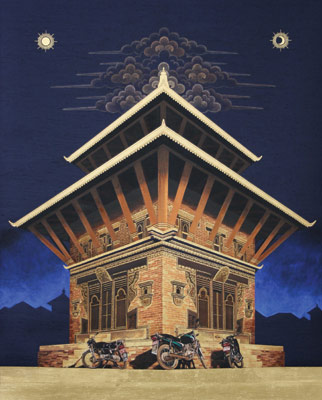
Across the gallery, painter Joy Davis adopts the sacred style of the Tibetan thangka in “Motorcycles at Changu Narayan Temple (Tibet),” using paint and gold leaf on silk to depict a Tibetan temple surrounded by parked motorbikes. By contrasting a modern subject matter with traditional painting techniques like saturated color, detailed brushwork, and symmetrical composition, Davis successfully reflects the juxtaposition of the modern and the ancient in contemporary Tibet.
Sculpture is well represented in the exhibition, with distinct but complementary examples of technique: Richard Aber’s “Structure 2-07” is a tilted arc made of rust-colored red cloth that closely reflects Joan Rosenberg-Dent’s “Pas de Deux,” a duo of anthropomorphic ceramic pieces imprinted with a woven texture. Both works display a natural lyricism and grace in their earthy tones and organic shapes.
In the design category, Scott Anderson’s examples of exhibition brochures and theater production posters for Westmont College showcase his subtle ability to capture the aesthetic truth of his subject without being overly literal.