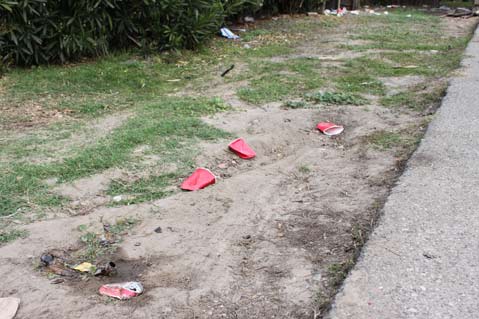
The Red Cups of Isla Vista
Are Students Environmentalists or Trashy Citizens?
Saturday, November 14, 2009
Take a walk down the streets of I.V. any day of the week, ideally on a Saturday or Sunday, and you’ll find the ubiquitous red cups.
You can’t miss them: big, bright, shiny cups littering the street, strewn across front yards, and even lying around in the wetlands. Look a little closer and you can find other types of trash all over the place as well.
Every time I see this it gets me thinking about how the students are supposed to represent our future. If so, the future isn’t looking so good. The students don’t seem to be all that environmentally aware.

Cat Neushul
Just in case you’re thinking this is going to be a student-bashing column, I’ll tell you up front, I don’t think all students are bad, just the ones who think I.V. is their trash can. There are lots of students out there doing the right thing. I set out to look for some of them so that I wouldn’t feel so negative.
I started by talking with Melissa Cohen, the Isla Vista Food Co-op manager. She had talked me down when I went into a trash rant a while ago. She agreed that there was a trash problem, and that something should be done. Cohen said, “People think they can trash I.V. because there are no repercussions.” She suggested that the county hire some form of officer to come into I.V. and write tickets “for students who are being unreasonably disgusting.”
She did not, however, think that this meant that there weren’t some students trying to help the environment. “The people doing good are overshadowed,” she explained. She named the UCSB Environmental Affairs Board, and the Adopt a Block program, a group that picks up trash after Halloween, as examples of students making a difference.
While I wasn’t able to find a new student program specifically targeting litter, I did talk to some students who are trying to increase the level of campus environmental awareness. Hopefully, with this type of awareness will come a realization that tossing plastic cups all over the place is environmentally unfriendly.
One of the good ideas I looked into was trayless dining in a residence hall dining facility. The concept, suggested by students on the Environmental Affairs Board, is being tried out in the De la Guerra Dining Commons. This means that students fill a plate or bowl with food and, without a tray to heap their plates on, they are not tempted to take more than they are going to eat. Results are encouraging.
Mark Rousseau, energy and environmental manager for UCSB Housing & Residential Services, said, “Overall, the waste pre- and post-consumer is lower.” He said that this was for a number of reasons. First of all, students aren’t taking as much, and second of all, he said, waste is being taken to a composting facility instead of sent to a landfill.
Rousseau said that in 2008 about 80 percent of the waste coming from De la Guerra was going to a landfill and 20 percent was diverted for recycling; now about 90 percent is diverted and only 10 percent goes to the landfill.
Some of the composting material is brought back to UCSB for use in the gardening beds. He said there were other environmental benefits as well. Going trayless means that students take fewer dishes, which means less water and energy is needed. Yes, the dorm dining rooms use ceramic dishware rather than disposable.
Megan Carney, a graduate anthropology student, is working on a project funded through a grant from The Green Food Initiative Fund Real Food Challenge. She is working on educating students about where their food comes from, and how food production affects the environment. Carney said she is in the process of calculating how much of UCSB’s food is “ecologically sound, fair, local, and humane,” and how much is not. Carney explained that this information will show them where they are now.
Carney is also working to get students involved in Meatless Monday, an international campaign. She and others plan to distribute information in residence hall dining areas to encourage them to go meatless, and egg- and lactose-free for a day. She said that she and other students will not only encourage students to go meatless, but will educate them about the effects agriculture and meat production have on the environment.
One of the students working with Carney to make Meatless Monday a UCSB reality is undergraduate Corie Radka. In fact, Radka said that she and fellow student Andrew Dunn, who are both on the Environmental Affairs Board, suggested the idea. The kickoff for Meatless Monday will be held November 23: There will be signs up, information tables, and a special showing of the film Fresh. When asked why Meatless Monday, instead of another day, she said it was a “good way to start off the week,” perhaps setting the tone for a person’s eating habits the rest of the week.
Radka will be contacting I.V. restaurants to ask them to support the Meatless Monday campaign by offering discounts for meatless entrees. It is the right time for this kind of action, she said. “This campaign is really important because I feel like a lot more people are environmentally conscious as compared to before.” However, people are focusing on eating local and organic, she said, when “actually, eating more of a plant-based diet does more to reduce greenhouse gas emissions, pollution, and biodiversity loss than eating both local and organic. It just blows those out of the water.”
In talking to students about these environmental issues, I found that I was the one getting an education. It made me realize that there are quite a few who are trying to make the future a little better. I think I might even try Meatless Mondays myself.
Even though there is trash on the streets of I.V., there is still hope. As Radka said “There are people that care a lot, and people that don’t care at all.” But maybe, just maybe, the people who don’t care will change their minds.

Related Links
Comments
Hello! Thanks for mentioning the trayless program in Housing & Residential Services. All four of the dining commons are trayless facilities, not just DLG. Preliminary audits of food waste since the beginning of the school year are showing a more than 40% reduction in food waste from last year! Extrapolated over the entire year this is more than 120,000lbs or 60 tons! (that's just an estimate at this point.) There has also been a noticeable decrease in the number of dirty dishes (so we're saving water and soap as well!). (As you can tell I work for Housing.) We're all very excited re: how successful the program has been thus far! Again, thanks for the mention!
DogOnLap (anonymous profile)
November 14, 2009 at 2:23 p.m. (Suggest removal)
Using a red cup to drink several beers from a keg has less impact on the environment than drinking several of your bourgoi import beers. The bottles must be manufactured, not to mention the weight of the bottles being transported takes extra fuel which can instead put into making several plastic cups. Keg drinking is probably more environmentally friendly than drinking from aluminum cans as well, even though these are recyclable materials they must be manufactured and transported. Therefore the red cup combined with the environmentally friendly re-usable keg is probably the most environmentally friendly aspect of IV partying.
You can move the parties away from IV, but that actually is worse for the environment as you are taking away the keg + re-usable cup model and replacing it with a bunch of people getting less environmentally friendly alternatives for their alcohol consumption, and the trash gets spread around other parts of campus, town and other schools. I'd love to see a better alternative presented, however. The "home cup" tradition should be going strong in IV. What is the "home cup"?? The "home cup" is any re-usable cup in the house that the people who live in the house and their very closest friends get to use instead of the red cups. This may give them priority at the keg if a long line forms, or it may just be a better way to distinguish your cup from others. So if the "home cup" gets your keg line priority, why not let people bring their own re-usable "home cups"? They get priority in the keg line and they are helping the environment. Sounds like a win-win!
Re-using your red plastic cup by bringing it from party to party is legal in IV since you can walk through the streets with your cup upside down. Drunk students may feel that they are bringing additional attention to themselves by carrying a big red cup that says "I've been drinking". In addition, they may feel that in their drunken stupor (which they have every right to be in) that they may accidentally rotate the cup upwards and find themselves on the curb, facing a life-destroying incident with IV foot patrol. People would be much more likely to re-use their cups and there would be a lot less trash if the IVFP cut out their tyrannical approach. I'm not saying they should leave, hell, give out citations for littering the damn cups!! Make sure people are staying safe... but stop arresting people for being drunk, and maybe instead help them find their way home! I always made sure my red cups made their way to a counter top or trash can. Most people do as well. There are always going to be people who are inconsiderate, but not everybody who participates in red cup keg parties are inconsiderate!
loonpt (anonymous profile)
November 16, 2009 at 9:51 a.m. (Suggest removal)
The meatless monday idea is great, by the way.. Everybody should try a good wholesome vegan diet to see how their body responds. Some people cannot function on a diet without meat, but that is only a small percentage of the population.
There are so many chemicals in our foods, and that combined with high fructose corn syrup I believe keeps the majority of the rest of the population meat addicts, believing that they must eat meat to survive. Meat is a good source for the majority of the nutrients our body needs, and the chemical signals that eating meat sends satisfies the cravings caused by the artificial chemicals.. but they are missing so many good things that come from fruits and vegetables.
The majority of the population would be fine on a good vegetarian diet, or on a primarily vegetarian diet and about 1/3 of the population would benefit and actually thrive on a vegetarian diet and most of them have no idea! Hopefully more people will realize that they can drastically cut their meat consumption and still find great tasting food to enjoy as they find or re-discover the foods that their bodies are really craving.
There is nothing wrong with cutting your meat consumption in half, it is great for the environment. Eating meat is not all or nothing. Every vegetarian meal that you eat benefits the environment and your health. I've been trying to get that message across for about 9 years now, but there are stubborn vegetarians and stubborn meat eaters who don't believe that a happy medium can be reached. They believe that the person who eats meat once or twice a month is akin to the person who eats meat 60-80 times per month.. This is ridiculous. When you are purposely cutting meat out from your diet, for one meal or for the rest of your life, your are restricting yourself to a vegetarian diet. That means you can be vegetarian for one meal (ONLY if you are PURPOSELY restricting meat, not if your meal just happens to not contain any cause you're eating mac and cheese...) that is the definition of a diet. Going on a diet for one meal is a bit ridiculous, but doing it for a day or several days is not. So try to be a vegetarian as often as you can. And remember the bitch on "Sex In the City" who said "he's like a vegetarian who eats meat" is a moron. Vegetarian, for 99.9% of vegetarians, is a temporary state! It may last you a week or 40 years, both are beneficial!
loonpt (anonymous profile)
November 16, 2009 at 10:17 a.m. (Suggest removal)