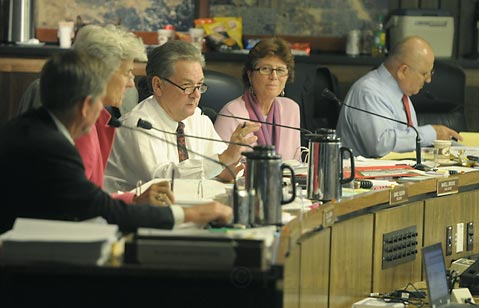
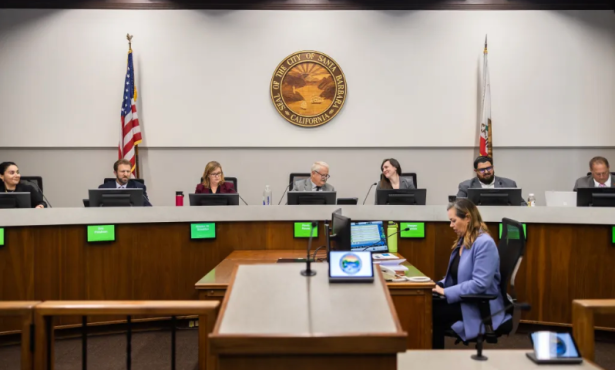
After four full-day hearings over the past three months, the controversial plan to expand the Santa Barbara Botanic Garden cleared a significant hurdle on Monday, October 26, when the County of Santa Barbara’s Planning Commission voted 3-2 to approve the project, albeit with a number of conditions. The vote left the garden’s proponents excited about moving forward on a project that’s taken more than five years of plotting, but deeply frustrated opponents and concerned neighbors in Mission Canyon, who are almost certain to appeal the project to the Board of Supervisors.
“We’re obviously grateful for the Planning Commission approval of the Vital Mission Plan,” said garden spokesperson Nancy Johnson. “Really, they validated more than a decade of work that went into creating this bare-bones plan that we feel has responded very well to the community and allowed us to fulfill our mission. Certainly, there are a number of conditions, some of which we volunteered and some of which we feel are a little restrictive, but we’re still excited about the vote and the process of beginning to be built, especially since the Jesusita Fire has destroyed so much that is here.”
Among other conditions, the request to build a kiosk on an eastern ridgeline was denied; events with more than 80 people were limited to three per month; overall attendance can grow by 1.8 percent a year up to 50 percent total, which amounts to a rise from the current 110,000 annual visitors to 160,000; and trail pavers may only be used on 10 percent of the property, not including those paths adjacent to buildings. Johnson called some of the limitations “disappointing,” but admitted that “we can manage with them.”
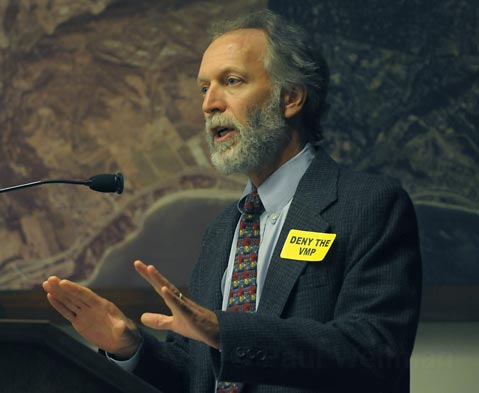
Attorney Marc Chytilo, who represents opposition group Friends of Mission Canyon, was frustrated and said that it’s “highly likely” the vote will be appealed to the Board of Supervisors. “They just didn’t look at so many different issues we identified,” he said. “I’d say they addressed about half of them.”
Chytilo specifically criticized 1st District Commissioner Michael Cooney, who wound up being the swing vote, for bending too much to the garden’s desires. “He went with whatever the garden said is okay,” claimed Chytilo. “He felt the need to explain himself to the Botanic Garden but he did not apparently feel the need to give a similar explanation to the residents and community as to why such a large expansion was consistent with Mission Canyon’s severe resource constraints.”
Overall, said Chytilo, “It is going to result, if it stands, in a substantial increase in visitation and the commercialization of the garden.”
Cooney, meanwhile, admits that he “absolutely” found himself in odd political company on the vote by siding with the two North County commissioners, Joe Valencia and Daniel Blough, who are typically more development-friendly. In approving the project, Cooney - whose district includes the Botanic Garden - voted against his usual conservation-minded comrades, 2nd District Commissioner Cecilia Brown, who was opposed to the bulk of the project from the get-go, and 3rd District Commissioner Marell Brooks, who voted to conceptually approve the project in early September and then changed her vote on Monday without any public explanation.
“This is the single most controversial project that I have seen in my five-plus years on the commission,” said Cooney. “There’s no doubt that passions run strong on both sides - there were merits in the concerns of the neighborhood and merits in the need of the Botanic Garden to refurbish their facilities and continue doing what they have been doing.”

Cooney, who, like everyone else, always anticipated that this project would eventually be appealed to the Board of Supervisors, stands behind his vote. “On balance, it’s a workable plan if you condition it like we did,” said Cooney. “I think either way, nobody was going to be happy.”
Despite the vast range of contentions on Monday, there seemed to be a unanimous feeling of surprise at Monday’s meeting when County Fire’s Glenn Fidler announced that his department would no longer be issuing red flag alerts, and that responsibility was now going to be handled by the National Weather Service. This announcement came up due to the concerns that increased usage of the Botanic Garden - which is currently mandated to close on red flag days - could create unsafe conditions during a wildfire, but its implications go far beyond this one project.
On that, both Chytilo and Cooney agreed. “That was concerning,” said Cooney, “because we look to the fire department not only to guide us on our activities but to be the monitor for determining when the red flag alerts are called. That was brand new and surprising.” Chytilo concurred, “That is just an enormous change.”
Calls to County Fire were not returned in time for this article, but stayed tuned to independent.com for more.

Print friendly
E-mail story
Tip Us Off
Comments
Share Article
Myspace


Previous Month


Comments
said Cooney. "I think either way, nobody was going to be happy."
Wrong, Cooney. Right now, the "new" Garden leadership is very happy....as they should be. Yesterdays PC vote helped change the mission and direction of the garden. So don't let yourself off the hook so easily. You could have made a difference and you chose not to.
sbsleuth99 (anonymous profile)
October 28, 2009 at 7:22 a.m. (Suggest removal)
I have to say that this threatened appeal is another case of Santa Barbara hyperbolic reactionary dribble. The reality is that the improvements the Botanic Garden is asking for are small, sensible ones. In light of the devastating fire on the property, there is a tremendous amount of work needing to be done, which this plan does not even seemingly address I might add. Neighbors and property owners in the area will not be affected in any meaningful way by the visitors to the park. Having visited there, I can say that the neighboring properties are hardly even visible as they are substantially masked by the thick tree cover, which also dampens the noise. Moreover, we're not talking about what is exactly a rowdy crowd when considering the typical park visitor. Rather these are families with children or otherwise adults. My recent visit to the park was rather peaceful. However, there was a dog who came down from one of the neighboring properties who was rooting around destroying some of the garden's specimens. My partner and I were able to corral this dog and call the owner's number on the dog's tag, who indicated to us that he routinely escapes and loves to run through the garden--one responsible property owner...
It seems to me, then, that the Mission Canyon property owners are the ones acting carelessly here. Their advocates seem more concerned with isolating and excluding the general public from a local resource that we all should be able to enjoy. They are disingenuously using trumped up arguments about supposed "impacts" to their properties. I have to wonder how much impact that particular dog did in eating expensive plant specimens inside the park. In short, this is a classic case of the pot calling the kettle black.
sbgradstudent (anonymous profile)
October 28, 2009 at 8:50 a.m. (Suggest removal)
"The reality is that the improvements the Botanic Garden is asking for are small, sensible ones." Yes, where were the complaints before this project, since the number of visitors is to be controlled even more than before?
The use of the Mission Canyon road neighborhood, if calculated as numbers/acre, is far higher by the residents than by the Garden. It is a case of the pot calling the kettle blacker.
tabatha (anonymous profile)
October 28, 2009 at 9:21 a.m. (Suggest removal)
This is a good decision. Michael Cooney is fair, deliberative and analytical in his decision making, and he was courageous with his vote. We would all like to have Santa Barbara stay the same, but growth is inevitable - so it should be well reviewed and regulated for the best outcome for both neighbors and the community. That is certainly the case here. Appeal, more appeal, I guess that's Santa Barbara also. I hope the Board of Supervisors supports this decision.
Ketch (anonymous profile)
October 28, 2009 at 1:39 p.m. (Suggest removal)
Cooney really dropped the ball this time. His thinking was muddled and he seemed unable to address many of the important issues, such as the size and bulk of the buildings, etc. Instead, he focused on relatively trivial issues, such as the microwave in the snack bar, etc. He was strongly influenced by an obvious "institutional bias" favoring the Garden's interests over the public's interests.
He and other Planning Commissioners spent inordinate time on issues directly affecting the historic landmark (Meadow Terrace, trail paving, etc.) on which the Historic Landmarks Commission has already taken a strong position after several hearings. Those issues are clearly within the Landmarks Commission's jurisdiction and the Planning Commission seriously overstepped its authority by second-guessing the decisions of another commission.
zorro (anonymous profile)
October 28, 2009 at 10:27 p.m. (Suggest removal)
The planned buildings occupy less than 1% of the 78 acres of the garden. How is that significant?
tabatha (anonymous profile)
October 29, 2009 at 8:35 a.m. (Suggest removal)
As long as no one gets hurt, huh? Lets look down the line a bit. Who will this really effect? Locals? Tourists? Its seems like some people don't know what to fight for. What's wrong with preserving nature and educating the youth? Most importantly, the real mission that Vital Mission Project should nail down pat is building a self-sustaining ecologically enhancing permaculture establishment. Then, teach the kids how and why. Be the example.
a_native_man (anonymous profile)
October 29, 2009 at 9:33 a.m. (Suggest removal)
Mission Canyon will be safer after these buildings are complete - the Fire Department vouched for that. The new buildings will be more green than the current that are in bad condition, and would get worse. The impact on the neighbors will be no worse than now. More children will be educated in safer structures. It is a win all around. Other institutions such as UCSB, SBCC have or are converting to green structures. I do not understand the negativity; it is like kicking and dragging people into the 21st century.
tabatha (anonymous profile)
October 29, 2009 at 11:46 a.m. (Suggest removal)
sbgradstudent says, "Having visited there, I can say that the neighboring properties are hardly even visible as they are substantially masked by the thick tree cover, which also dampens the noise."
As a VISITOR, how does sbgradstudent quantify "...hardly even visible..."? And, no matter the answer, how does (s)he know that is sufficient to mitigate visual impacts.
Similarly, how does (s)he know how much the noise is dampened? And how much dampening is sufficient? And how does this dampening change over the seasons?
Sigh, the critical thinking skills of grad students are not apparently what they used to be.
SezMe (anonymous profile)
October 30, 2009 at 1:12 a.m. (Suggest removal)