Goleta Finally Adopts a Housing Element
Industrial Sites to Be Rezoned for 20-Units-to-Acre Residences

This August, the Goleta City Council finally adopted a Housing Element for its General Plan. The State Housing and Community Development Department (HCD) still has the last word, but its latest letter indicates that only fairly minor tweaking is required before it will certify the element. It has been a long haul, but hopefully the bureaucratic needs of the state have been taken care of, and we have a document that addresses the housing needs of Goletans.
There is an outstanding need for housing, both for sale and for rent, affordable to low-income families, senior citizens, individuals with special needs, and moderate-income workforce families. The goal is to achieve a balanced and diverse community, with a variety of housing types and choices, compatible with existing Goleta neighborhoods.
Fundamental to Goleta’s meeting its state-required housing numbers are the sites north of Hollister Avenue that were rezoned from office/industrial to residential housing at 20 units to the acre. Goleta is required to designate housing sites for 938 units for the 2009-2014 planning period, and the Hollister sites alone can accommodate 800 to 900.
Some years ago it was thought that the increased value of the land from re-zoning, together with moderately high density, would allow the development of market rate units that were “affordable by design”-multifamily units of modest size, attractive and financially accessible to middle income working families. This vision quickly vanished as housing values, along with construction costs, escalated.
Goleta is requiring that developers price 20 percent of the units on these sites to be affordable to low to moderate-income households. Without such provisions, for-sale housing will not be accessible for the average family in Goleta.
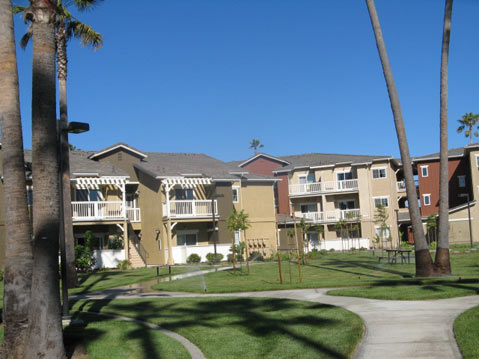
But designating sites is one thing. Actually putting housing on the ground is another. There are developers who question whether it is possible to build for-sale housing at a density of 20 to the acre. We know it can be done for rental housing. We have the example of the recently completed Sumida Gardens with 200 units, 34 of which are affordable to very low, low and moderate-income families.

Two of the Hollister sites have already come in with plans for rental projects. This will meet a real need. Rents, of necessity, level off at a rate affordable to tenants. Over the last three years on the South Coast, however, rents have increased faster than the county median income, and many are paying more rent than the recommended 30 percent of their income. We can hope these additions to the rental housing stock will help keep these increases in check.
It is equally important to include some for-sale housing as part of the mix. Homebuyers and renters have different expectations. While some renters may stay in the same place for many years, in general they are more transitory and less demanding in their requirements. Homebuyers, on the other hand, are making an investment in their future and are looking for more space, convenient covered parking, maybe a garage, and other amenities. At the City Council hearing on the Housing Element, one councilmember asked if any of the developers present knew of for-sale projects at 20-per-acre. He got blank looks in return.
Would those thousands of commuters from North County and Ventura exchange their single-family homes in those communities for a condo close to work in one of these developments? The answer is probably “No.” But new residents and younger workers might well be interested, if these projects are attractive and well designed.
Creative solutions may involve the layout of a site, with higher densities on one part and more traditional town homes on the rest. While units with at least two bedrooms may be more marketable, it is also true that demographics are changing. Smaller units may suit senior citizens who are thinking of downsizing from a single family home; and young singles and childless couples might be happy to be able to purchase a studio or one bedroom apartment as an entry into home-ownership. “Affordable by design” may yet be a possibility for these individuals. These sites have the additional attraction of being close to Metropolitan Transit District bus service on Hollister Avenue, and within walking and biking distance of work, UCSB, and shopping.
While one solution for developers would be to build at lower densities, of 15 to 20 units to the acre, the importance of zoning at least 20 homes per acre is that the state recognizes this as meeting the city’s requirement to provide for the development of affordable housing. Whether or not this is an unrealistic solution for the South Coast is of no account to the state. But we do have to show HCD that we are making a good faith effort to meet the goal and provide incentives for affordable housing.
In talking to several homebuilders and to city staff, I believe that while it may not be easy, 20 units to the acre for-sale housing is doable. While all development must be held to high standards, the housing element does provide incentives for beneficial projects, such as those for senior, special needs, and affordable housing. Environmental protections must be preserved at all costs, and Goletans are even more averse than Santa Barbarans to high buildings. But there can be some flexibility in standards for such things as lot coverage and setbacks, to enable these higher density projects to go forward.
The bottom line is there is time to work out some of these issues. There are several approved projects that are not getting underway because financial backing is simply not available in today’s economic climate. The market is determining the pace of development at this time, not city regulations! It will take a turn in the economy before we begin to see the housing that we need for that balanced and diverse community that we want, and practice may define what can be done.