Eco-Fashion Takes the Runway
How Patagonia’s Sustainable Philosophy is Influencing the Garment Industry


A stunning woman wearing a red jacket and khaki shorts balances precariously on seaweed-covered rocks, the surf pounding dramatically in the background. It’s a gorgeous photo fantasia in Vogue’s November 2009 issue, but instead of featuring clothes from Prada or Chanel, the model wears a label not usually associated with fashionista chic: Patagonia.
Patagonia, known worldwide for producing high-tech sportswear, is not usually seen on über-models, unless one of them happens to be climbing the Himalayas. But this unique, Ventura-based company is clearly gaining a reputation for its cutting-edge style. Upstairs at Pierre Lafond, a high-end store in Montecito, boasts several racks of Patagonia jackets and sweaters. “It’s a new application of an excellent, old established company,” said the boutique’s buyer, Shelley Koury, who began stocking Patagonia clothing and luggage two years ago. Patagonia’s sales representatives were initially surprised when she first approached them to place an order. “I think they were baffled as to why I was pursuing them as a line” she admitted, but strong store sales have confirmed her fashion instincts. She reports that customers love mixing Patagonia jackets and vests with more traditional “luxury” designer lines. Patagonia’s reputation as an eco-friendly company was also a big plus for Koury. “We have control over how much money we spend,” she said, “and spending it on products made by companies like Patagonia is money well spent.”
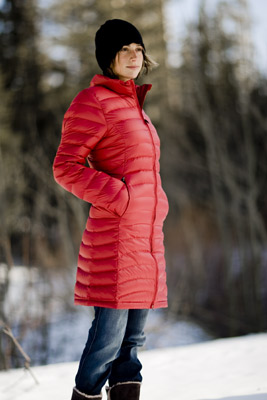
In fact, Patagonia may be as renowned for its environmental activism as for anything the company sells. Throughout the last 15 years, Patagonia has given away $34 million in grants and in-kind donations to environmental causes. It also produces an annual booklet — on recycled paper — entirely devoted to its environmental initiatives. The company’s Web site (patagonia.com) has more in common with a nonprofit’s than a retail site. You could spend hours reading environmental essays, tracking the carbon footprint of Patagonia products from design to delivery, or perusing the employee Weblog and never even get close to buying anything. But Patagonia obviously knows how to sell; last year, alone, sales of its clothing, footwear, luggage, and backpacks exceeded $315 million.
The source of this unorthodox business approach is Patagonia’s founder, Yvon Chouinard, a renowned mountain-climber and environmental activist, whose unconventional management style — “MBA” or “management by absence” — has fostered a company people clamor to work for. (Every Patagonia job opening draws at least 900 applicants.) And no wonder: Surfing in the middle of the workday is encouraged. Organic food is served in the company-subsidized cafeteria. Childcare is available onsite. Yoga classes are offered at lunch. Paid time off is given for nonprofit volunteering. (I know it’s all true — my sister works there.)
So it is not surprising that Patagonia’s clothing designers are a special breed. Most are athletes in their own right and keenly aware of the physical demands made on their designs. Patagonia’s clothing must withstand extreme conditions (subzero or extremely high temperatures, constant water contact, gale force winds, to name just a few) and not impede the wearer’s movements. They must also be durable, lightweight, and dry quickly. Color is a safety issue — the wearer must be visible in a rescue situation. Comfort is imperative. Designing clothing to satisfy all these requirements involves a great deal of research and experimentation — which means Patagonia’s clothing designers are essentially scientists. Their laboratory is Mother Nature.
Eric Rice, Patagonia’s Senior Technical Designer, has worked at the company for 13 years. A serious climber himself, Rice combines personal experience with an industrial design background to produce Patagonia’s “technical” lines: Alpine, Baselayers, Insulated, Velocity (running/Nordic skiing) and ski/snow. All “technical” garments are carefully engineered, and three or more prototypes are made for each before full-scale production starts. Rice views the manufacturing process as integral to design: “That’s when both sides (design and production) are thinking about how to do it as opposed to us saying ‘here’s how we want to do it.’”
The garment prototypes undergo rigorous field testing by athletes who give detailed feedback. As John Rapp, Patagonia’s Senior Lifestyle Designer, explained, “In the middle of winter, we can FedEx a board short to Hawai‘i and say, ‘Give us your quick 3-day [evaluation].’” Some product testers are even sent “half-and-half” garments made with two different fabrics and asked to determine which fabric performs the best under specific conditions. According to Rapp, Patagonia’s product testers are so skilled that “they’re virtually designers.” Their feedback is carefully reviewed, and each garment is modified accordingly. Items like wetsuits or waders can take years to perfect. Even existing garments produced every year — what Patagonia calls “carry-ins” — are subject to constant updating. And Patagonia’s clothing is designed to last for years and years. “Our goal,” said Rapp, “is that when the garment starts to wear out, it does so in its entirety. The colorfastness starts to fail just as the stitching [does], just as the fabric [does], just as the pocket bag [does], and everything else. We don’t want one Achilles’ heel.”
This diligent trial-and-error process distinguishes Patagonia from the designer fashion industry, where creative timetables are dictated by store delivery dates. Some companies may produce as many as six collections per year; Patagonia offers only two — fall and spring. This means its designers have the luxury of at least six months to develop a collection that will ultimately be judged not only on how it looks but also on how it works on the body.
Yet Patagonia’s goal of designing the most functional sports clothing on the market is not at the expense of beauty. According to Rapp, once the technical requirements have been satisfied, the final step is evaluating its aesthetics: “Is this the most beautiful thing we can make?” Eric Rice believes that “by designing for really specific functions, the end result does turn out beautiful … When you don’t have frivolous things added on everything, it’s just really pure and really beautiful.”
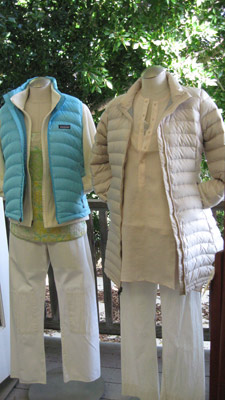
These days, Patagonia designers journey to far-flung locales seeking inspiration for each season’s color palette. But it wasn’t always done this way. Chouinard’s book Let My People Go Surfing: The Education of a Reluctant Businessman describes choosing the colors for the company’s first pile garments: “We couldn’t muster an order large enough to have the fabric customized, so we had to use [the mill’s] existing stock, which came in an ugly tan and an equally hideous powder blue.” (The fabric itself — fake fur — was originally intended for toilet seat covers.)
Throughout the years, Patagonia has been an industry leader in developing fabric for technical clothing. Chouinard himself proved extremely talented at dreaming up new applications for synthetic fabrics (hence the powder-blue fake fur). Patagonia’s textile development department, working in tandem with fabric mills, has developed Synchilla fleece, Capilene polyester base layers, and Regulator insulation, all fabrics that set new performance standards.
But these advances came at a cost, as Patagonia discovered in 1994 when it commissioned an environmental impact assessment of the four fibers it used most (polyester, nylon, wool, and cotton). The assessment revealed — as anticipated — that oil-based polyester and nylon consume a great deal of energy. The surprising discovery was that industrially grown cotton is even more damaging to the environment. Within 18 months, Patagonia had switched to 100-percent organically grown cotton. (It was a risky move at the time because there wasn’t much organic cotton available and the ginners and spinners had to be persuaded to clean up their acts, as well.) Patagonia also discovered it could make Synchilla jackets from recycled plastic soda bottles (“bottle fleece”), and through its Common Threads Recycling Program, established in 2005, customers are encouraged to return certain worn-out Patagonia clothes to be recycled and made into new polyester garments. (The list of recyclable garments continues to expand and even includes some non-Patagonia-made fleece garments, enabling the company to recycle its competitors’ waste, as well as its own.)
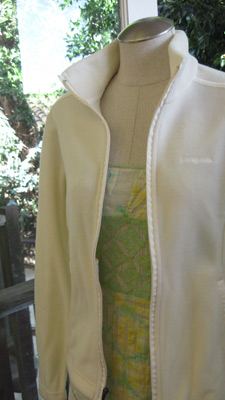
But this is only part of the story. Patagonia spends a significant amount of time, effort, and profits attempting to live up to its mission statement: “Build the best product, cause no unnecessary harm, use business to inspire and implement solutions to the environmental crisis.” Much of the responsibility for setting this course of action falls to Jill Dumain, Patagonia’s Director of Environmental Strategy. Her tasks include everything from helping the company find ways to reduce the carbon footprint of its facilities to making its Web site one of the best online resources for environmental information. It helps that Dumain has a degree in textiles, because she’s well aware of the harm their production and use can cause. Dyes, including “natural” ones, are often extremely toxic, as can be the process of growing and harvesting plant fibers. Every step in the supply chain — from the farms to the fabrics — is assessed to determine its environmental impact.
This is no small task for a company that uses textile mills and factories all over the world, and it is complicated by the fact that almost every industrialized country has its own set of environmental standards. Attempts to unify these standards on a global basis are ongoing but, as with all international efforts, are subject to political polarization. In the meantime, voluntary organizations have banded together to establish international standards for environmental and fair labor practices. Businesses can be “certified” and a seal (think “Good Housekeeping”) attached to their products.
Patagonia follows the textile standards established by bluesign technologies, an independent organization started by a group of dyehouse chemists (bluesign.com). Patagonia chose bluesign because, in addition to assessing textile mills’ standards, it also provides the mills with assistance. According to Dumain, this has allowed several of these mills to actually increase their resource conservation while reducing costs. Patagonia is also affiliated with the Fair Labor Association (FLA) (fairlabor.org), which protects workers’ rights and improves working conditions worldwide. FLA conducts unannounced independent audits and enforces its Workplace Code of Conduct in Patagonia’s supplier mills and factories. And Patagonia uses its business clout to encourage the rest of the apparel industry to follow its environmental ethos. For example, prAna, which makes yoga and climbing apparel, decided to convert to organic cotton based on information received from Patagonia.

And the company is having an impact on the future of ecologically based fashion design. In the fall, Otis College of Art and Design in Los Angeles will offer a minor in environmental sustainability. Otis alum Wanda Weller was Patagonia’s design director before joining the fashion design faculty; and Claire Chouinard (Yvon’s daughter) graduated from Otis in 2006 and designs Patagonia’s women’s sportswear. Otis Fashion Design Chair Rosemary Brantley calls fashion designers the “chief poisoners of the earth” but believes that all clothing companies will soon be following Patagonia’s lead by hiring their own Jill Dumain “to help limit their environmental impact. … Right now, eco-conscious clothes are about 15 percent more expensive than other clothes” Brantley said, “but studies have shown that once the cost gap is breached, customers will choose the ‘clean’ garment.”
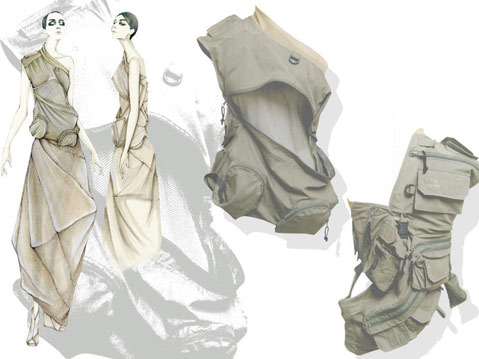
Each year, Brantley asks well-known fashion designers to act as mentors for Otis students. Like Project Runway, students are given a design concept from which they must construct garments. The results are presented at a runway show and are judged by members of the fashion industry. This year, Brantley asked Isabel Toledo (über-talented designer of Michelle Obama’s inauguration dress) and her husband, (noted artist and fashion illustrator) Ruben Toledo, to act as student mentors in partnership with a famous sportswear company. The Toledos agreed, provided they could work with Patagonia. As they explained in a recent email, “We know about Patagonia because both my wife and I are bikers and we always need outdoor stuff that works. As fashion folks, we love things that are authentic and have a true American Voice, and Patagonia has just that. Any design that allows you to live without fuss and allows you to use it as it suits you — that is what it’s all about.” The Toledos also believe Patagonia’s eco-friendly approach is influencing the fashion industry. “It’s the new norm,” they say.
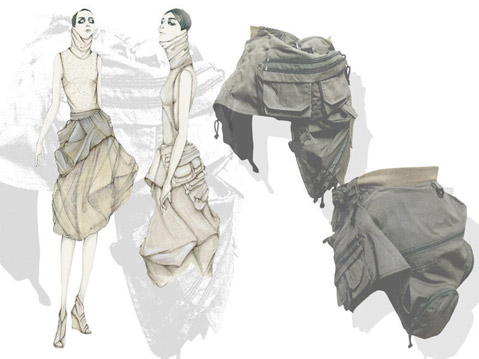
The Toledos worked closely with Claire Chouinard, who advised them on eco-friendly fabric choices and helped formulate the Otis design concept, which asked students to “imagine clothing 20 years from now, in eco-friendly materials, with multi-uses, convertible features, and day-to-evening functionality.” Isabel Toledo arrived from New York to supervise the first fitting of the students’ garments; Chouinard helped guide the last, pre-runway, fitting. “[Claire] strikes a perfect balance between fashion design savviness and a practical approach to merchandising,” wrote the Toledos. “She is very clear about her Patagonian vision!”
The final result of this creative collaboration was nothing short of amazing. I watched model after model float down the runway in the student-made ensembles created from Patagonia bottle fleece, organic hemp, recycled tents, sleeping bags, and parachutes. The message is clear: Save the earth — and look fabulous doing it.
Seeds of Patagonia

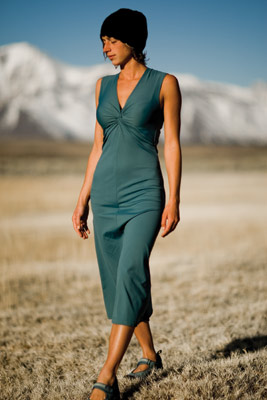
In an airy, sunlight-filled industrial building less than two miles from Patagonia’s Ventura headquarters, married business partners Karen Stewart and Howard Brown produce their own line of eco-conscious fashion, made from green fabrics such as Mongolian cashmere, organic cotton, hemp silk charmeuse, merino wool, and yak down. Their label, Stewart+Brown, was established in 2002 following Karen’s five-year stint designing clothes for Patagonia. Stewart+Brown is determined to make the fashion flock as environmentally aware as outdoorsy Patagonians.


Photos by Nancy Neil
Retailers were initially reluctant to stock Stewart+Brown’s organic clothing, assuming, according to Brown, it was all “ugly scratchy hemp hippy garbage stuff.” The main problem was education: Patagonia has spent many years educating its customers about the environment and the importance of sustainable production practices. “We had to educate all of our customers because our customers were not Patagonia customers. They hadn’t been educated that way,” says Brown. Which is why, Brown explained, he and Stewart consider themselves “organic pioneers”: “We were the first organic line in almost every boutique we sold to. There was no other one. Nothing. We’re not saying we invented it; we’re just saying we pioneered it in the fashion industry.”


Photos by Nancy Neil
Stewart+Brown donates a minimum of one percent of all sales to nonprofit, nongovernmental environmental and social welfare organizations. They wish their competitors would join the eco bandwagon: “We don’t want to be the only ones in this space; we need a healthy ethical fashion movement. If [Patagonia] can do it and they’re a big company, and we can do it and we’re a small company, then there’s no excuse for not doing it,” said Brown. Stewart added, “We wanted to prove it could be done.” Fait accompli.
Stewart+Brown clothing can be found at Wendy Foster Sportswear in Upper Village Montecito. The company’s Web site (stewartbrown.com) explains the origins of its fabrics and detailed care instructions.