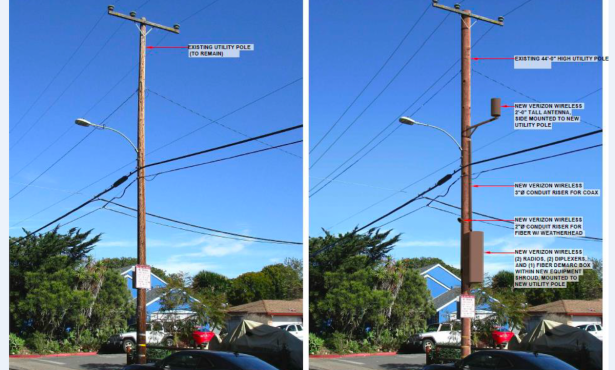
The controversial cellular antenna project being fought by Montecito residents inched closer to reality on Tuesday, as the Santa Barbara County Board of Supervisors moved toward undergrounding as much of the NextG project as possible. This decision came in two forms: one, it allowed the San Jose-based company to start a trenching program to put the rest of the network’s fiber-optic system underground, including work in the coastal zone; and two, it set a September 21 hearing date to consider a program to “vault” the white hardware boxes that currently are hanging next to antennas throughout the rural foothill community.
In both regards, the supervisors found themselves in handcuffs. Although the overriding concern driving the neighborhood opposition is possible health effects of the cellular devices, federal law preempts local jurisdictions from denying telecommunications infrastructure due to safety fears. As such, the supervisors had previously directed staff to deliver the findings needed to deny the projects based on aesthetic concerns, and staff complied, arguing that the project would be better if the white boxes were put in underground “vaults.” On Tuesday, NextG quickly offered to comply with the vaulting idea and also, in a stroke of strategic goodwill, reduced the number of antennas in Montecito from 10 to 8. The vaulting program is what will be considered again on September 21.
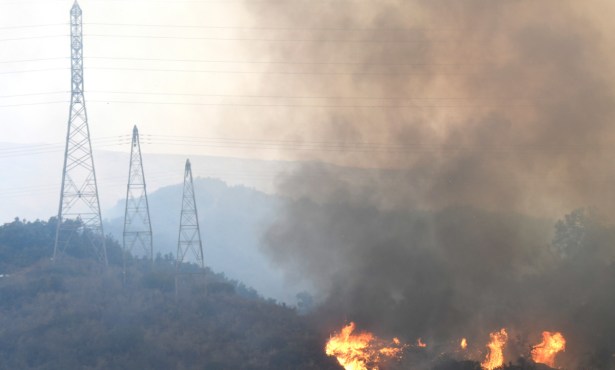
As to the trenching — which was argued against by both neighbors as well as a Native American representative, who claimed the work may disrupt Chumash sites — the supervisors found themselves stuck again. Had they denied the project, NextG had the right to install the equipment on the power lines, and would have likely done so, citing a need to move forward with the project. Plus, given the desire to see the rest of the project undergrounded — save for the antennas, of course, which must remain on the power lines — the supervisors were philosophically tied to allowing an underground program to proceed. They voted unanimously to do so. The City of Santa Barbara also required NextG to vault many of the nodes within its borders.
“NextG is appreciative that the county recognized our need tonight to provide service to the rest of the county by approving the trenching permit,” said NextG representative Patrick Ryan on Tuesday night after the meeting, noting that the Montecito antennas are the last of 142 nodes — and the associated 104 miles of fiber optic “backbone” — to be installed throughout the South Coast. “We are also encouraged about the opportunity to propose modifications on September 21, as recommended by the county staff, and hope to obtain the board’s approval that day for the eight remaining nodes in the county. We are confident that we will be able to address the board’s aesthetic concerns.”
Montecito residents, however, weren’t so enthusiastic. After noting the old adage about the camel’s nose leading its way into the tent, Peter van Duinwyk of the Montecito Association opined, “The methodology used by NextG in this case seems a little bit underhanded and not the kind of pressure that is very pretty to witness in public.”
Print friendly
E-mail story
Tip Us Off
Comments
Share Article
Myspace


Previous Month


Comments
Are you kidding.....NextG put a gun to the BOS.
They acted like a corporation that will come in and do what it wants regardless of what the community or even the BOS wanted to see being done.
One speaker said that nextg was knocking at the front door and even if you don't answer they were going to come in the back door anyways.
NextG spoke of public outreach and all the residents there said they had never been contacted and that NextG was not portraying themselves as a positive and responsible applicant.
Here is what really happened.
NextG played the system to its fullest, They got an exemption from the Public Utilities commission ( or some state agency, I forget) and have been running around with that as a free pass to do what ever they want. The Monticito Planning commission denied there permit because they felt that it did not qualify as an exempt project, the State Agency had not taken into several points of approval on this exemption. The denial of the permit at the planning dept opened the door to the BOS to review.
They went before the BOS at the start and gave the BOS a bargaining offer. Grant trenching tonight and we will defer the rest of the nine appeals to sept and look are reducing two nodes. Carbajal stood up and spoke that this all didn't feel right, why are we even considering bargoning with an appeal? it was just wrong.
Just before the BOS made the motion to continue to sept staff spoke up and said NextG told them that day that If you do not approve trenching and we will just do on the poles and move on.
The installation of the lines on the existing poles are considered to be completely exempt for any permit requirements and in fact are cheaper than trenching. This would cause a visual blight. The point that this topic came out was just before the BOS were about to continue all the appeals to Sept 21st. Everyone in the room saw NextG actions as a complete disregard of the BOS authority.
If you had been there you would have seen the BOS got slapped.
That was the real story there. The impact of NextG project are supposed to be guided and governed by the conditions of approval. I bet they will find a way to do the project just as they want regardless of these conditions. The attitude and methods used are clear they will be someone to watch closely.
In my three years of hearings I have never seen such a play out of posturing and dramatic manipulation of the system.
KsenSku
KsenSku (anonymous profile)
August 5, 2010 at 1:50 a.m. (Suggest removal)
the 2003 amendments to CA Public Resources Code 5097.993 says
"that any person is guilty of a misdemeanor if the person:
*unlawful and maliciously;
*excavates upon, removes, destroys, injures, or defaces;
*a Native American historic, cultural, or sacred site, that is listed or may be eligible for
listing in the California Register of Historic Resources, pursuant to
Section 5024.1, including any historic or prehistoric ruins, any burial ground, any
archaeological or historic site, any inscriptions made by Native Americans at such a site,
any archeological or historic Native American rock are, or any archaeological or hsitorical
feature of a Native American historic, cultural, or sacred site...."
This amendment, known as the 'Chesbro Law' after Sentor Chesbro was enacted as the "NATIVE AMERICAN
HISTORIC RESOURCE PROTECTION ACT (NAHRPA).. The penalities are up to a year in jail, a $10,0000 fine.
Civil penalties can be up to $50,0000.
I am sure NextG can afford this.
KsenSku
KsenSku (anonymous profile)
August 5, 2010 at 1:54 a.m. (Suggest removal)