For the Probation Department, it could mean closing down Los Prietos Boys Academy, a wildly positive and successful program that helps troubled youth turn their lives around. For prosecutors in the District Attorney’s Office, which already sees more cases per attorney out of any California county, it could mean an increase from the current 477 cases per attorney (up from 378 last year) to 567.
These are just two of the worst-case-scenario presentations the Santa Barbara County Board of Supervisors received Tuesday, as they begin to sharpen their red pencils in anticipation of the June budget sessions, when the real bloodletting will occur. In the meantime, the five supervisors have the pleasure of figuring out how they will go about cutting roughly $38 million from their budget, about half of which comes from the county’s General Fund. This week, they heard from department heads on what a 7 percent cut across the board would look like in their respective offices, though such sweeping cuts are unlikely to be the final result of budget deliberations.
For some, like Gordon Auchincloss from the DA’s Office, the presentation was almost too much to bear. Auchincloss, a polished, seasoned senior prosecutor with years of experience prosecuting criminals and stepping in front of the supervisors for the first time after DA Christie Stanley’s recent retirement, had to pause more than once in the midst of his presentation, the weight of what he was doing on his shoulders and mind. “I can tell you, the pressure of standing up here and representing the office, with so many jobs on the line, is something I’ve never experienced in trial,” he explained to the sympathetic board.
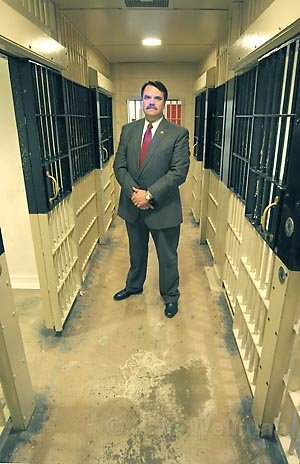
Paul Wellman (file)
Sheriff Bill Brown, pictured here in Santa Barbara County Jail, told the board Tuesday that “public safety needs to be priority one.”
For others, most notably Sheriff Bill Brown—who is in charge of the department funded most largely by the General Fund—it was a chance to put their foot down. “We are at a critical point in our county’s future,” Brown told the board. “Public safety needs to be priority one.” In a statement that was to be echoed by most who stood at the podium, Brown outlined how in the last two years he had already cuts dozens of positions, millions of dollars, and held open positions created by retiring personnel. “We’re out of gimmicks, we’re out of tricks,” he said, “we’re out of anything to do.”
Public Defender Gregory Paraskou explained that the extra $800,000 his department received from the board last year was still needed. His department is constitutionally obligated to provide representation for defendants who can’t afford an attorney. If a lack of funding force his attorneys to declare themselves “unavailable” on a case, defendants would get a more expensive contracted attorney, an alternative the county can ill afford.
Of course, while no one wants to see people lose jobs, there appears to be places where departments can trim fat. Potentially on the cutting board in the DA’s Office is a PowerPoint support services position to help prosecutors prepare presentations for jury trials. And while the sheriff put in the top tier of his cuts a gang team and closing the Santa Maria branch jail, he left his public information officer position untouched, a position that for the last two years has been filled with a civilian who makes as much as a senior deputy, a point 1st District Supervisor Salud Carbajal pointed out more than once.
Still to come next Tuesday are updates from the remaining county departments, including Alcohol, Drug and Mental Health Services and Information Technology.
So how did we get here? The main reason for the budget gap in the General Fund is flat or declining revenue. For the first time in most anyone’s memory, and at least since 1978, the estimated percent change in countywide assessed property value will be negative. In closing comments, some board members broke out the familiar song that has been sung at budget hearings past—that the county can’t just be looking at how to tail off spending, but also how to produce revenue. So far, in the past few years as the budget hearings have become more and more painful, the county has been unable to figure out how to do that.
And, salaries and benefits remain an issue, having, over the past three budget cycles, grown by 11 percent. Several have wondered why the county doesn’t take a look at its employer funding of the pension program, which currently sits at a 17-year amortization period. A more drawn-out, 30-year amortization—or a sort of mortgage the county pays to fund retirement—would save the county as much as $15 million this year.


Print friendly
E-mail story
Tip Us Off
Comments
Share Article
Myspace


Previous Month


Comments
Go back to 2% pension accumulation per working year from the 3% that many employees now get. 3% always was unreasonable and greedy, and enables the possibility of retirement at 48 years old with maximum benefits. Rare, but possible.
Retirement should only be possible at 60 with 2%/year.
sevendolphins (anonymous profile)
February 24, 2010 at 4:54 a.m. (Suggest removal)
Be clear. The only employees getting 3% are "public safety" (including those doing admin jobs, but are sworn officers/deputies). For example the Fire PIO is a fire captain. His is getting full public safety benefit. The non-sworn civilians get 2%/year at 57. The major problem is the defined benefit versus defined contribution. The Board should immediately change that benefit to defined contribution for all new employees (immediately) and then work on the current work force.
goletaguy (anonymous profile)
February 24, 2010 at 8:27 a.m. (Suggest removal)
The problem is not declining revenue; the problem is overly generous salaries, benefits, and pensions. By recent report, as much as 70% IN EXCESS OF PRIVATE SECTOR. Vote these bums out.
JohnLocke (anonymous profile)
February 24, 2010 at 10:12 a.m. (Suggest removal)
I would love to see the source of your stat, mr. johnlocke.
"70% IN EXCESS OF PRIVATE SECTOR"
So you think Gordon Auchincloss, or most any attorney in the DA's office with comparable case load, is making 70% more than their colleagues in the private sector?
That would run counter to my understanding, which is anecdotal based on friends in both spheres.
Chester_Arthur_Burnett (anonymous profile)
February 24, 2010 at 10:27 a.m. (Suggest removal)
This is easy -- no people cuts necessary
No raises, no increase in retirement income, and all employees and retirees pay 5-10% of the THEIR income to cover increase in retirement cost.
If they do not want to do that they can increase age of retirement, get rid of retirement 'spiking' capabilities and reduce the percentages used for retirement payout.
loneranger (anonymous profile)
February 24, 2010 at 11:31 a.m. (Suggest removal)
Whatever cuts we make today will hurt. It's not easy at all for anyone involved. I feel bad for the people having to make these decisions.
Then again, when things get better and money isn't as tight, I'm sure we'll be opening up our wallets again. It's the ebb and flow of our economy.
Public workers can make a lot of money when things are good, but on the flip side they are the ones that take a lot of hits when things are bad.
bronc (anonymous profile)
February 24, 2010 at 3:15 p.m. (Suggest removal)
Sure, I'll be clear. Nobody, nobody, deserves 3% a year pension and (possible) retirement at 48 or 51 with lifetime healthcare and 90% of their full salary, with COLA. That is greed, and anyone getting such a deal is demanding fewer jobs to cover the work, since the cost of that generous retirement package is exorbinant.
Anyone getting 3% a year and 48-51 age at retirement is demanding a reduction in public safety, although their job title or classification falsely indicates otherwise.
Simply discussing staffing reductions without mentioning a root cause of over-generous retirement packages is insincere and inaccurate.
sevendolphins (anonymous profile)
February 24, 2010 at 6:10 p.m. (Suggest removal)
Hmmmm where were all these fiscal conservatives a la Taxpayer Assoc during the previous Firestone-led BOS majority 2005-2009 when all the executive salaries including and esp those surrounding Mike Brown went sky high----for those who can't do the math, that means it is their retirement costs that are exorbitant- not those of the average blue collar public employee
sbsleuth99 (anonymous profile)
February 25, 2010 at 8:14 a.m. (Suggest removal)
Yes, Chester_Arthur_Burnett, when salaries and benefits are counted in a properly fiduciary way, the difference is just that big. Ya gotta look at LIFETIME compensation, not just current comp. Retirement at 50 is a HUGE benefit to the employee and HUGE cost to the taxpayer and is part of compensation. Not only must the taxpayer pay someone's pension for 25 or 30 years (which, for those who don't get it, is part of compensation and a major driver of the stated difference between public and private employees), the taxpayer must also pay for that person's replacement's salary and benefits. Just comparing salaries is an old government union employee trick that I quit falling for decades ago.
On another note, an across the board budget cut is just plain stupid. Look at the budget folks - it's online. In the past 2 years, the Sheriff has been cut by $5 million or so while Social Services have ballooned by $45 million and serious crimes have increased nearly 600% (Daily Sound today's issue) in the past decade. So let's cut the Sheriff, DA and Public Defender? Obviously, our elected officials are not too concerned with public safety, however pious their public pronouncements. And I call that malfeasance, if not outright criminal.
JohnLocke (anonymous profile)
February 25, 2010 at 11:43 a.m. (Suggest removal)
Simple facts that can be checked with an internet search:
The life expectancy of a police officer in the United States is 57 years.
The life expectancy of a criminal in the United States is 64 years.
The national divorce rate for cops is 75 percent
An officer under extreme stress is five times more likely to take his own life than to be shot in the line of duty.
while there are exceptions, cops do not get paid retirement for 25-30 years. They generally die within 5-7 years of retirement. Enough said.
goletarealitycheck (anonymous profile)
February 26, 2010 at 5:04 p.m. (Suggest removal)
I've specifically posted (though not in this chain) that public safety (police, fire, etc.) be exempted from budget cuts and the focus be on social services. So far as retirement statistics go, isn't SB 20-and-out?
JohnLocke (anonymous profile)
February 27, 2010 at 10:47 a.m. (Suggest removal)
There are lots of ways to fix this issue without mass layoffs and reduction in services.
Probably the biggest issue is when here is a layoff it is by seniority so the newer people are out the door first. This should be done based on performance.
Possibly the next biggie is to do a way with retirement spiking -- retirement payments should be based on an average of salary over several years -- not the highest year.
If someone is promoted within 5 years of retirement that salary needs to be averages with pre-promotion pay.
After that we need to look at lowering the percentages and increasing the retirement age.
At the end of the day it needs to go to a defined contribution plan and eliminate the retirement board and all the cost associated with it.
loneranger (anonymous profile)
February 27, 2010 at 11:30 a.m. (Suggest removal)
Calpers (the California Retirement System) says the life expectancy of safety employees is in the 80 year range, and no different than other state retirees. However, safety employees retire earlier and thus receive higher benefits.
http://www.davisvanguard.org/index.ph...
sevendolphins (anonymous profile)
February 27, 2010 at 11:51 a.m. (Suggest removal)
Dolphins, i will grant you your point The article is clear about 'Safety Employees." But, cops a are part of the safety employee class, that includes fire, probation, DA investigators, and others. As a single group their life expectancy is much less than the other in the safety class. Just look at the number of medical issues cops often experienc that are presumed to be work related compared to others who have much less presumptive medical issues, even fire, to see the difference...Look at apples and apples, not apples, oranges, pear, lemons, and grapefruit...I can accept the argument that something needs to be done about retirement. Maybe even go back to 3@55 and increase the employee contributions, but it needs to be done with the managers and execs realizing they are not subject to the same stress as line and street personnel. Maybe once they make Lt they should give up safety retirement. Let's not make the ones who do the real work suffer because the stock market went bad and the politicians refuse to set the appropriate priorities.
goletarealitycheck (anonymous profile)
February 27, 2010 at 2:26 p.m. (Suggest removal)
Just because it says on the internet that Police Officers have shorter life expectancy doesn't make it true, although it may be true. It would be convincing to see a Calpers study of just Police Officers.
It is all safety employees who right now can retire at 48-51 years old with maximum benefits, not just police officers.
Policeman are in a dangerous profession... 3.4 times the average death rate. But airline pilots, taxicab drivers, construction workers, and farm workers have higher death rates. Why do we make all those workers pay a premium to give amazing retirement benefits to all safety workers?
http://www.mensstuff.net/issues/byiss...
sevendolphins (anonymous profile)
February 27, 2010 at 7:45 p.m. (Suggest removal)
Studies in Oregon and a variety of other states indicate that *police officers* do not have a significantly shorter life expectancy than the general public:
http://www.newgeography.com/content/0...
sevendolphins (anonymous profile)
February 27, 2010 at 11:23 p.m. (Suggest removal)
"Just because it says on the internet" is a caution everyone should be aware of, but the item above was quoting a study by the Calpers folks. Not quite the same as posting stats or studies without reference.
JohnLocke (anonymous profile)
February 28, 2010 at 2:59 p.m. (Suggest removal)
A presentation by David Lamoureux, a Calpers actuary is at:
http://www.scribd.com/doc/24143670/Ca...
page 43 states that safety workers and miscellaneous workers have the same life expectancy.
page 25 states that safety workers retire at 55 on average.
The rest of us get to work to 65 or 70 or until we perish to support the very generous pension benefits and medical benefits received by safety workers.
sevendolphins (anonymous profile)
February 28, 2010 at 5:31 p.m. (Suggest removal)
And just think how much it costs the taxpayers to pay for that extra 10 or 15 years at maximum salary plus (usually) medical and cost of living benefits. Something close to the original cost of the employee. (which is how public employees are calculated to make 70% more than private sector workers, Chester_Arthur_Burnett). Do the math: Net Present Value and all that. Answer: convert public employee pensions to defined contribution plans, just as the private sector has done over the past decade.
JohnLocke (anonymous profile)
March 1, 2010 at 9:16 a.m. (Suggest removal)
In defined contribution plans, the private sector rips off contributors with outrageous fees. That's not good either.
I think a hybrid is the way to go... defined contribution is fine, but locked in index funds so all the pension fund mismanagement by (usually rightwing) financial advisors is avoided. Something like equal defined contribution by employer and employee, and then when you retire, you see the balance and can influence a little bit the withdrawal rate. A % of salary up to a maximum (like 401(k) etc).
Do this for everybody... police officers, fire, military, etc. I would put police and fire into the VA for medical care... they deserve guaranteed medical care, just like military veterans.
The real problem with medical care costs for pensioners skyrocketing is the venal behavior in the medical care industry... $100 tylenols, 3000% markup on antibiotics, $125 million/year for insurance company execs. Maybe put all public employees into the VA.
sevendolphins (anonymous profile)
March 2, 2010 at 8:47 a.m. (Suggest removal)
Great idea on pension reform; a little simplistic on medical, though I do agree that insurance companies are a big part of the problem. Also trial lawyers, esp the torts guys (modern day but much bigger time ambulance chasers). My namesake would be spinning in his grave, but maybe universal Medicare is the only practical solution.
Do you have an example of a 3000% markup on anti biotics - that's 30 times cost (don't forget that cost includes amortized R&D - thanks to our brilliant federal government, U.S. citizens get to pay the entire cost of R&D for drugs that are marketed worldwide).
JohnLocke (anonymous profile)
March 2, 2010 at 12:56 p.m. (Suggest removal)
http://www.independent.com/news/2010/...
Seems to me the marketplace takes care of the research costs etc. *before the markup of 2,999% by Cottage*.
Then it is not the cost of indigent healthcare being shifted, either. If so, then why is Cottage making $50 million/year profit?
I know someone who sat with their dying husband and literally recorded in shorthand each pill, kleenex, IV pack, etc for weeks. The bill that came had 2 or 3 times as many items on it as the eyewitness count. When they complained, the hospital said, `What do you care, your insurance covers it.' They fought and got the charges reversed, but naturally, the insurance company was mainly irritated, not thankful.
sevendolphins (anonymous profile)
March 2, 2010 at 2:05 p.m. (Suggest removal)
Excellent points. Note that it's apparently the local not for profit hospital making the big markups, not Big Pharma, who is usually the object of so much fury. Just goes to show that big is bad - big business, big medicine, big government, big unions...
JohnLocke (anonymous profile)
March 2, 2010 at 5:51 p.m. (Suggest removal)
B4 leaping to huge generalizations, however, it would be good to know if the Cottage incident was an anomaly, common to Cottage, common to other hospitals, etc. Making the unresearched assumption that this is common practice and branding the entire industry on the basis of a single case isn't reasonable or productive.
More of a concern to me is that the insurance company considered the complaint an irritation. Sounds like some third party (i.e. representing the consumer) is in order.
JohnLocke (anonymous profile)
March 2, 2010 at 7:56 p.m. (Suggest removal)
That local hospitals have monopolies, and that they jack up prices, has been a serious topic in the healthcare debate. Costs for a standard procedure like an appendectomy vary widely across the country. And then quality and good outcomes is by no means correlated with costs. This discussion has been in the Atlantic Monthly a few months ago (really good article and very non-partisan by a LA writer on how his father died; also the Planet Money series on NPR has covered this).
Even in a market that has several hospitals and insurance companies in competition, the prices for procedures don't follow normal economic theory. The costs don't sink to a low, similar value due to competition.... instead, insurance companies `pick a winner' and negotiate a much lower cost for that hospital, and try to drive the other hospitals out of business.
The whole issue of costs and how hospitals manipulate them tends to make discussions about insurance company competition across state lines irrelevant. The `free market' unfortunately includes the freedom to establish monopolies, the freedom to price-fix, and the freedom to charge for poor service with no evaluation of outcome; and it is those freedoms that seem to be winning in healthcare.
sevendolphins (anonymous profile)
March 3, 2010 at 6:08 a.m. (Suggest removal)
http://www.theatlantic.com/magazine/a...
is the Atlantic article. Very thoughtful, and, strangely enough, supports the tea party viewpoint, although a priori neither side would want to agree they actually agree.
sevendolphins (anonymous profile)
March 3, 2010 at 9:04 a.m. (Suggest removal)
And here is a story about $140 tylenols, $24 dollar inch-square alcohol swabs, etc:
http://money.cnn.com/video/news/2010/...
sevendolphins (anonymous profile)
March 4, 2010 at 11:08 a.m. (Suggest removal)