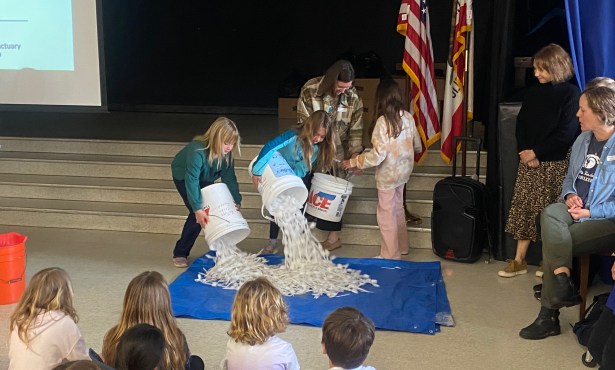
Distressed pelicans gathered on Cabrillo Boulevard Thursday due to winter storms and diminishing food sources. One of the main causes of the unusual event was reportedly the city’s removal of a key food source for local pelicans — the harbor’s bait dock — which was moved in anticipation of this week’s storms.
According to Julia Parker of the Santa Barbara Wildlife Care Network, pelicans often face difficulty this time of year because of the harsh weather and the migration of their two main food sources, sardines and anchovies. In addition, said Parker, many of the pelicans this year are less than a year old, and have thus never dealt with winter weather.
Last year, many pelicans followed their food up north to Washington, only to suffer from frostbite and famine on the way back south. This year’s events have been more extreme. The Santa Barbara Wildlife Care Network — the only pelican rehabilitation facility on California’s central coast — currently has twenty-five pelicans at their Seabird Satellite Facility. The Wildlife Care Network is a nonprofit, volunteer organization.
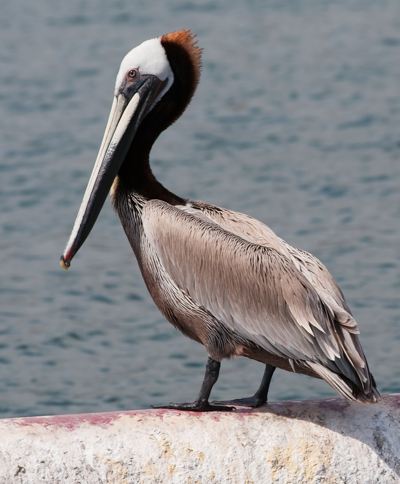
The California subspecies of the brown pelican (Pelecanus occidentalis californicus) was classified as federally endangered in 1970 and as endangered by the state of California in 1971. Nearly wiped out by DDT and habitat loss, pelican populations have recovered greatly since then. On February 5, 2009, they were delisted from the U.S. Fish and Wildlife Service’s Endangered Species List, largely due to their thriving nesting grounds on Santa Barbara and Anacapa Islands.
This recovery, however, may come with its consequences. Parker speculated that one of the main reasons why this storm hit the pelicans so hard this week may be their reliance on the harbor’s bait dock as a source of food. While normally the pelicans should migrate north with their food sources, Parker said, many of them may not have migrated because one significant food source was still available. The sudden disappearance of this food source may have led to the injury and distress of many pelicans on Thursday.
The Wildlife Care Network is asking for volunteer help in transporting inured birds as well as donations. They can be reached on their helpline at (805) 681-1080.
Print friendly
E-mail story
Tip Us Off
iPod friendly
Comments
Share Article
Myspace


Previous Month


Comments
can you remove that annoying crap above (or wherever it appears) ? it's obviously advertising and nothing to do with the story.
surfrmom (anonymous profile)
January 23, 2010 at 5:52 p.m. (Suggest removal)
Too true about the pelicans --- except that the first paragraph is in error. The bait barge is not a food source for the pelicans but a place for them to roost, to rest safe from people and dogs on the beach.
The birds fend for themselves for food, although this extended rain and very muddy waters have made fishing very difficult to impossible for the birds. It's a vicious circle: no food and they weaken so that they have a hard time hunting for food.
Even so, feeding them at the harbor, if anyone is tempted, is not a good to thing to do since it acclimates them to being fed ...and getting hooked.
citti (anonymous profile)
January 23, 2010 at 8:18 p.m. (Suggest removal)
Pelicans and humans definitely weren't made to coexist like this.
AZ2SB (anonymous profile)
January 23, 2010 at 8:49 p.m. (Suggest removal)
The story is inaccurate. Nearly the same thing, only more severe, happened last year. The adult pelicans that normally should be heading South from Oregon, are once again lingering and arriving in weakened conditions. The storms add to their debilitation. It has absolutely nothing to do with the bait barge. And, another misconception in the article is that Santa Barbara Wildlife Care Network has the only pelican rehabilitation facility on the central coast. The fact is that International Bird Rescue, with its 2 huge aquatic bird facilities, is taking in the majority of birds in Northern CA and Los Angeles region, and relieved the overburdened Santa Barbara facility from at least twenty birds - taking on the cost of their care. In SLO County, Pacific Wildlife cares for pelicans. There are MANY wildlife organizations up and down the coast responding to this event which extends far and wide.
diametryk (anonymous profile)
January 24, 2010 at 5:51 a.m. (Suggest removal)
That's correct but the IBRRC is not on the Central Coast, but in San Pedro. Indeed, they are taking in some of the Santa Barbara pelicans, as did their Cordelia branch! And doubtless the Pacific Wildlife Care is also struggling to help; they, too, have serious funding issues. It is a struggle for the wildlife care organizations. The SBWCN is the only wildlife care organization for Santa Barbara coast, also taking in seabirds from Ventura.
It's not at all the same thing as last year. There are fewer pelicans here, for one thing, this year. Quite a few pelicans have been observed in the bay area flying north to Oregon where, in the Newport area, there is a lot of food — and there are a lot of pelicans and sea lions that usually would have been south. For another, this series of storms was unusually strong and long-lasting.
The bait barge is a roosting place, that's all -- but that's important as anyone who's been around Sea Landing during the rains would observe. No blame or criticism intended here. Had the barge not been removed, it would have been destroyed.
When the SBWCN permanent facility gets finished on Fairview, the care will be expanded --- assuming, that is, there can be volunteers for this primarily volunteer-operated organization. To help, call 681-1080.
citti (anonymous profile)
January 24, 2010 at 11:51 a.m. (Suggest removal)
"Pelicans and humans definitely weren't made to coexist like this."
--AZ2SB
What in the world are you talking about? "Made" by whom? "Like this" means like what? What kind of coexistence were we made for?
Can you try to coexist with a sensible comment?
SezMe (anonymous profile)
January 25, 2010 at 1:28 a.m. (Suggest removal)
In an article about birds, interesting that we get some fly by night comments.
Bird (anonymous profile)
January 25, 2010 at 8 a.m. (Suggest removal)
When anyone feeds the birds, the word gets around and all the birds show up. Feeding pelicans will just cause them to turn into seagulls which we know are just flying rats. We dont need flocks of pelicans hanging out at the dumpsters behind the grocery stores and donut shoppes.
teepster (anonymous profile)
January 28, 2010 at 10:38 a.m. (Suggest removal)
Pelicans wouldn't be likely to hang out around dumpsters, but if fed at the waterfront or harbor or Stearns Wharf, they would hang out there, begging and lunging at fishermen/fishing line or just visitors, ending up getting hooked or with wings wrapped in fishing line. The end result of such injuries is too often very bad.
Some of us, with the cooperation of Frank at the Bait Shop and with the Waterfront Dept, have worked hard to prevent this. It may seem a kindness to feed the wild but it, too often, is not. If you want to feed, feed your backyard birds, not the truly wild ones.
citti (anonymous profile)
January 29, 2010 at 12:04 p.m. (Suggest removal)
I remember reading in the Independent, about a person or group that spent their time 'hacking' the beaks of Pelicans with a machettie or other large cutting tool, after what was stated the birds were seeking food from the Wharf and harbor or from fishermen. This charactor was never caught or found so with these birds hungry and needy, this creep will be back their old tricks very soon, keep an eye out for half or all beakless Pelicans.
dou4now (anonymous profile)
January 30, 2010 at 12:28 a.m. (Suggest removal)
This story is, unfortunately, very inaccurate. These are adult pelicans suffering, and they were clearly more hungry than usual even before the storm began, and before the bait barge was moved - and it was only secured to a dock nearby. They do not feed from the bait dock, but they do seek refuge there from all of the awful people who torment them when they are trying to rest on the beach. When the storm hit, they began truly starving to death - they were collapsing and dying all over the place. After the storm, the water was filthy and thick with sediment and run-off. Many are still dying.
diametryk stated:
"Nearly the same thing, only more severe, happened last year."
While that may be true for other areas, I can assure you that this year is by far more severe than the last here in Santa Barbara, and it is different in many ways as well.
2324 (anonymous profile)
February 4, 2010 at 1:17 a.m. (Suggest removal)