An Aviary to the Max
Audubon and Natural History Museum Break Ground on Home for Rescued Birds

I got the chance to meet last week with reps from the Audubon Society, its education program Eyes in the Sky, and the Natural History Museum to learn about the compassionate and arduous journey these partners took to bring a dream—to create an aviary for rescued birds—into reality.
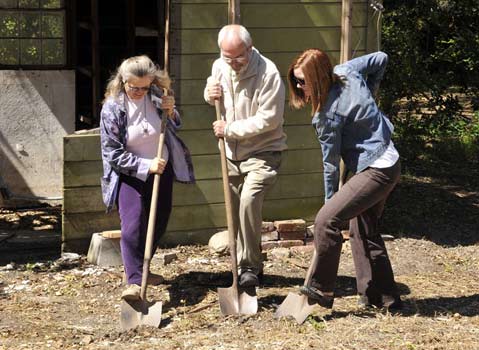
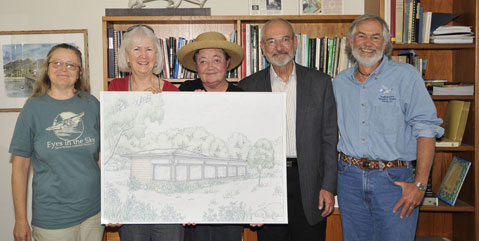
The story of a great horned owl named Max, and the Santa Barbara Audubon Society’s dream of a permanent sanctuary for him and other unreleasable birds, was not breaking news in my life. My father, Steve Ferry, now unshackled by previous obligations as an engineer, dedicates his time to bird pursuits. Chief among these are endeavors with Audubon. I tagged along to Audubon events anytime I knew that Max — and his companions who now look forward to life in the aviary — would be in attendance. Most recently, on May 22, I got to attend the long-awaited groundbreaking ceremony held at the Santa Barbara Museum of Natural History site where construction of the aviary is set to begin within the week.
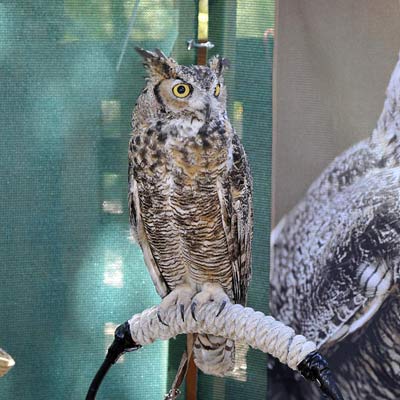
Max’s home has been in the works at least since its first documented milestone in 2004, the signing of a memorandum of understanding, the understanding being that construction of a modest aviary on museum grounds would begin in February 2006. So reports John O’Brien, who joined up with Audubon in a variety of capacities the year the memorandum came to be. Among other things, he volunteers for Eye in the Sky, the program that brings Max and his feathered pals to local school kids. He now serves as program chair of S.B. Audubon Society and coordinator of the building of the birds’ new home, a pivotal role in which he serves as liaison between the partners who made the aviary possible.
The aviary will be officially owned by the museum, which, states Director Karl Hutterer, is “all about studying nature.” He believes “birds represent the splendor and diversity of nature, and its fragility.” The aviary will make it possible for birds and their handlers to interact with museum visitors on a daily basis. This will require many volunteers and Audubon welcomes the involvement of bird enthusiasts, especially those with daytime availability.
Roadblocks were frequent on the journey to getting the aviary built, reports O’Brien. Fundraising, by dedicated Audubon folks, took years longer than expected as the cost of construction turned out to be considerably more than projected. Darlene Chirman, president of Audubon’s local chapter, reported that another persistent challenge was obtaining the City of Santa Barbara permits required to build the structure at the museum. For example, an innovative solution was needed to meet the commission’s desire for siding that would match the adjacent, historic MacVeagh House and at the same time satisfy the fire marshal’s standards for fire resistance. The location for the prospective aviary was changed, additional archaeological reports were needed — it’s no wonder painstaking years went by before Audubon and the museum secured a plan to build it.
A donor plaque and the aviary’s six enclosures honor major donors, notably the Santa Ynez Band of Chumash Indians Foundation (which donated $25,000), the Wallis Foundation ($40,000), and In Memory of Hugh McMillan. The aviary was made possible by numerous other private donors as well, who all together helped Audubon come up with over $150,000 to build the aviary. Dolores Pollock, cochair of the development committee, announced the aviary will be officially named for Audubon itself, a fitting title commemorating the dedication of Audubon members in this terrific endeavor.
Gabriele Drozdowski, founder of Eyes in the Sky, will feel a change close to home once the aviary is built, as she has kept Max and other birds in her rented home (with thanks to her very tolerant landlord) for nearly two decades. Drozdowski, a transplant from Bavaria, wears many hats. She was even a mime at one point. Reflecting her experience as a child and family entertainer, Drozdowski’s presentations are as amusing and nurturing as they are full of information about birds. She said that her passion for rehabilitating birds began during the “massive bird die-off” caused by an early 1990s El Niño weather event. She came into possession of a small aviary by chance and began taking in brown pelicans (at the time an endangered species) injured by the storms. Her dedication to helping birds, most of whom do get released back into the wild, has continued throughout subsequent years.
Max the Owl has long been the star of Eyes in the Sky and must be considered one of the major players in the production of the aviary as well. He has served as teacher, foster dad for orphaned baby owls, and all-around celebrity. Drozdowski, a gifted raconteur, fondly recalls her introduction to Max. A hiker found the injured owl and brought him to wildlife authorities when Max was about six months old, though Drozdowski believes he must have fallen from his nest when he was just a few days old. Given his early introduction to humans, Drozdowski said, Max “thought he was one of ours or we were one of his.” He learned to fly and hunt due to natural instinct, but his bond to people, and belief that he was a human baby, meant he could never be released into the wild. Max learned to aid young injured birds in their recovery, playing a key role in the release of about 75 birds in all.
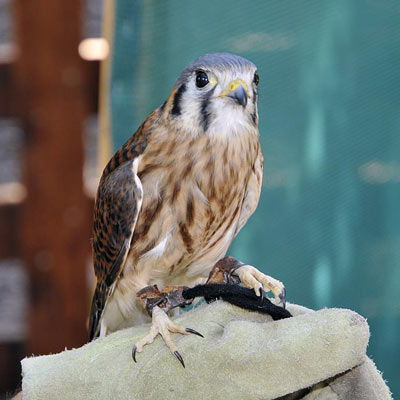
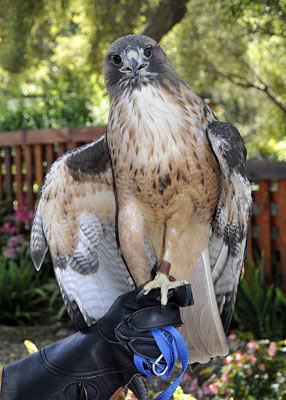
Max and the other birds were key attractions for fundraising events, reports Drozdowski. Hutterer agrees, calling them “irresistible” and “ambassadors of wildlife.” Some of the other birds are a red-tailed hawk who goes by the name of Ivan, an American kestrel called Kachina, and a Western screech owl named Tecolita.
The project is a great source of well-deserved pride for the Audubon Society, said Pollock, adding that this is the first time the Santa Barbara chapter has built anything, much less something so ambitious. Audubon and the museum expect a formal dedication of the aviary to take place in October.