Coal Oil Point’s Plover Protectors
Education, Not Enforcement, Is Motto

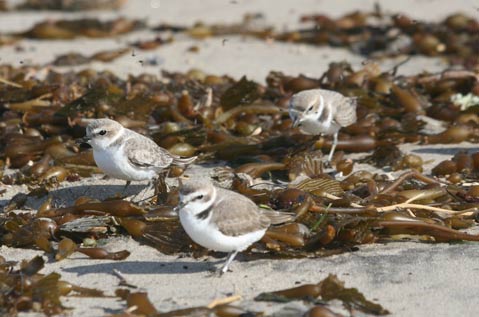
Jennifer Stroh runs the Western snowy plover docent program for UC Santa Barbara’s Coal Oil Point Reserve, recruiting, training, scheduling, and generally solving problems for a corps of plover protectors. These beach watchers are primarily educators who come armed with enthusiasm and interesting facts about their feathered charges, though they may also carry slingshots should crows get too close to eggs or chicks.

At present there are around 60 docents—trained volunteers who spend two hours a week minimum watching over the sparrow-sized shorebirds—but during some nesting seasons there have been up to 100 in service, including many UCSB students. Docents protected the snowies, as they are called, an average of 72 hours per week between January and September in 2008 (the last year data is available). An early volunteer when the program began in 2001, Stroh has gradually taken on more responsibility as her feelings deepened for the plovers and their sandy, seasonal home.
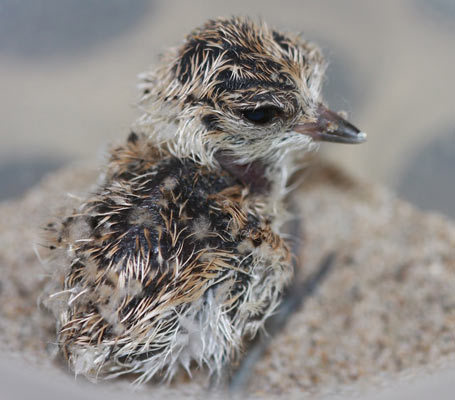
She says she was initially unaware of the tan-and-white birds as she jogged along Sands Beach, until a fellow Audubon member pointed them out. Once she learned to spot their nests on the beach and dunes, and observe the fluffy, insect-gobbling chicks, she signed up. “I really love showing people the plovers for the first time,” she said with a smile; it reminds her of her first encounter.
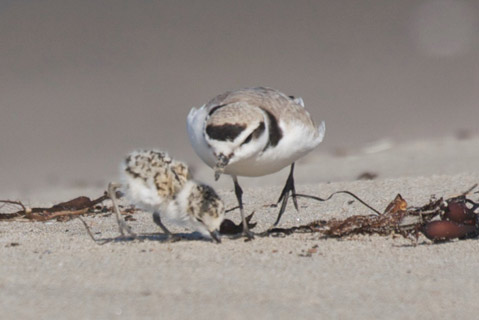
“The docents are essential, they are crucial to the plovers’ success since the protective measures we have are largely symbolic,” explained Cris Sandoval, resident director of Coal Oil Point Reserve and founder of the docent corps. A rope “fence” marks a shifting boundary between the nesting zone of the snowies—whose declining population led to a 1993 federal classification of threatened with extinction—and people’s recreational areas on the beach. It is an unusual coexistence of humans and wild birds.
“We need people’s cooperation to make it work,” Sandoval added. Visitors are asked to leash their dogs before stepping on the beach, stay on the ocean side of the fence, pick up after themselves so that the birds’ natural predators do not find food near plover habitat, and engage in other common-sense behaviors. The docents are the main means for securing this cooperation.
The docents act as nonthreatening sources of information about the habitat, the seabirds, and the reasons behind the rules governing the conduct of humans and their dogs. Most of the time it boils down to connecting the dots so that people understand they are sharing a special place with a bird that needs to be left undisturbed to recover on its own.
At a training session earlier this month for new docents, Stroh emphasized, “We’re not on the beach as enforcers; we’re educators who are trying to minimize disturbance of the snowies. Hopefully, we can get people to care about the beach and the plovers.” The docents were given a tip sheet on how to act with recalcitrant visitors and the phone number of the UCSB campus police in case backup is needed.
(For readers interested in becoming snowy plover docents at the reserve, Stroh can be reached by email at stroh@lifesci.ucsb.edu. The next training session is on April 3 at 9 a.m. in the Cliff House on West Campus.)
Visitors usually stay calm when the rules are explained. Stroh’s 2008 report noted that during the first nine months of the year, which included the five-month breeding season, docent “interactions” with the public were mostly positive or neutral, seldom negative. It was not that smooth an experience in the beginning, recalled Ed Easton, one of the earliest docents who is still active.
“Keeping my cool when really objectionable people said really nasty things to me” was one of the most difficult lessons he had to learn, said Easton. “It’s rare now, but it was more frequent in the early days.” Still, it probably helped prepare him for his current position on the Goleta City Council.
Increases in the plovers’ vital statistics testify to the effectiveness of the docents’ efforts to minimize disturbance, and of other measures undertaken, like employing a professional trapper to reduce skunk predation. Snowies’ nests went from one in 2001, with one chick fledged, to last year’s 65 nests, with a total of 61 chicks surviving to fledge. The key number is that of chicks that survived to fly away, and which hopefully will return to nest.
Though 2009’s was the highest total of fledglings counted, nature has taken its toll. Skunks were very active predators of the hatchlings in 2007 and 2008. In 2009 the reserve’s trapper reported killing 24 striped skunks and eight raccoons during the plovers’ breeding season.
Lethal controls distress Sandoval, a biologist who likes skunks and knows they are a natural part of the ecosystem. But, she explained, due to wildlife health concerns, federal rules do not allow relocation of the animals.