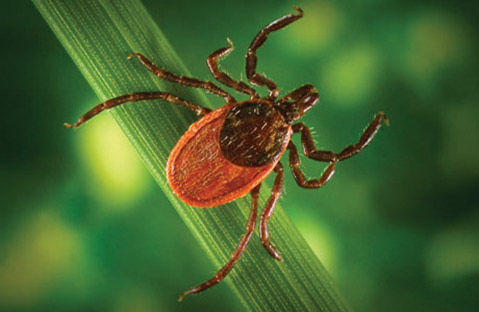
A tick bite may seem harmless enough, but it can give a person Lyme disease, the most common tick-borne disease in the U.S. and a dangerous disease if untreated. Lyme disease can be particularly difficult to diagnose in California because it’s unexpected, delaying essential treatment. May is Lyme Disease Awareness Month, and as more people enjoying the outdoors will be coming into contact with ticks, it’s a good time to learn about this often overlooked disease.
In California, western black-legged ticks can carry bacteria known as Borrelia burgdorferi. When a bacteria-laden tick bites a person, bacteria can be transmitted and give the person Lyme disease. In some California areas, the number of ticks carrying B. burgdorferi “can be up to 10 percent,” although it’s often much lower, explained Professor Cherie Briggs at the University of California, Santa Barbara, whose group studies Lyme disease in California.
“In California, we have the ticks, we have the bacteria, and we have some species of hosts that are really good at transmitting it,” said Briggs. But Californians have a factor that may be making infections less common: lizards. Lizards host 90 percent of Californian ticks. They’re so important to tick survival, Briggs and collaborators reported in a recent study published by the Proceedings of the Royal Society B: Biological Sciences, that when lizards were removed from an area, there were far fewer ticks the next year. And all those lizards “are really cool because not only do they never transmit Lyme disease, but they’re also cleansing the ticks of Lyme disease. It is pretty unusual.” When bitten, they actually kill the B. burgdorferi bacteria in the ticks.
Unfortunately, people don’t have the lizards’ immune systems. In people, the first symptom of Lyme disease, following a usually painless bite, is often a small spot that develops into a larger circular rash. Additional symptoms include fever, lethargy, aches, and, if left untreated, severe arthritis, neurological abnormalities, heart complications, and other chronic medical problems.
Because of its many symptoms, Lyme disease can be mistaken for other diseases, especially in California where doctors “don’t consider it to be a problem,” said Briggs. Additionally, available diagnostic tests are unreliable for early infections. The independent film Under Our Skin, which screened at the Lobero Theatre this month, portrays undiagnosed and misdiagnosed patients.
If an infection is caught early, it can be treated with antibiotics for a few weeks, but patients left untreated can be harder to treat, and treatments are hotly debated. The International Lyme and Associated Diseases Society supports long-term use of antibiotics, but according to the Infectious Diseases Society of America, which sets treatment guidelines, this doesn’t benefit patients and can be potentially fatal—not to mention that “long-term antibiotic use is a good way to develop antibiotic-resistant other things,” said Briggs.
When wandering in forested or grassy areas, to prevent Lyme-infested tick bites, try wearing light-colored long sleeves and long pants tucked into long socks. Insect repellents can also be used. Lyme-transmitting ticks can easily be overlooked because they’re about the size of a poppy seed. “One of the more risky behaviors is sitting on logs,” said Briggs. Luckily, ticks are usually attached for more than 48 hours before they transmit Lyme disease, so it pays to take a moment to make sure you haven’t brought any Lyme-bearing ticks home on your person.



Print friendly
E-mail story
Tip Us Off
Comments
Share Article
Myspace


Previous Month


Comments
Even if the tick that attaches to you is carrying Lyme disease, it still must be attached and feeding on your blood for at least 24 hours to possibly transmit the disease.
This point needs to be stressed more strongly. Then stressed again.
Not every tic bite is automatic Lyme disease as many people believe.
sez_me (anonymous profile)
May 25, 2011 at 8:27 a.m. (Suggest removal)
Sez_me is right - and having had it twice (or at least once - it was hard to diagnose some years ago in coastal Massachusetts, the hotbed for it and where about 35% of cases do not have the telltale rash), it clears right up with antibiotics. Keep an eye out for embedded ticks after walking in wild brushy areas; best to wear light-colored pants. Pets can also be affected.
at_large (anonymous profile)
May 25, 2011 at 10:40 a.m. (Suggest removal)
"This (long-term antibiotics) doesn't benefit patients" says the IDSA. This is completely incorrect and more importantly--a very harmful statement. It seems the IDSA doctors did not take the Hippocratic oath to do no harm?
IDSA doctors want to leave Lyme under-treated, with people left to suffer needlessly, and to end up completely debilitated; losing jobs, then potentially their lives--for fear of a super-bug? This is absolutely, completely and utterly ridiculous.
I was treated with long-term antibiotics. I took a really good pro-biotic; my kidney and liver blood work was monitored each month. I never had yeast problems nor any other complication and am feeling much, much better (if I hadn't been given long-term treatment I'd still be bed-ridden or possibly no longer alive).
If left up to the IDSA, the fastest growing infectious disease in the country will be left under-treated forever, with people dropping like flies. It is inevitable that the IDSA's policy of under-treating Lyme Disease will end up negatively affecting our already depressed economy because of a substantial drop in our country's healthy, productive workforce. The governor of Massachusetts addressed this very issue. It's time the whole country did.
cd57 (anonymous profile)
May 25, 2011 at 1:19 p.m. (Suggest removal)
Having had Lyme's Disease a few years ago I've tried to keep up to date on new studies. When I was diagnosed I had circular rashes all over my body, a fever and migraine type headaches. I never saw the one that got me nor did I get a "bullseye" in just one spot. It was a series of red circles ranging in size from 4-8inch in diameter. I was treated with Antibiotics for a full 30days but started feeling 90% better after 48 hrs. I have since been symptom free for the last 3 years, and I'm told by a doctor friend (someone I trust completely) that treatments only lasting 2 weeks are just as effective if you have caught it early enough.
One study I found last year (and I wish I could post the link here but I can't find it again) showed that the disease can be transmitted in as little as 30min but is rare, however the thinking that it takes up to 24hrs has been proven incorrect.
I have worked in the medical field several different times throughout my life and can attest to the severity of MRSA or Staff infections and their resistance to current antibiotics so I can understand the desire not to 'over medicate' and possibly increase these superbugs. IMHO each case is different and treatment should be tailored to each individual's circumstances instead of just a blanket treatment plan.
ThomasGypsie (anonymous profile)
May 27, 2011 at 9:28 a.m. (Suggest removal)
Nice to know we can get medical advice from the blogs.
eyewitness (anonymous profile)
May 27, 2011 at 7:51 p.m. (Suggest removal)
Wish there were a Frontline for humans. Or some dietary supplement that people could take. Ticks are all over Santa Barbara's foothills -- it's either stay on the paved paths or be on the alert for the crawlies after you get home.
Moonrunner (anonymous profile)
May 29, 2011 at 11:28 a.m. (Suggest removal)
Unfortunately, that odd tickling on the back of your neck doesn't mean Bigfoot is looking at you.
CO-INFECTIONS IN LYME - Babesiosis, Ehrlichiosis, Bartonella.
Other tick borne diseases - Tularemia, Tick Paralysis, Tick borne relapsing fever, Rocky Mountain Spotted Fever, Colorado tick fever.
Source: http://www.canlyme.com/coinf.html
Adonis_Tate (anonymous profile)
May 30, 2011 at 9:18 p.m. (Suggest removal)