Squid Fishing in California
About 11 Los Angeles Coliseums-Full Caught Annually
Saturday, November 12, 2011
In great numbers, California market squid (Loligo opalescens) gather to reproduce or spawn in the sandy bottoms off our coast. Birds have gathered to feed on the squid. Some seabirds can dive and swim nearly 100 feet to catch squid and other prey species.
Boats from Ventura Harbor and other destinations are also gathering to fish for the squid this time of year. At night, you may notice a network of lights flickering on the horizon on the north side of the islands and in the Santa Barbara Channel. The light-boats attract the squid and make it easier to land them in the fisher’s large purse seine or brail (or nets).

Michael McGinnis
The squid on your dinner plate at a seaside restaurant has likely traveled a long road back to town. In a great irony, the squid was probably caught from the waters of our region, exported to Asia or Europe for processing and packaging, and then sent back to us for our own consumption.
There are over 285 species of fish that are landed commercially (and recreationally) along the California coast. According to the California Fisheries Atlas, commercial landings can be grouped into four main types of fished species: groundfishes, coastal pelagic fishes, highly migratory fishes, and invertebrates. There are 16-18 recognized fisheries in California for species within these four broad groupings — including about 145 species of finfish and invertebrates.
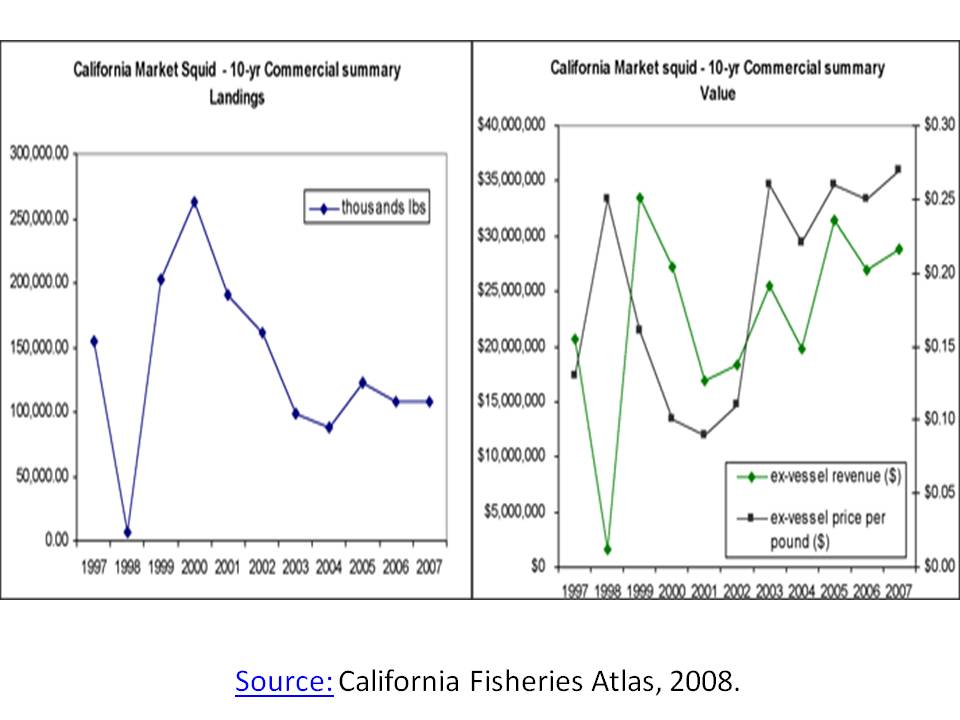
California Fisheries Atlas, 2008
Squid: What a Catch
California fisheries account for about 2 percent of California’s ocean economy. Landings once amounted to more than 500,000 metric tons per year, valued at over $600 million annually. But commercial fish landings have dramatically declined since the 1980s. By 2007, they had dropped to 173,000 metric tons valued at $117 million. This decline reflects the lower volumes of high-value species, such as finfish.
The fact is that higher volumes of lower valued species, such as squid, have replaced the big fish once caught from our marine area. Today, invertebrates account for more than half the value of total commercial landings in California. Ecologists refer to this process of shifting to lower value invertebrate species as “fishing down the food chain.” Higher-value fishes have been fished out and replaced by lower-value but higher-volume commercial activities.
California’s history of commercial fishing activity is symptomatic of the loss of “big fish” across the world’s oceans. A generation ago, a recreational fisher could fill a gunny sack of rockfish from the waters of the islands. Large rockfish have all but disappeared from our waters. Arthur McEvoy describes the history of fishing in California in A Fisherman’s Problem as one that has “followed a repetitive pattern of boom and bust, one typical of fisheries the world over.”
When government determines the level of fishing pressure that should be allowed, it rarely considers the needs of other animals that depend on these species. There is a lack of ecological information on the squid stock and population. This poses a problem for the management and economic use of species.
Today, the management emphasis is primarily on what fishery economists refer to as maximum sustainable yield (MSY). Setting the MSY is a theoretical exercise based on economics and biology. The idea is that the largest yield (or catch) can be sustainably removed from the ecosystem from a species’ stock over an indefinite period of time. One goal of MSY is to maintain the population size at the point of maximum growth rate by fishing individuals that would normally be added to the population. That would thereby manage the population to continue to be productive indefinitely. The question is whether MSY is a sustainable approach to manage fishes when information on stock or population is unknown, as in the case of commercially landed squid.
Since the late 1980s, a majority of the top commercially fished species from California have been exports. Major exports. The growth of major commercial fisheries is based on the demand for these species from Asian and European markets. An excellent example is squid, which is ranked by volume as one of the state’s largest commercial fish landed. Market squid ranked sixth by volume and 16th in value among U.S. commercial fisheries’ exports in 1999 — higher than any other California commercial fish. During the past 25 years, most of the squid caught off California has occurred in the nearshore marine areas of the Channel Islands, which is one of 13 designated national marine sanctuaries.
There is no reliable scientific information on the abundance and distribution of squid. There is a lack of ecological information on the existing biomass or the status of the population of market squid. Nevertheless, the Fish Management Plan for Market Squid, developed by the California Department of Fish and Game, considers the MSY and the seasonal catch limitation to be 118,000 tons. This was coincidentally the highest landing for the fishery during 1999-2001. I asked a friend at Cal Tech to provide me with an estimate of the total volume of squid caught off our shores based on this seasonal catch limit set by Fish and Game. His rough estimate is that 118,000 tons is 11 L.A. Coliseums full of fish.
The presence and abundance of the squid in California marine areas are of paramount importance to the millions of fishes, birds, and mammals that compete for this resource with human beings. The market squid is a principal forage item for a minimum of 19 species of fishes, 13 species of birds, and six species of mammals.
The presence of local commercial fishers is one distinctive feature of our region. Their local maritime knowledge is unique and needs to be preserved with the fish they catch. While our harbor includes some of the last remaining commercial fishing boats along the South Coast, we should still question the scale or level of fishing when we decide to eat a wild-caught fish. The level and amount of fish removed from marine ecosystems of our region matters.
If we are to support a slow-food movement for the marine environment, we need to think about how we economically use the fish protein from our marine systems and the ecological importance of the fished species. Like squid, most of the other top commercial species, notably sea urchin, among others, are exported. Consumers in other regions might or might not consider it, but we certainly need to recognize the importance of many of these species to the marine life off our coast. Birds, seals, whales, and a range of other organisms depend for their survival on the return of the squid.
Overall, “globalized” industrial-scale fishing activities may not sustain the essential ecosystem services that we all depend on. We should think about where our seafood comes from, how it was caught, and the ecological costs of industrial-scale fishing. Walk the dock on Saturday morning. Buy the white sea bass or halibut or other locally caught fish from the fisher. If squid is available, ask the fisher how to prepare it for your family. Engage the fisher in a conversation. Consider the role the fish plays in the ecosystem, the type of fishing gear used to catch the fish, and where the fish is sold.
Fishers can contribute in many ways to our economy. But it can also be an extractive industry that threatens the health and integrity of marine ecosystems. Encourage local fishing, but also don’t hesitate in challenging the resource use of the maritime commons. Each of us is dependent on a healthy commons — it is our common heritage.
Related Links
Comments
The Author makes a good point about the MSY not taking into account the Big Picture. The California Fish and Game has been as worthless as teats on a Boar concerning Ocean Management of our Fish Stocks.
I looked at the California Fisheries Atlas but it really lacks historical perspective.
Back in 1970 when the Abalone Industry was dying, the little 24’ Ab boats took to diving for Sea Urchin. These same boats would max out their hold with sea urchin and head home, if memory serves about 8,000lbs. Many overloaded 24’ former Ab boats capsized in the ever-changing waters of the Santa Barbra Channel. Divers were pulling in 80-100K+ per year and without any regulation of the catch by the CFG. Soon 44’ Down-East Lobster Boats were being trucked across the United States into California. Large profits allowed these boats to be paid for in cash. 44’ Lobster Boats allowed multiple divers to dive off one boat and over-harvest a location. Thus the Boom-Bust cycle began again; Sea Urchins today are a drop in the bucket compared to the 1970’s harvests.
Early 1990’s were the same for Squid. Light Boats came down from as far as Washington State. The net reels came off and large land based generators were dropped on deck, of 31-36 boats, along with large lights to pull the squid to the surface so the Seiners could net them. The Light Boats looked for the squid and called the Seiners in for the catch.
Large fleets of Light Boats worked between Point Dume and Mugu Rock and up the coast towards Santa Barbara.
Squid harvest has dropped today, just by the observation of how many Light Boats now work the area, it is a fraction of its former early 1990’s self.
Swordfish in 1970 would swim across the Pacific and dine on the rich squid off of Anacapa Island. These fish averaged 500lbs in weight and fetched $2.00 a pound at market. Each fish was worth $1,000.00. The fish would gorge on deep squid and then come to the surface to sleep and sun. The CFG allowed spotter Aircraft to be used in the fishery, to spot and call in a Plank Boat to harpoon the fish while it slept on the surface; many boats pulled 10 to 15 fish a day, you do the math. Coupled with the long lining of Swordfish in the 1980’s early 1990’s between Hawaii and the Mainland, the Anacapa Island Swordfish fishery is no longer.
The Story goes on and on. The California Fish and Game that has consumed $100’s of millions of Taxpayer Dollars over the last 50 years, if not billions. CFG has batted ZERO on the sustainability of any Fishery. I have to ask why do we even bother funding the bumbling Bureaucracy.
howgreenwasmyvalley (anonymous profile)
November 13, 2011 at 3:04 p.m. (Suggest removal)
One of the reasons urchins were plentiful in the first place, as with abalone, was the eradication of their primary predator a hundred years earlier - the sea otter. Once the sea otter came back into the picture, populations of urchins and abalone began to return to pre-extinction levels, and harvesting was part of this, as well. So the question of sustainability is influenced by what was 'natural' in the first place.
On the matter of squid, Mr. McGinnis once again shows his lack of scientific credentials, more anxious, as usual, to criticize those (like DFG) who have labored to understand and manage the fishery for squid. The truth is that the state and federal resource agencies charged with fishery management have been working for a couple of decades to gather relevant data to prevent over-harvesting of this invertebrate species (not a "fish" as Mr. McGinnis refers to it). One of the difficulties of managing such a species is its short life span, about a year in length. As a NOAA website states, "Market squid is a fast-growing species with a short natural life span - they reproduce right before they die, around the age of one. Even without fishing, the entire population can replace itself annually. As a result, market squid populations can handle a relatively high amount of fishing pressure."
(http://www.nmfs.noaa.gov/fishwatch/sp...)
And, the truth is, market squid HAS handled relatively high amounts of fishing, with 2009 landings of around 200,000,000 pounds.
Are there unanswered questions about the ecological impact on other species by the squid fishery due to human hunger for seafood? Most probably. The same can be said for any fishery. Should we be concerned about this? Definitely. But critics like McGinnis, unschooled in either biology or fishery management, don't advance an intelligent conversation.
And as to DFG 'wasting 100's of millions of tax dollars'? - as stated by 'howgreenwasmyvalley' - that's a real laugh. DFG has been largely funded over its history by revenues from hunters and fishers, both sport and commercial, not general fund revenues. Yes, that has begun to change over the past decade or so, but it would be nice if critics weren't so blinded by their bias to agencies like DFG that they're not interested in facts. Is fishery management difficult and expensive? Yep. Has DFG ever been funded adequately to protect the people's resources? Not even close. But the professionals there have done, and continue to do, the best they can do under the constraints and limitations placed on them. Perhaps Mr. McGinnis can start there if he wants to do readers a service.
Pagurus (anonymous profile)
November 14, 2011 at 9:37 a.m. (Suggest removal)
Drove down the coast last night... counted at least 8 squid boats right off the coast- literally- from El Cap.
maybeso (anonymous profile)
November 14, 2011 at 10:38 a.m. (Suggest removal)
Can you take a reporter seriously when he doesn't even know the true definition of the word "fisher"?
Webster's New World Dictionary: Fisher n 1. the largest marten, have very dark fur 2. this fur
mbcrabber (anonymous profile)
November 14, 2011 at 11:25 a.m. (Suggest removal)
How can one take seriously someone who cannot use a dictionary (on line, at the click of a mouse button)
Merriam-Webster
Definition of FISHER
1: one that fishes
2 a : a dark brown North American carnivorous mammal (Martes pennanti) of the weasel family
b : the fur or pelt of this animal
Merriam-Webster/Thesaurus
Fisher noun
someone who catches fish
Synonyms fisher
Related Words fisherfolk, fisherwoman; angler, fly fisherman, giller, surf caster, trawler, trawlerman, troller; waterman
There is more - use google.
tabatha (anonymous profile)
November 14, 2011 at 11:51 a.m. (Suggest removal)
Pagurus,
Gee Squid Fishing is just fine. Why then are not the Light Boats coming down from Oregon and Washington like they did in 1990? Observation - less catch and no one is willing to pay for the Light Boats to sit Idle. The economics have changed with less catch.
Looked at the cost of a Salt Water Fishing License lately? I thought purchasers of Fishing Licenses qualified as Tax Payers.
Who paid for the fleet of CFG Catamaran Patrol Boats, Tax Payers?
Just in my Life Time, local to the Santa Barbara Channel, the following species have been wiped out, abalone, dinner plate sized rock scallops, blue shark, mako spark, thresher shark, black sea bass, swordfish, bull sheepshead, red rockfish, cabazone, lingcod, pacific salmon, bonita, barracuda, etc.
Sorry Fail is simply that Fail. I have nothing against the CFG, it has just not been effective, a fishery stops only after it BUSTS, not a good way to manage sustainability.
howgreenwasmyvalley (anonymous profile)
November 14, 2011 at 12:44 p.m. (Suggest removal)
Seems like MVM's point is we are working our way down the food chain which seem correct. I think a 500 lb swordfish has a much longer lifespan than a year, so they get over here from their journey and there aren't any squid? Just a matter of time before they are gone. It all seems very interconnected. I wonder if these new MPA's will actually do anything to remedy the situation? None of this has ever been undertaken before, so there will be a learning curve, and it might be expensive. But hey, you got to start somewhere! It seems the sea is very resilient if we just leave well enough alone. Hey I like to go fishing and use squid as bait at times. Some fish don't show up unless it is very warm, and it has been cold now for awhile, but the other points about rock fish and the dwindling numbers are very true.
bimboteskie (anonymous profile)
November 14, 2011 at 4:37 p.m. (Suggest removal)
maybeso, I think 8 may be low and they've been in that same area for a month or more. I'm really concerned about what they are doing to that concentrated area, what the bycatch is, and how many (if any) squid will be left to be part of the local food chain?
If the catch is being exported and feeding some overseas country, then it seems they are possibly raping our local waters without concern (probably zero knowledge of the impact). Scary!
cycleboy (anonymous profile)
November 14, 2011 at 7:07 p.m. (Suggest removal)
Facts are stubborn things; always good to check 'em before publishing. After reading the squid piece, I went factfinding. Here's facts...impartial, objective scientific study, not newspaper articles. Different than the squid article.
Fact 1: (re: hi-vol. low value fisheries replace low-vol. hi-value fisheries) "Fishing down the food chain" rhetoric common in today's lay journals has been discredited in the scientific literature; average trophic level in world fisheries has increased, not decreased; larger fish are not necessarily more valuable than smaller; large-fish fisheries didn't precede others (remember sardines?), and they aren't more prone to collapse. Google: Branch, T. et al. 2010. The trophic fingerprint of marine fisheries; Sethi, S. et al. 2010. Global fishery development patterns are driven by profit but not trophic level; Pinsky, M. et al. 2011. Unexpected patterns of fisheries collapse in the world's oceans.There are more like these.
Fact 2: (re: declining landings of finfish and shellfish). Contrary to the article, declines in CA landings have been due almost exclusively to catch-restricting regulations, as objective review of fish stock assessments by the Pac. Fisheries Mgmt Council shows. Such review is in press by Hilborn, R. et al, and appears soon in the journal Conservation Biology. It supports three findings: 1) bottom fish abundance today is roughly the same as in the '80's when landings peaked; 2) total annual bottomfish production never declined during this period, i.e., the ecosystem, not individual stocks, was never overfished; and 3) even in fish stocks deemed overfished, annual surplus production didn't decline during these years.
Preliminary study of the carbon footprint of prominent fisheries indicates that squid seining has one of the lowest carbon footprints. And seining for pelagics takes less energy than other forms of food production, notably land-based agriculture. For relative costs of various food production modes, Google: Pelletier, N. et al. 2011. Energy Intensity of Agriculture and Food Systems. Holistic, critical thinking is required to see the big picture.
A couple of other facts selectively unmentioned by the article:
Fact 3: DFG declared the squid fishing season over as of Friday, 11/18 at noon, due to an abundance of squid, reaching quota earlier in the season than usual.
Fact 4: The DFG squid management plan (read it!) accounts for ecosystem services of squid as food for fish, seabirds and marine mammals when quota-setting. The zealous concern for "protecting the ocean" is actually shared by the management agency.
So, summing up: facts are stubborn things, and it would be well for folk who like to "educate the public" on ocean resource management to check a few prior to hitting the "send" button. And remember: support local fisheries!
oblio (anonymous profile)
November 15, 2011 at 10:29 a.m. (Suggest removal)
Link to the CA DFG site of statistics, the first glaring problem is the total lack of information from the 1970's and seeming good data from the 1980's and then poor data again. Our Government at work. TOTAL DISGRACE
http://www.dfg.ca.gov/licensing/stati...
I would like to see data from the 1970's on Swordfish.
1980 410 Swordfish permits - 1989 88 Swordfish permits
Then the Swordfish Permits get skewed with gill nets and sharks.
Squid, only very recent data (2005) and nothing from 1990's, so "oblio" how would the DFG know if they cannot compare the trend line of the last 20 years?
Talk About Junk Science.
Perfect Example why a Fishery goes BUST, the People entrusted with the management of the Fishery don't have a clue, they are just guessing and they have always guessed wrong.
howgreenwasmyvalley (anonymous profile)
November 15, 2011 at 3:15 p.m. (Suggest removal)
The problem with quoting things is the context is lost. Who funded the studies and therefore could there be any bias? What factors didn't get included (as howgreen mentions above)?
It's easy to call something fact because one or more experts studied it. It still doesn't tell the whole story.
It will be interesting to see if the boats at El Cap leave by the weekend. I still wonder if they've been within about a 1 square mile area for over a month, how could that area not be fished out? What bycatch did they pull in?
I also have to wonder about the scientific info stating that various fish populations haven't declined. Anyone who spends time in/on the local waters would likely disagree. Try finding a big rockfish or male sheephead off the local coast.
BTW Oblio, how's Arrow? ;-)
cycleboy (anonymous profile)
November 16, 2011 at 6:21 a.m. (Suggest removal)