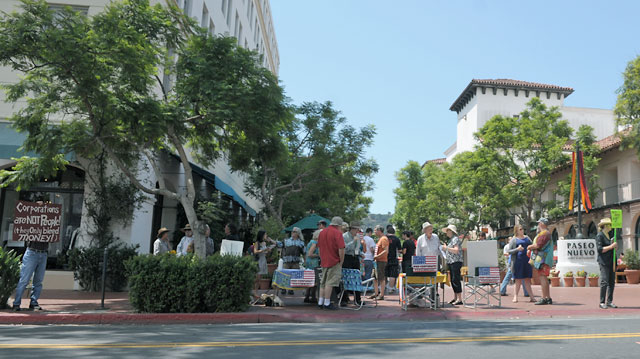
The Progressive Democrats of Santa Barbara hosted a Move to Amend rally at the Paseo Nuevo shopping mall this Saturday to protest the concept of “corporate personhood,” which currently allows corporations to retain several of the same constitutional rights that individual citizens are guaranteed.
The rally was part of a national Move to Amend movement to end constitutional rights for corporations. About 20 activists collected signatures petitioning the City Council to pass a resolution supporting an amendment to the U.S. Constitution that would end corporate personhood.
Many rally participants expressed concern over the controversial decision made in 2010 by the Supreme Court in the Citizens United v. Federal Election Committee case. The landmark ruling declared that the First Amendment prevented the government from being able to limit independent political expenditures by corporations and unions.
Antonia Robertson, co-chair of the Santa Barbara Move to Amend group, said that several cities have already passed resolutions supporting the amendment and that the group is hopeful that the Santa Barbara City Council will do the same. A two-thirds majority vote in the House of Representatives and the Senate is required to propose a constitutional amendment.
City councilmember and rally attendee Cathy Murillo expressed personal support for the resolution but didn’t want to speculate on the positions of other councilmembers.
Lois Hamilton, chair of the Progressive Democrats of Santa Barbara, said that she had plans to meet with Mayor Helene Schneider and Councilmember Bendy White to discuss the resolution. “The resolution essentially states that we do not agree with the decision of the Supreme Court in the Citizens United case, and that we are against corporate personhood,” Hamilton said. “Money does not equal free speech, and we do not want [corporations’] unlimited, undisclosed money to determine our democratic elections.”
Sharon Byrne, head of the Milpas Community Association, said that a serious concern is that while constitutional amendment would need congressional support, the lawmaking body is also financially supported by corporations through the idea of corporate personhood.
Activist Michael Merenda said that many of the participants present at the rally were retired or older working professionals who are interested in improving the country for future generations. “A lot of the people here are retired or are around 70 years young,” Merenda said. “They are here because, even though they may not normally consider themselves activists, they want to make this country a better place for their children, grandchildren, and great-grandchildren.”


Print friendly
E-mail story
Tip Us Off
Comments
Share Article
Myspace


Previous Month


Comments
I support this.
Num1UofAn (anonymous profile)
August 20, 2012 at 7:26 p.m. (Suggest removal)
Is there no other way to nullify this horrible Supreme Court decision than by a constitutional Amendment? That sounds really difficult to accomplish. Would not a law suffice? Is there a constitutional lawyer in our midst who could opine please?
blackpoodles (anonymous profile)
August 21, 2012 at 12:13 a.m. (Suggest removal)
One of the most egregious aspects of Citizens United v. FEC is third parties (not the political parties or the candidates themselves) can now raise unlimited funds when they organize as a tax-exempt 501(c)4 without revealing who their contributors are.
That means Citizens United or Swift Boat Pirates might just be one rich guy with a self-serving agenda, but we'd never know who footed the big check to make all the brainwashing ad and influence peddling buys.
So if we can't limit the amount of money, at least we should make disclosure of 501(c)4 donors mandatory. How can democracy exist without that kind of transparency?
Another thing that can be done is to enforce the use of 501(c)4's more tightly. They're not supposed to be used for political advocacy. But the Federal Election Commission is rife with partisanship so enforcement is rare.
EastBeach (anonymous profile)
August 21, 2012 at 12:43 a.m. (Suggest removal)
In 2006, 1.3% of all third-party campaign spending was undisclosed. In 2010, it rose to 44%!
Who knows what it will be for 2012?
http://www.opensecrets.org/outsidespe...
EastBeach (anonymous profile)
August 21, 2012 at 12:50 a.m. (Suggest removal)
Coincidentally, Warren Olney discussed anonymous "dark money" contributions to 501(c)4's today on his "To the Point" show:
http://www.kcrw.com/news/programs/tp/...
It looks like the IRS (as opposed to the FEC) is going to have to crack down on this form of campaign finance abuse. So far, there's been no action.
For the 2012 campaigns, conservatives groups are especially complicit. So far, they've raised $70M in dark money while liberal groups have raised only $1.6M. This according to ProPublica.
More info here:
http://www.propublica.org/article/fro...
EastBeach (anonymous profile)
August 21, 2012 at 1:28 p.m. (Suggest removal)
How do they feel about workers being forced to join unions and then automatic payroll deductions being used to fund political campaigns?
"Money does not equal free speech."
Scooter (anonymous profile)
August 21, 2012 at 1:55 p.m. (Suggest removal)
To level the playing field, neither unions nor corporations should be allowed to donate or to force others to donate.
JohnLocke (anonymous profile)
August 21, 2012 at 5 p.m. (Suggest removal)
Locke might be onto something, as well as donor transparency. Not every union/corporation is good/evil.
Ken_Volok (anonymous profile)
August 21, 2012 at 5:03 p.m. (Suggest removal)
A surprisingly large majority of Americans of all political stripes thinks the Supreme Court's Citizens United decision is wrong:
http://www.washingtonpost.com/wp-dyn/...
The Supreme Court has gotten it wrong in the past. It upheld "separate but equal" segregation laws in Plessy v. Ferguson, and upheld slavery in Dred Scott v. Sandford.
Disclosure: I'm not a part of "Move to Amend". It just so happens I've been reading about campaign finance reform.
EastBeach (anonymous profile)
August 21, 2012 at 5:19 p.m. (Suggest removal)
There's a local angle to Citizen's United and the Super PACs it enabled ...
This year, the Supreme Court made it clear that Citizen's United applies to state and local campaigns when it decided American Tradition Partnership Inc. v. Bullock (5-4). That case struck down a 100 year-old Montana law that said corporations could not contribute directly to political parties and candidates.
The Montana law is widely viewed as resulting from the sleazy election of "Copper King" Senator William A. Clark, who basically bought his seat in the Senate. In fact, Mark Twain said about Clark's election:
“He is said to have bought legislatures and judges as other men buy food and raiment. By his example he has so excused and so sweetened corruption that in Montana it no longer has an offensive smell.”
Of course, William Clark was the father of Huguette Clark, the heiress whose estate across from the Bird Refuge is now being settled.
EastBeach (anonymous profile)
August 21, 2012 at 5:33 p.m. (Suggest removal)
"JohnLocke" has got some of this quite wrong; unions cannot 'force' political contributions, as a matter of long-standing law.
Hudson Notices are provided to non-union government sector workers which breaks out political expenses and allowing employees to pay for only the benefits which they gain by collective bargaining. "...a public sector union, while permitted to bill nonmembers for chargeable expenses, may not require nonmembers to fund its political and ideological projects"
The law was just further refined in June by the Supremes, with Alito delivering the opinion:
http://www.supremecourt.gov/opinions/...
Employees are still required to pay for benefits received from collective bargaining, but a Union cannot force payments, essentially borrow money, from people for political activities to which they don't agree.
binky (anonymous profile)
August 21, 2012 at 6:02 p.m. (Suggest removal)
It appears union members can opt out of, or get refunds for, portions of dues that are used for political campaigning:
http://www.dailykos.com/story/2012/06...
Anyone have info to the contrary? Better yet, any union members out there who can comment?
The interesting thing is shareholders have no say as to how corporate political contributions are spent.
EastBeach (anonymous profile)
August 21, 2012 at 6:07 p.m. (Suggest removal)
Citizens United ranks up there with the worst of all Supreme Court decisions. Cf. Ronald Dworkin's withering review in pages of New York Review of Books last year.
@EastBeach, well, I agree mostly with you, but not with the "surprisingly" at your comment about how many Americans sincerely do not agree with the 5 conservative justices. Maybe Roberts was making up for this completely partisan vote on Citizens by switching on Obamacare mandate (as a tax, uh, OK, John Roberts, whatever it takes you to get to a humane & liberal position for once). Many Americans instinctively understand that mega-corporations will vote their own interests, not those of the people generally. Since we live in a military democracy -- hey, admit it -- the armaments, oil, space, high tech all serve the imperium. And you know, we are truly exceptional, unlike all earlier empires, right?
DrDan (anonymous profile)
August 21, 2012 at 6:13 p.m. (Suggest removal)
Well looks like that's a nonissue then. If I were a Chick Fill-A customer, could I get a discount for disagreeing with it's chieftain?
Ken_Volok (anonymous profile)
August 21, 2012 at 6:15 p.m. (Suggest removal)
Thanks binky. This article also says:
http://www.latimes.com/news/nation/na...
"... For that reason, public employee unions must give dissenting members the right to opt out of paying the share of dues that goes to politics."
This means the playing field is really tilted in favor of corporations because shareholders have absolutely no say whereas union members do.
EastBeach (anonymous profile)
August 21, 2012 at 6:21 p.m. (Suggest removal)
However, I worked for an organization in which it was made quite clear that "voluntary" donations were mandatory. I'm sure the unions are quite capable of the same behavior. Plus, the "opt-out" feature binky mentioned sounds good, but I wonder if anyone actually opts out (thus drawing the union's attention to that individual's political "disloyalty"). By barring both corps and unions from donating, with strong penalties for transgressors, we can be sure that donations are from individuals and voluntary.
JohnLocke (anonymous profile)
August 22, 2012 at 8:34 a.m. (Suggest removal)
Not exactly a fair comparison, EastBeach: shareholders are not being billed for the activities (whereas employees are).
Of course the expenses for political activities by a corporation can be built into a budget, but I still don't think it lines up in the same way.
- - -
JohnLocke: Alito's opinion covered 'opt-in' vs. 'opt-out' on mandatory fees, and he (and the Court) believes the current opt-out method is a mistake and allows for infringement of 1st Amendment rights.
The primary reason on collection of fees from NON-union members, in the eyes of the Court, has been to avoid 'free-riders,' those who benefit from collective bargaining by unions as non-members. The art in the laws has been to avoid limitations on free speech, or coercion of those rights.
binky (anonymous profile)
August 22, 2012 at 9:32 a.m. (Suggest removal)
I think we all agree that Citizens United was a terrible decision, but I don't understand why it would take a constitutional amendment to undo it. Can anyone explain?
blackpoodles (anonymous profile)
August 22, 2012 at 10:50 p.m. (Suggest removal)
The Supreme Court has the final word on the laws of our country.
Either they need to make new decisions which change existing law, or the people, via Congress, can amend the Constitution.
The extra-legal method is the Executive branch simply ignoring or not-enforcing, the law.
binky (anonymous profile)
August 22, 2012 at 11:20 p.m. (Suggest removal)
I'm not a lawyer, but my simplistic understanding is based on the Wikipedia citation:
http://en.wikipedia.org/wiki/Citizens...
The court's majority opinion was ... the part of the "McCain/Feingold" law prohibiting corporations & unions from funding political ads within 30/60 days of an election violates the freedom of speech clause of the First Amendment. This hinged on at least two important arguments:
1. The First amendment is applicable to both people and "associations of people" (e.g. a corporation).
2. Spending money is essential to disseminating speech, so limiting the former is like limiting the latter.
I think this is why groups like "Move to Amend" want to amend the Constitution and put in language that exempts corporations from freedom of speech.
You can read the rest of the Wikipedia citation and see that this strategy probably stems from the dissenting opinion written by Justice Stevens (he was about to retire so he really let loose).
EastBeach (anonymous profile)
August 23, 2012 at 12:07 a.m. (Suggest removal)
I think Justice Stevens made some good points in his dissent about how corporations are really something different than a person.
But I think the achilles heel of the Constitutional amendment approach is that newspapers and media are corporations too.
EastBeach (anonymous profile)
August 23, 2012 at 12:22 a.m. (Suggest removal)