Natural Weed Whackers
Feasting on Wild Oats

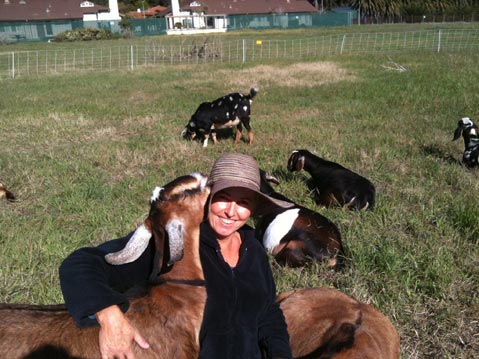
There are some new attractions out on the bluffs in the Devereux area: mini-Nubian goats inside a moveable fence, chomping on weeds to provide open space for native plants to thrive.
One day I encountered Cristina Sandoval, the goats’ owner and the director of the Coal Oil Point Reserve, sitting outside the fenced-in area, just watching. When I asked what she was doing, she said she was monitoring the goats to see what they were eating. She was making sure that they were chomping on the invasive species and not the native plants. Luckily, this group of goats likes to eat avena (wild oats), which is exactly what Sandoval wants to see.

She said the bluffs are covered in avena, an annual plant that is not native to the area. She started setting the goats up in various fenced-in areas around the bluffs in the hopes that they would eat the weeds and leave the rest of the area ready for restoration work.
Sandoval has 13 goats, her own private pets, on the job, but she said she would need more to be able to do weed control all along the bluffs. “I don’t have enough goats,” she said. “I thought I had too many, but it’s not enough.”
In addition to that problem, a dog managed to jump in over the fence and started to chase and bite the goats. Since then, Sandoval has only set the goats out to feed on the bluffs when she is there to monitor how they are doing. “I can’t leave them,” she said.
Sandoval said she got the idea of using her pet goats as weed-control and fire-abatement agents from a newspaper article. She said the goats “do a good job.” However, she has plans to have them do more.
Even though the goats are out on the bluffs to do a job, they have become quite a spectacle due to their novelty, location, and personalities. People often come up to the fence and discuss among themselves why they might be there.
Sandoval said that when she is away from home, she has a friend watch the goats. According to Sandoval, the goats know several words, including the phrase “go for a walk.” She said they quickly recognize whoever is watching them as their herder and follow wherever that person leads. You might catch a glimpse of the herd as they walk back to their home near Sands. It is an usual sight that can make you stop for a moment just to watch.
The goats have names, and several are pregnant. Ivy, for example, is thought to be pregnant with triplets and is scheduled to give birth in five weeks. Sally, her daughter, is still too young for breeding.
One of the most interesting goats is the one called He/She. Sandoval said she is a hermaphrodite. She was born a female, but later started to show the characteristics of a male, including a mane. However, Sandoval said she retains the personality of a female goat, meaning she is mellow and social.
In fact, all the goats taking part in this weed control experiment are females. Sandoval said, “The boys are too rambunctious to do restoration work.” She added that they are more interested in the girls than in the job at hand.
There are a couple of interns, ages 6 and 11, who are helping with this experiment. They remove manure, pet the goats to make sure they stay people-friendly, and help with the milking. “The kids learn where milk comes from,” she said. She said the two interns were amazed by how much work it takes to milk the goats, who can produce up to a gallon of milk a day.
She said she drinks the raw milk daily and also raises honeybees. “It’s a great way to live sustainably,” she added.
So, next time you take a walk along the bluffs, keep an eye peeled for the mini-Nubians. You might just get a chance to interact with these beautiful and friendly animals as they do their work, creating an open space for native plant restoration.