Santa Barbara’s Own Aikido Master
Lia Suzuki Teaches Martial Arts at Her Downtown Dojo

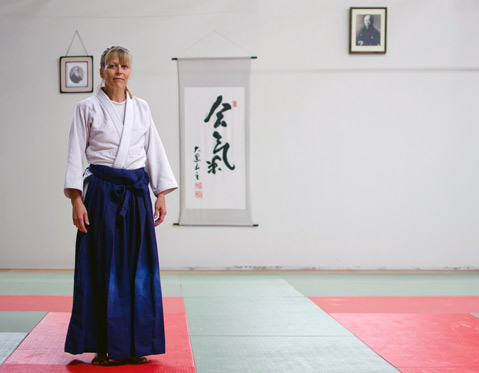
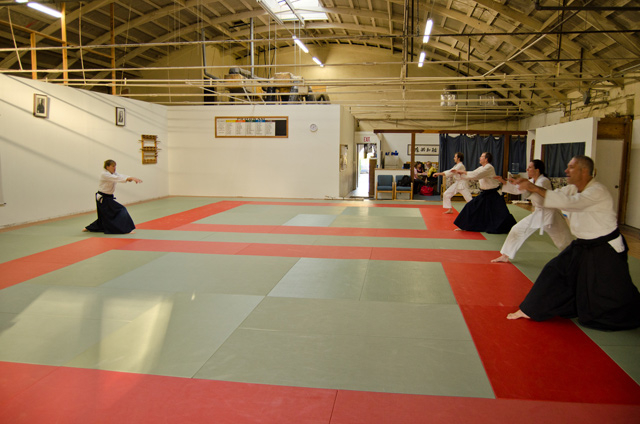
Lia Suzuki recently held a training session for the more advanced of her aikido pupils. They were mainly sturdy, middle-aged men, along with one woman, who was younger and smaller yet appeared equally solid and athletic. In dutiful silence, they stood along the base of the dojo’s grappling mat, hands loosely clasped together at the waist, waiting for their sensei — their teacher — to begin.
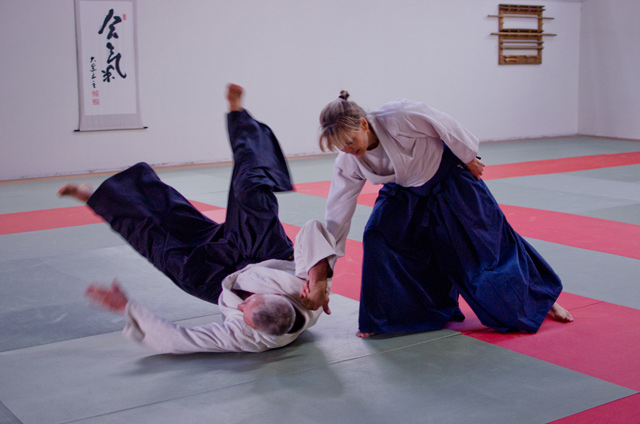
Suzuki led them in stretches and warm-ups, no explanations needed — they’ve done this before. (Some even have black belts, an honor received once the rank of first dan is attained, which usually requires five disciplined years of intense training. Suzuki has reached the sixth dan, and since starting to study aikido in 1982, her training hasn’t stopped.) Suzuki, finishing warm-ups, walked to center-mat, calmly kneeled, and pointed to one student. He’s been singled out, prompted to attack. Without a word, and without hesitation, he lunged for her. After deftly tossing him aside, the exercise continued for several minutes, with Suzuki taking on each student in rapid succession. The display of reflex and technique was impressive, and she hadn’t even begun to sweat.
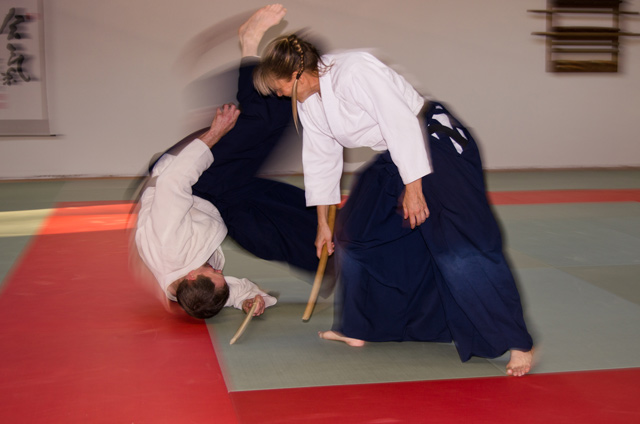
Aikido is unlike most combat arts. Punches, kicks, and other aggressive strikes are largely absent, while energy-redirecting throws, evasive maneuvers, and strategic joint-locks receive the most emphasis. In this combat style, hurting your adversary isn’t the goal. Rather, with aikido, the safety of your opponent is just as crucial as your own. This may seem impractical to some — many criticize aikido for its apparent disdain for simulating how real fights ensue — yet, for Suzuki, it is anything but: “If you want quick, easy, effective self-defense, then just buy a gun — because learning martial arts is not easy.”
Roughly translating to “the way of harmonious spirit,” aikido seeks — above all — the peaceful resolution of conflict, and not with just physical confrontations but also those stemming from inside one’s own mind and spirit.
As a child, Suzuki already knew she would aspire to be a practitioner of martial arts. In 1987, at the request of her instructor William Gleason (who has published two books on aikido), Suzuki embarked to Japan to train under Yoshinobu Takeda Shihan, a man who is widely regarded as the greatest living aikido master.
“He was like some great Olympic runner mixed with the artistry of Picasso,” Suzuki said. With such a worthy opportunity, Suzuki had “no problem” heading to Japan “with only a thousand bucks and a backpack.” For nine years she remained there, in Kamakura, training in one of the city’s oldest shrines.
When she left Japan, Suzuki had been deeply affected by its refined cultural heritage and traditions. She speaks Japanese fluently and incorporates many of the customs she learned in Japan in her own dojo. In fact, the particular form of aikido she teaches — called Aikido Kenkyukai — exists as part of a broader organization, with dojos in several countries. The only U.S. dojos (in Santa Barbara and Goleta, as well as in Pennsylvania) were all started by Suzuki, and she’s already planned the opening of another one in Los Angeles.
Nonprofit Dojo
After pulling into the parking lot of her dojo, Suzuki stepped out of her aging car, its black paint fading and chipping off. “Can you tell I work for a nonprofit?” she asked. Initially a commercial enterprise, her Santa Barbara dojo officially converted to a nonprofit organization about four years ago in response to the economic downturn. It’s been doing well since and garners a much more genuine community dynamic between Suzuki and her students. “I don’t like seeing them as customers paying for my livelihood,” she said. “I want to keep our standard of teaching professional without actually being ‘professional.’”
Suzuki is a bit taller than the average woman, has blond hair, blue eyes, and looks as if she’d feel more at home in a wetsuit surfing along Santa Barbara’s coast. She speaks thoughtfully and is very generous (this reporter was pleased to have been given a free beginner’s introduction to aikido). Most pleasing, though, was to hear how she understood the nature of her own practice.
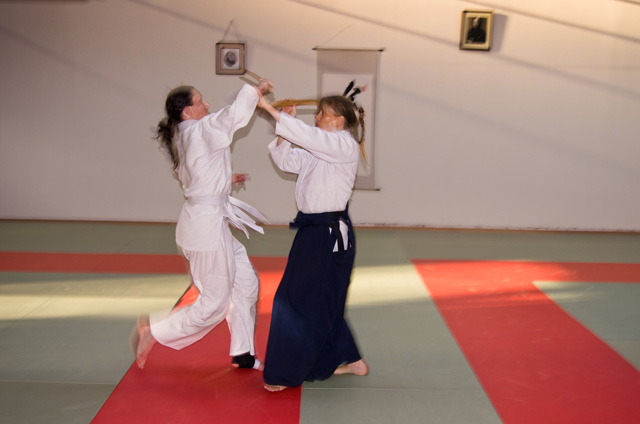
“I look to the classical musicians — Bach, Mozart, Chopin,” she said. “They were able to create masterpieces but only after first mastering the techniques, the rhythms, movements, and tempos. Much the same is true of martial arts. In the beginning stages, for about five years, you strictly emulate your master, learning everything you can. Then you’re free to create, to develop your own aikido.”
As she sat at her desk, Suzuki said, “One wise saying that’s guided me in my teaching goes something like this: ‘The young man knows the rules; the old man knows the exceptions.’”
The Dalai Lama couldn’t have said it better himself.