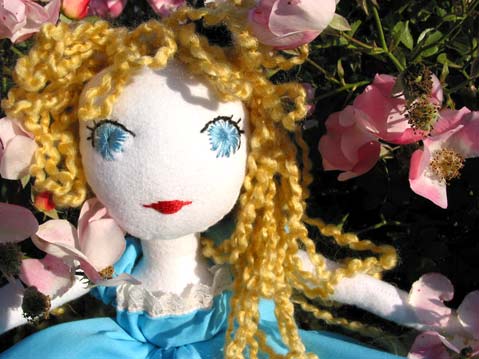
Curiouser and Curiouser
N is for Neuroscience
Runway Model Rats' Drug Lust
Nicole de Ayora approaches Professor Aaron Ettenberg with a few questions about neuroscience, and following a minor tiff over protocol, the two have a lovely emailed conversation about the drug habits of runway model rats. Read story.
M is for Marijuana
Carla Amurao quizzes Rich Powell, a UCSB lecturer on the biological action of psychoactive recreational drugs. Read story.
L Is for Lesbian
Carla Amurao interviewed not one but two professors on the subject. A lively discussion follows with Leila Rupp and Verta Taylor, who were hired by UCSB as a couple and who chair UCSB's Women's Studies and Sociology Departments, respectively. Read story.
K Is for Kabbalah
In this amusing face-to-face interview with Rachel Wilkinson, religious studies professor Richard D. Hecht compares Kabbala the ancient Jewish mystical tradition with Kabbalah the spiritual trend popularized by Madonna (the Hollywood celebrity, not Jesus's mom). Read story.
J Is for Jealousy
Davis Buss is one of the leading lights of evolutionary psychology, a controversial discipline holding that human psychology was designed via natural selection to solve problems faced by ancestors who lived in hunter-gatherer societies way back home in the Pleistocene epoch. Read story.
I is for Investing
Rajnish Mehra, a Professor of Finance in UCSB’s Department of Economics, tries to explain the stock market to Martha Sadler. Read story.
H Is for Horticulture
This week's brilliant scholar is environmental horticulturalist Jan Scheinle, maven of Santa Barbara Community College's Lifescape garden, that latter-day Eden where hundreds of edible ornamentals bloom and fruit. In this exchange of emails, she and Martha Sadler discuss the importance (or not) of soil amendments, and the advisability (or not) of peeing on plants. Read story.
G is for Genome
Professor Eduardo Orias, who has mapped its genome, discusses the seven genders of the tiny predatory protozoan known as Tetrahymena, the possibility of creating giant unicellular organisms, our potential immortality, and other scenarios. Are they science, or science fiction? Judge for yourself when you read this week's installment of plain talk with brilliant scholars. Read story.
F is for Feminism
Martha Sadler discusses the subject with UCSB's Dr. Jacquiline Bobo, author of Black Women Film and Video Artists, Black Feminist Cultural Criticism, and Black Women as Cultural Readers. And if anyone should be able to explain the intersection of race and femininity in Amercian visual media, it's Dr. Bobo. Read story.
E Is for Energy
The Indepedent's consumate reporter attempts to answer such questions as "Where does energy come from?" and "Why is the sky blue?" The answers might surprise you, especially if weren't paying enough attention in physics class. Read story.
D is for Dream
For this week’s Curioser and Curioser, Martha Sadler sat down for a chat with Stephen Aizenstat, the founder and president of Pacifica Graduate Institute, a co-founder of Earth Day, and an internationally respected expert on dreams. Read story.
C is for Corporation
This week, Martha Sadler quizzed UCSB’s Professor Charles Kolstad on the topic of corporate responsibility. “This is a big area of discussion,” he told her, “particularly within environmental circles.” He proved concise but insightful. Read story.
B is for Biology
For this edition of Curioser and Curioser, Martha Sadler sent questions via email to UCSB professor Alice Aldredge, who is the chair of the Depatment of Ecology, Evolution, and Marine Biology and teaches the animal kingdom portion of the university's introductory biology series. Read story.
A is for Astronomy
Welcome to Curioser and Curioser: Plain Talk with Brilliant Scholars, yet another new weekly online feature for Independent.com. Each Wednesday in this space, you can find interviews with noted scholars on topics ranging from science to society, arts to arithmetic. We’ll be going through the alphabet for the next six months, starting with this week’s “A is for Astronomy.” So read on, and let us know what questions and topics you’d like us to cover. Read story.
Previous Month