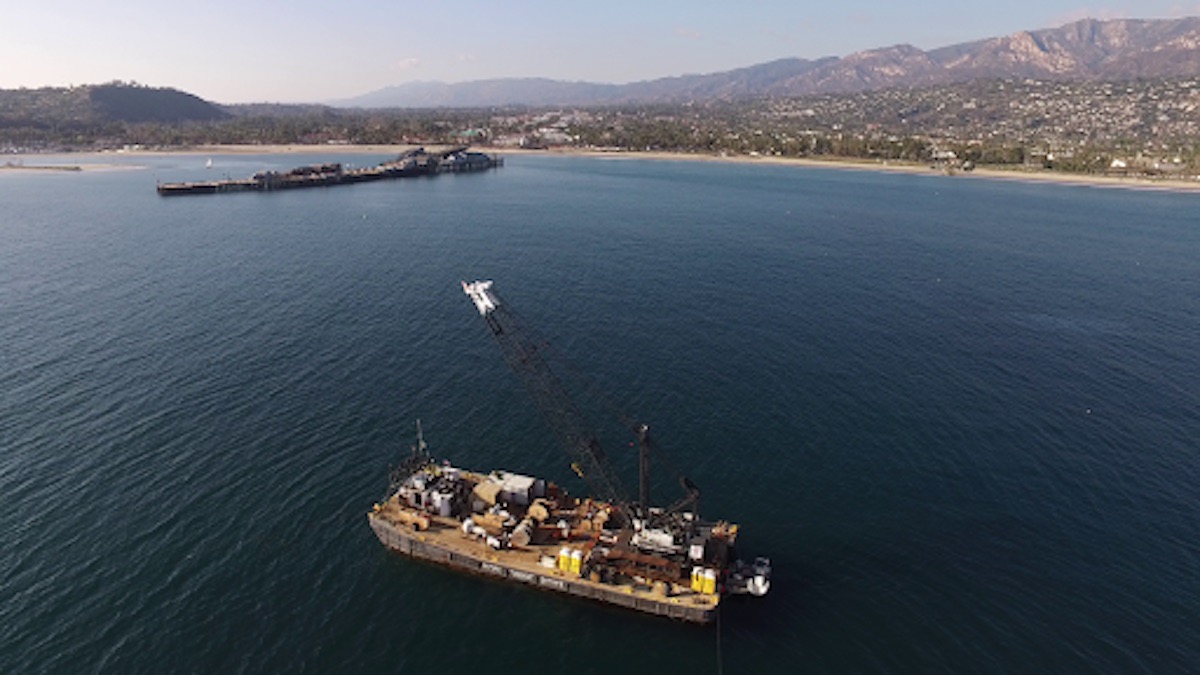
Santa Barbara beachgoers have recently taken note of a new, 270-foot barge along the coastline.
Named Ocean Protector, the giant vessel is taking up temporary residence near Stearns Wharf to complete necessary repairs for Santa Barbara’s desalination plant. Over four weeks, it will reinforce the intake pumps that deliver water from the ocean to the plant onshore.
According to the City of Santa Barbara, crews will be placing 450 tons of protective rock around the pump platforms, “making them more resilient to strong currents caused by storms and tidal changes.” The design is expected to last 50 years and will cost the city a little more than $5 million.
As the work is completed, the barge is housing all associated staff, equipment, and materials. Construction is taking place daily from 7 a.m. to 5:30 p.m., seven days a week, through late November, the city said.
One of the pump platforms, situated half a mile from shore in about 35 feet of water, has become “partially suspended” about 18 inches above the seafloor due to strong ocean currents, the city noted, leaving a risky amount of space beneath it without the necessary supports to protect it from damage.
While temporary measures were implemented to stabilize the structure, the city says that “long term reinforcement” is necessary to prevent the pump from potentially moving or collapsing.
“The project will implement a permanent repair by removing the temporary measures, filling the void space, and placing large rocks around the perimeter of both structures to help prevent future scour,” the city said in its announcement.
The pumps were supposed to have this rock armoring when they were originally built in 1991 to protect their sandy foundation, but for reasons unknown, it was never installed.
The city realized this when upgrading the platforms in 2016 with new pumps and screening systems during the desalination plant’s reactivation. Before its reactivation in 2017, the plant had been on “standby mode,” but has since been an important addition to the city’s water supply portfolio. It produces three million gallons of drinking water per day, meeting the needs of 30,000 city residents.
“This project helps ensure that the desal plant’s infrastructure can withstand threats from natural disasters such as major storms and sea level rise,” said Joshua Haggmark, Department of Water Resources director. “Our City has developed the most diverse water supply portfolio in the state and continues to make smart and innovative investments to ensure our infrastructure continues to provide reliable water service.”
City staff obtained a $4.1 million grant from the Federal Emergency Management Agency in 2020 to fund the work. The remaining $1.8 million in costs are being covered by a combination of city water rate revenue and the sale of water to the Montecito Water District.