
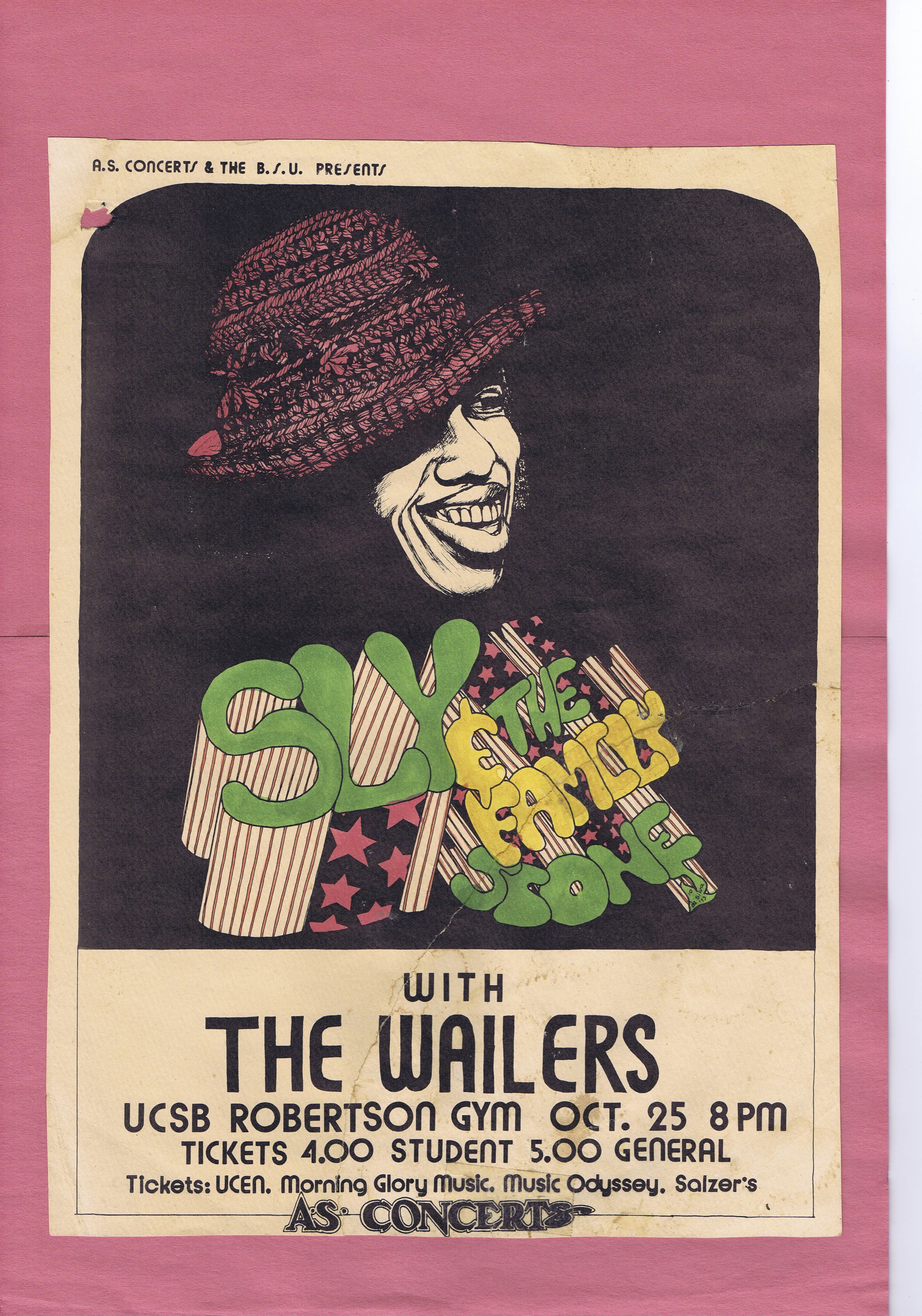
Sly & The Family Stone got the coveted call to be featured performers on The Ed Sullivan Show in December 1968. Following Sly’s invocation, “Don’t hate the Black, don’t hate the White / If you get bit, just hate the bite,” the band stormed through a torrid medley of hits. At the climax, Sly signed off, saying: “Thank you for letting us be ourselves!” Sullivan called Sly over for a final on-camera handshake, his signature stamp of approval. San Francisco’s adopted son had finally arrived.
Of the paradigm-shifting legends who’ve made recent transitions, the epitaph following the death of Sly Stone, born Sylvester Stewart, is inarguably the most elusive and perplexing. One of the undisputed vanguard and influential music creators in the late 20th century, Stone left a brilliant, frightening, messy Gordian knot of a life that remains largely undeciphered. What is unmistakable is the unparalleled genius behind dozens of hits and more than 100 official releases that near-singlehandedly recalibrated the globe’s ear for popular music.
“Everything changed after Sly & The Family Stone,” said Vernon Reid, guitar virtuoso and founder of the band Living Colour. “In terms of impact and the kind of shift they created, there isn’t a greater American band.”
Once a child prodigy and major figure in the Bay Area scene, Stone broke new ground and shattered barriers, both musical and cultural, on so many levels in such a short time that it’s easy to take for granted. At their height, he and his revolutionary band posted 10 Top 40 hits, including three number-ones that crossed Top 40, urban, and rock radio formats. They were among the most formidable live acts in the business, their zenith coming at the legendary Woodstock festival in 1969. Carlos Santana said in a 2019 New York Times article, “There were only three bands I recollect that were putting it all on the line. You’re playing like Buddy Rich or Miles Davis — you’re playing for your life. Sly & The Family Stone for me is No. 1. Jimi Hendrix is No. 2. Everybody else has to fight with us [Santana] for No. 3.”
Less stated is the radical influence the band had on the sound, look, feel, and message of popular music. One of the first self-contained, multi-gender, interracial, genre-fluid bands to ever top the charts, their impact coursed over 60 years: The term “funk” as a formal genre didn’t exist until the music industry excised Black artists from rock ’n’ roll spaces and made Sly its poster boy; the group’s flamboyant streetwear set a new standard for rock fashion; Motown moved from its anodyne polish-and-sheen perch to an earthier, more socially attuned sound; bandleaders such as Miles Davis, Prince, and Herbie Hancock lifted heavily from the Family Stone template; doors opened for white bands steeped in funk, jazz, and soul such as Blood Sweat & Tears, Tower of Power, and Chicago; an avalanche of bands built off Sly’s polyglot sound — Earth, Wind & Fire, The Ohio Players, Parliament-Funkadelic; and as hip-hop emerged, The Family Stone’s tracks were foundational beats and breaks.
Sly’s triumphs, peaked more than 50 years ago, have since been obscured by a widely documented hellscape of drugs, wild extravagances, label disputes, haphazard live appearances, the dissolution of the band and Sly’s inner circle, uninspired music, jail stints, public withdrawal, the loss of his massive fortune, and declining health from years of self-abuse. Questlove, who has emerged as a “Sly Whisperer” of sorts, explained in Rolling Stone, “Sly faced the pressure of living up to [others’] expectations, creating a constant conflict between his creativity and the anxiety of being in the spotlight.”
Despite his decline, there’s never been any loss of interest in Sly — an obsession remains in reconciling his early brilliance with the reality of a deeply troubled man. Perhaps there will never be a true “knowing” of Sly Stone. There are only dissected, often misaligned sketches of a mastermind at his best and worst: from outsiders, from Sly’s inner circle, and noncommittal self-critique from Sly. He had long lost interest in being “known” (at times, even to himself). But that came at the price of mislaying the key factors that made “Sly Stone” possible. In one interview he said, “I soon realized there was a downside [to fame], and the downside caused me to be very willing to get off the scene. You get further down than you realize — Jimi, Janis, and on and on. I’d look at the circumstances and realize I had to back off.”
The flaws of the man have largely outsized the authenticity of the genius, often in ways not applied to peers of similar stature who’ve committed considerably worse offense. Which is not to give Stone a pass. But considering his apex catalog and generational influence, he undeniably reshaped the landscape for everything that followed. This demands a much larger conversation — on Beatles, Stones, Dylan levels — about the things that Sly Stone got right, at least musically. Because, at his best, he got more right than nearly everyone around him.
If he didn’t, we wouldn’t still be talking about him.

