
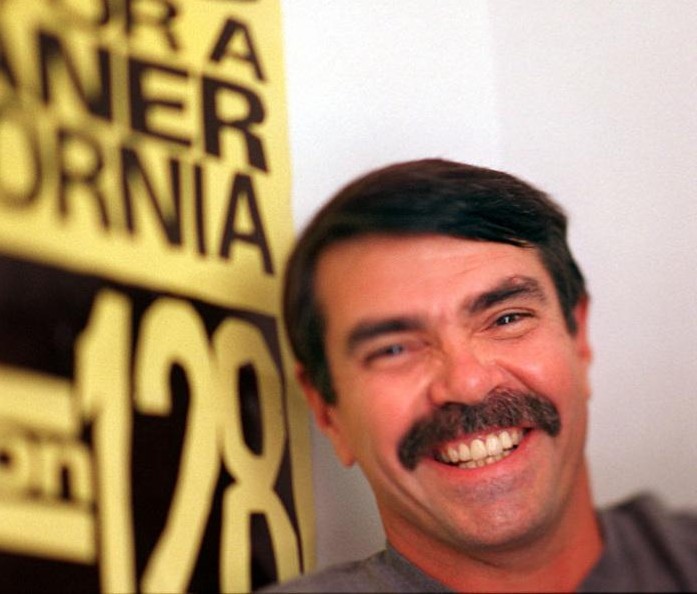
Ed Maschke, longtime Santa Barbara County environmental activist, political consultant, labor organizer, and elected official, passed away peacefully at his home in Lompoc on May 24. He is survived by daughters Gwenivere (1970), Jennifer (1973), and Aurora (1980); 10 grandchildren; one great-grandson; countless friends; and the thriving California solar energy industry he was instrumental in creating.
Interest in people and their ideas was the hallmark of Ed’s skill as an organizer. He saw every conversation as an opportunity to expand his own network or bring others together to build a larger movement. Whether in time, money, or advice, Ed was always very generous. For him, political organizing in defense of the natural world was a mythic struggle of light against darkness. If you were on his side, there was always a place to stay in his home, a shared meal, or an adventure.
He also had a commitment to confronting enemies that burned almost as brightly. For those who would plunder that which cannot be replaced, there would be no mercy. Ed took great joy in lifting up the worthy, but he got just as much pleasure from taking down rapacious land developers, unscrupulous politicians, and oil industry PR flacks. Upon receiving word of his passing, the Santa Barbara Independent’s Nick Welsh perfectly captured this duality, describing Ed as “gleefully pugilistic.”
Born in and raised near Cleveland, Ohio, Ed was the second son of Edward J. and Ellen Manning Maschke. After high school, Ed joined the Navy and was posted to Central California to work on avionics for jets that were flying bombing missions in Vietnam. His views on the war changed when he saw footage of the bombs being dropped on straw huts in rural villages.
After the Navy, Ed attended College of the Sequoias in Visalia, where he became a campus activist and met Jo Ann Pectol. They married in March 1970 and moved to Isla Vista. Ed entered the UC Santa Barbara Environmental Studies program and again threw himself into political activism.
Ed became known for his analytical acumen and organizing skills. He helped elect environmental stalwart County Supervisor Bill Wallace four times from 1976 to 1992 and managed campaigns for slow-growth candidates to the Goleta Water Board. Ed then sat on the Water Board from 1977 to 1985. Subsequently, Ed served as 3rd District Planning Commissioner for eight years.
On the day in 1976 when Ed accidentally burned Governor Jerry Brown’s hand during a demonstration of a primitive solar oven, solar and wind electrical generation was the real objective. That was the year the lobbying group SUNRAE (Solar Use Now for Resources and Employment) was created by Ed and fellow activist Alan Mirviss.
A year later, Governor Brown signed AB 1558, carried by Assemblymember Gary Hart for SUNRAE and a small group that Brown called “solar guerrillas.” The law provided homeowners and businesses with a tax credit covering 55 percent of the cost of new solar installations. President Jimmy Carter later signed a federal version of the California tax credit and installed solar on the White House.
In the fall of 1993, Ed joined the California Public Interest Research Group (CalPIRG) as the statewide executive director, where he led efforts to push the California Air Resources Board to adopt regulations promoting electric vehicles, some dozen years before they became commonplace. In the late ’90s, Ed worked with SEIU (Service Employees International Union) in organizing, advising in labor relations, training new staff, and mentoring them for the future.
Ed wasn’t all politics, causes, and campaigning. His eclectic interests included rocks, astronomy, painting, coin collecting, and U.S. history. He truly loved the outdoors. His activities included hiking, camping, wandering around the desert, running, cycling, and skiing. He was especially fond of water — swimming, kayaking, scuba, and snorkeling.
After a serious skiing injury in 1994, which left him a paraplegic, Ed didn’t slow down. He continued to travel, making many trips to his beloved desert, to Mexico, and to the East Coast and the Central Valley to see family. Sometimes, these were solo activities, but they were often done with lovers and friends.
Ed enjoyed cooking, a skill he learned from his mother when he was 13; barbecuing; and tending to his fruit trees. His skill at playing poker and blackjack matched those of the campaign trail. One friend stated that “Ed was the kind of good friend who would laugh and snarl while emptying your wallet at the poker table.”
From his start managing the Isla Vista recycling center through a five-decade career in politics and lawmaking, Ed Maschke brought unmatched vision, tenacity, and integrity to his fight for economic justice and a cleaner environment. In all his work, Ed’s core philosophy was to leave this earth in a little better condition than he found it. His many friends are better people and the world is a better place because of him.

