
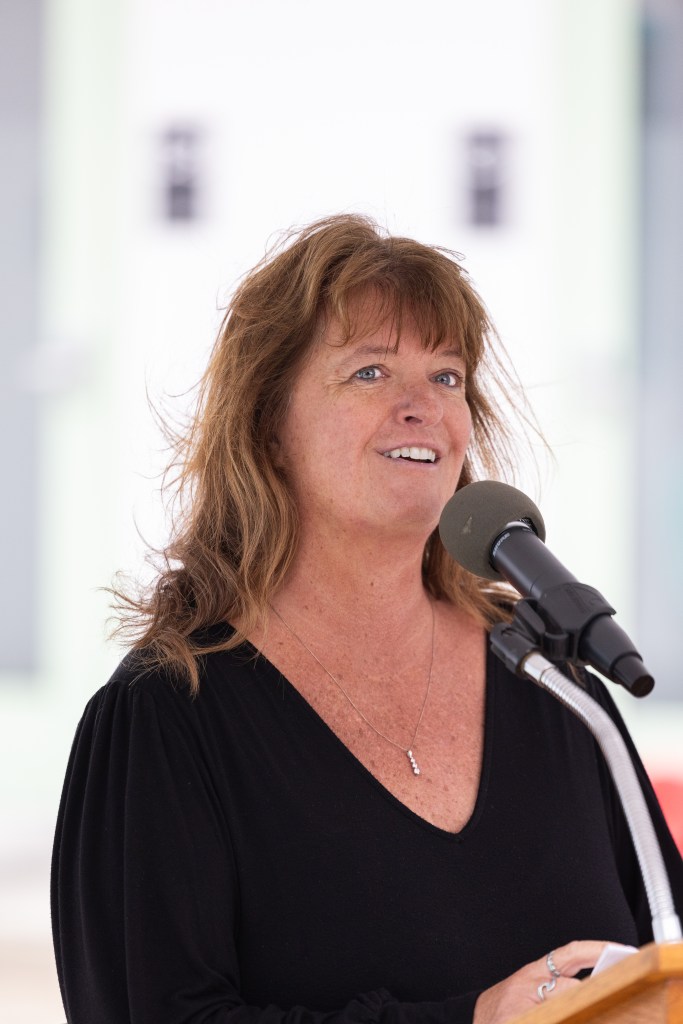
Sylvia Barnard with Her Tiny Homes
and Magical Kitchen Saves Lives
Good Samaritan Is an Organization
That Actually Helps People
By Nick Welsh | Photos by Ingrid Bostrom
October 9, 2025
The first time I met Sylvia Barnard — chief cook and bottle washer for the Good Samaritan homeless shelter enterprise — it was at Hedges House of Hope, a former sorority house in Isla Vista that she had magically transformed into a sanctuary for people living on the street.
At that time, COVID was in its full epidemiological fury, UCSB was closed to students, and Isla’s Vista’s parks had been taken over by tents, cardboard lean-tos, shopping carts, sleeping bags, old bicycles, trash, and other signs of life common to homeless encampments.
Drugs were rampant and overdoses common. Emergency workers found it all but impossible to even locate the ill and dying, let alone to haul them out on stretchers. Sexual assaults were reportedly commonplace. And the obvious risk of fire under such perilous conditions had the county fire marshal pulling his hair out.
At that time, an iron-clad law prevented police from rousting a homeless person from public spaces unless another shelter could be found. None existed. Also, public health officials, struggling with the rapid spread of COVID, hoped that, despite the many problems in the Isla Vista encampment, it would nevertheless offer a chance to contain the disease. In that moment, containment was everything.
Sylvia Arrives
Into this mess parachuted Sylvia Barnard and Good Samaritan, the Santa Maria shelter organization she’d been running since she was 25 years old. The plan was to erect a small village of prefab plastic tiny homes the color of cold suet and plop them down on the Isla Vista Community Services District parking lot, even though they had to sign a strict lease that would force them out in six months.
Naturally, there was opposition. The strongest voice against the plan that eventually emerged was Father Jon Hedges of St. Athanasius Orthodox Church in Isla Vista, a revered religious leader whose ministry to the homeless population was the stuff of legend. His opposition spelled the kiss of death.
Then Sylvia — as she is more commonly known — met with Father Jon. They had the usual frank exchange of views. Hedges, a man of definite religious beliefs, was set in his opinion. Sylvia, also animated by strong spiritual beliefs and every bit as stubborn, played her trump card. She asked Fr. Jon to “pray on it,” and she would do the same.
The next day, Hedges called Barnard. He’d changed his mind. He was all on board.
The rest, as they say, is history.
That history, however, is little known. Today, four years later, Good Samaritan boasts 1,000 beds, 84 programs, and 40 locations (mostly in Santa Barbara, some in San Luis Obispo). It serves 5,000 homeless people a year by offering outreach, detox, rehab, mental healthcare, not to mention shelter, housing support, and whatever else it takes to get people back on their feet.
In Santa Barbara County, Good Sam runs three tiny home villages for the Bay area philanthropy DignityMoves, as well as Goleta’s Buena Tierra housing at a former Super 8 hotel, and the county’s sobering center. It also manages all the winter warming centers when the weather turns wet and cold. It’s not an exaggeration to say Good Sam — a private nonprofit — has morphed into an informal, but essential, branch of county government.
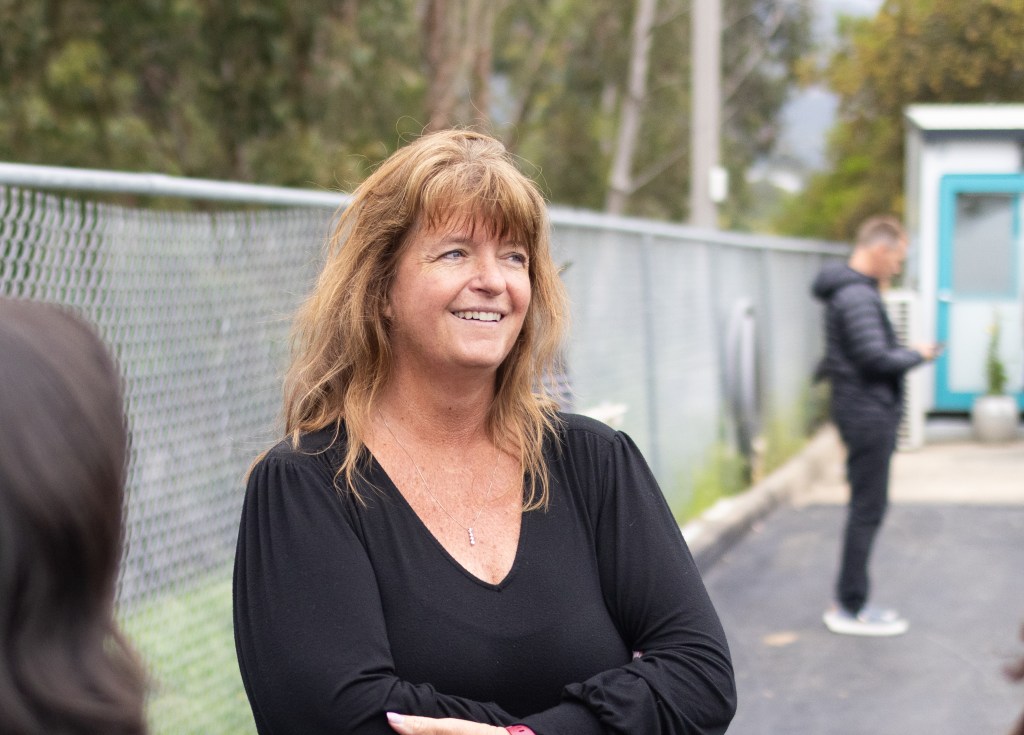
Sylvia’s Journey
Sylvia Barnard, now in her early 50s, became pregnant right after high school and soon found herself on her own. For three hard years, she struggled to learn first-hand how to navigate the bureaucratic complexities of Santa Barbara County’s welfare system. Despite those challenges, she attended City College and UCSB, where she even reported for the campus newspaper, The Daily Nexus, sometimes with her baby daughter in tow. During that time, she also produced a how-to manual and video, “One Mother to Another,” explaining how the safety net worked.
That project helped her land a job as a grant writer for what was then a small, desperately struggling homeless shelter in Santa Maria. In this chaotic context, Barnard got offered the top job. Her appointment as director was not universally applauded. One shelter employee, she remembers, tried to run her over in the shelter parking lot.
Welcome to Good Samaritan.
Good Sam Empowered
All this, and more, will be celebrated next Thursday evening, October 16, during a fundraising benefit for Good Samaritan at the Lobero Theatre. The event features the premiere of the short film Hope Lives Here, which is hosted by Monecito resident Meg Ryan and is about Good Samaritan’s work, and it is intended to help expand Good Samaritan’s surprisingly limited public profile and further boost the organization’s already astonishing prowess as a fundraising juggernaut.
After the screening, Barnard will be interviewed on stage by actor — and recent arrival to Santa Barbara — Duane Henry, perhaps best known for his role in the TV show NCIS. Henry remembers a period where he had to squat on friends’ living room couches and lived — for a spell — in U-Haul storage vans.
Maybe Henry will ask Barnard about growing up the daughter of an oil company executive who was stationed in Venezuela, Nigeria, and Indonesia. Maybe he will ask Barnard about how she — as a very young child in Nigeria — witnessed a political assassination right in front of her eyes and how she was held hostage with her schoolmates by men wielding machine guns.
Maybe Henry will also ask why Barnard thinks there’s been such a spike in the percentage of chronically homeless people. For years, it was 10 percent of the homeless population, but now she says it is 50 percent.
Or about the increase in severity Barnard’s seeing in the mental health and addiction problems of people on the streets. And lastly, why is it that, no matter how many people get off the streets and into housing, there are always more people without homes?
She might want to take the opportunity to mention the impact she sees from Trump’s edict to deny homeless services to people without proof of citizenship. Thirty percent of the people recently cleared out of encampments in the Santa Ynez River, she noted, were undocumented farm laborers who work in local fields for local growers.
Mostly, I’m guessing, he might ask why someone so graced with such evident entrepreneurial chops, improvisational ingenuity, and get-shit-done follow through isn’t making big bucks running a Fortune 500 company.
Team Good Sam
Barnard is quick to praise the strength of Good Sam’s administrative leadership team, many of whom have been working with her for years. Their skills and commitment, she says, enabled the nonprofit to jump from a staff of 100 before COVID to 400 today. But really, she says, it’s about the mission: “Every homeless person is somebody’s somebody. They deserve to be able to get back. If we can offer up a piece of that journey, that’s what we’re here to do.”
To that end, Barnard estimates, Good Sam has served 70,000 individuals over the years, raising something in the ballpark of $350 million to do so. Of course, Good Sam is hardly the only game in town: there’s also New Beginnings, United Way, AmeriCorps, City Net, and PATH to name a few. But PATH is now in the process of selling its 200-bed Cacique Street homeless shelter to the city of Santa Barbara later this year. And it’s all but certain Good Sam will get that management contract. When it comes to sheer size, breadth, and integration of services — nobody else comes close, not even the County of Santa Barbara.
Good Sam Rules
Then there’s the quiet efficiency of the operation. Barnard stresses that shelters have to be safe for both residents and workers. There’s a striking dearth of ambient melodrama clouding Good Sam locations.
Rules are enforced. Crowds do not congregate at entrances. Random drug tests are administered. People who flunk get bounced. But people are allowed back if and when they check into one of Good Sam’s sober centers. “Sometimes recovery takes a couple times,” Barnard said. “Sometimes a few dozen.”
Sylvia’s Kitchen
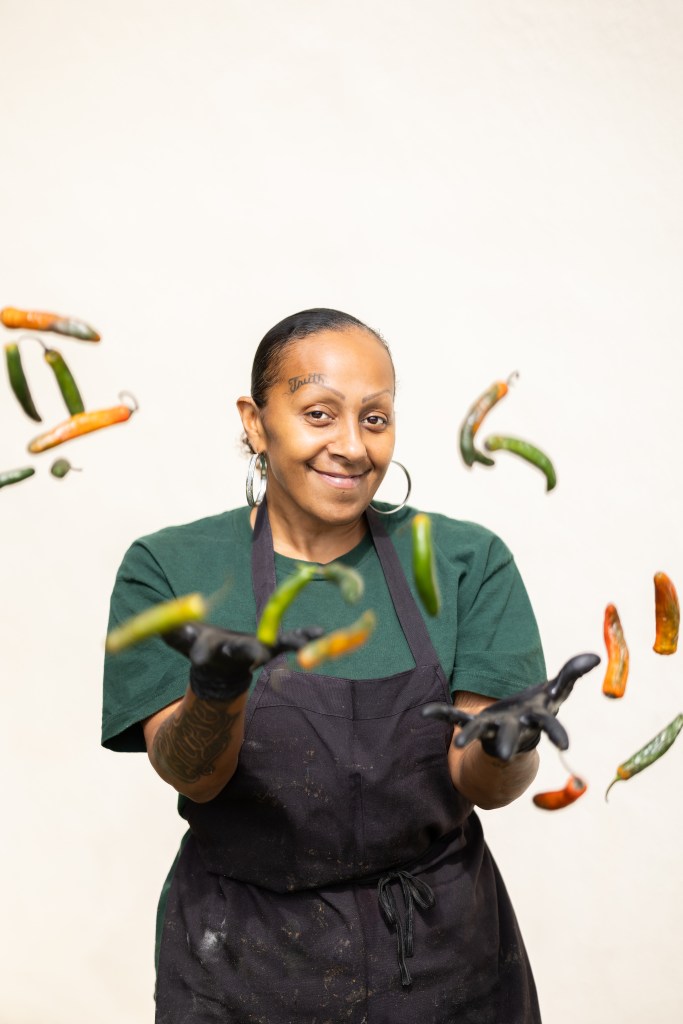
On Thursday, October 16, the people preparing and catering the evening’s hors d’oeuvres will be served by graduates of the Good Samaritan’s culinary arts training program run out of Hedges House in Isla Vista. Among them will be a preternaturally exuberant, much tattooed, 47-year-old survivor from Carpinteria named Truth. Born Shareese Leona Hardeman, she legally changed her name to Truth, as an anagram for “To Rule Under the Highest”
She and her husband had led a breakneck journey of homelessness and methamphetamine addiction that took them to death’s door multiple times. When they were camped out by the Carrillo Street Freeway offramp some time ago, they occasionally visited the Father Virgil Cordero Day Center. There they learned about the Santa Barbara Rescue Mission, where they eventually entered that program and got sober.
Truth was eventually referred to the Hedges House in Isla Vista where she encountered its culinary program. Though she knew nothing about Good Samaritan, the minute she entered its kitchen, it was love at first sight. “I love that kitchen,” Truth said. “I love feeding people. I know what it feels like to starve.”
Truth completed the six-to-eight-week program and recently landed a full-time job for the Westside Boys and Girls Club, but she continues to volunteer at the kitchen seven days a week. “I made it,” she said. “I got my glow on. I am real. Truth is real. When I cry now, I cry tears of joy.”
Farm to Table
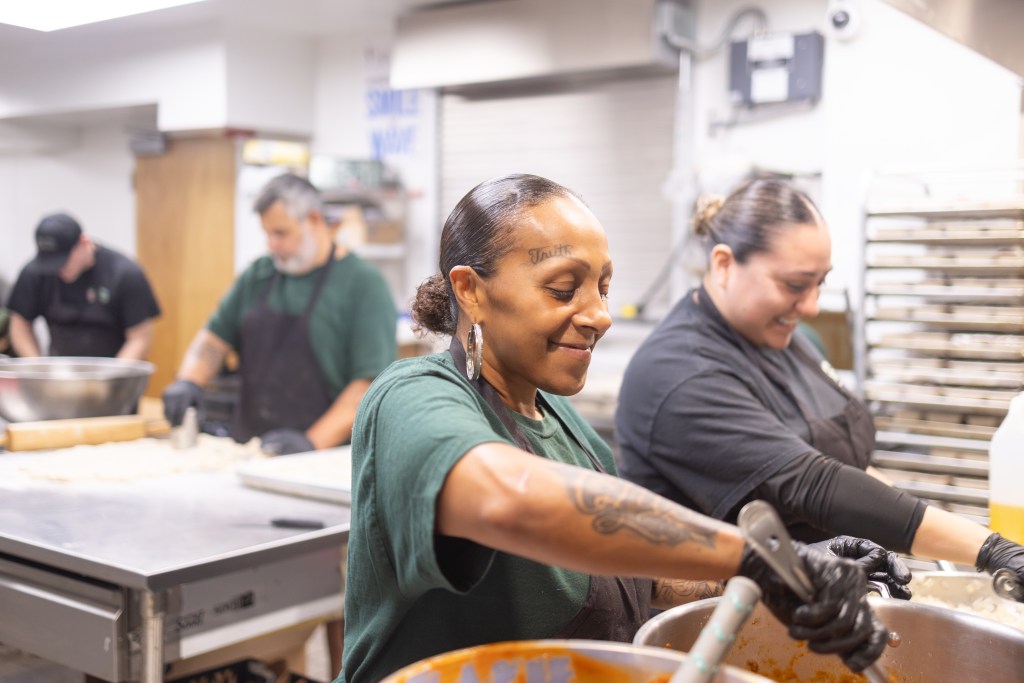
Truth is just one of many to work with the program’s guru, Don Hardin, at his magical kitchen. A well-known Santa Barbara chef and baker, Hardin retired a few years ago from a long career of directing the culinary arts programs at Santa Barbara High School and the city’s Parks and Rec department. Not long after, he began overseeing the Good Sam project at Hedges House in Isla Vista. There, he teaches and works with homeless residents preparing 800 meals a week that feed the residents at all Good Sam’s South Coast operations. Most of the produce served at these meals — broccoli, kale, cauliflower, beets, and cabbage — is harvested from a small, 3.5-acre farm adjacent to the Good Sam BridgeHouse homeless shelter in Lompoc.
Barnard rented the land from Santa Barbara County and recruited Jeff Hendrickson, a farmer with 31 years of experience working farms around the Lompoc area. Clearing the land was an ordeal, as it was choked with weeds, but now it has an orchard with 352 fruit trees, tons of winter vegetable, and 70 chickens and 15 ducks.
Part of Hendrickson’s job is to teach cultivation and irrigation skills to shelter residents inclined to try. It’s similar to how Hardin teaches homeless students the rudiments of kitchen prep and cooking. Usually, the two programs each have 4-5 students at any given time.
Before working at the Good Sam farm, Hendrickson’s experience with many of the people who hung out in the riverbed had been “not positive.” He described how they’d come onto the property he previously farmed and poach his crops. All kinds of illegal things, he said, took place down on that riverbed. Now, he sees these people who had once been homeless working with him 16 hours a week in exchange for a $50 voucher, And it’s his favorite part of the job. His experience, Hendrickson said, “is one of those things you didn’t know you had in you.”
Unlike most BridgeHouse residents who are required to leave in the morning, those who sign up for the farming are allowed to stay all day. For people trying to wean themselves from addiction, having a place to be and something to do can be powerfully therapeutic. “Before, I looked at these people as lazy drug addicts,” Hendrickson said. “Now I see people who took a couple a bad bumps and couldn’t get back up. They’re part of the family.”
“I love that kitchen,” Truth said.
“I love feeding people. I know what it feels like to starve.”
Sylvia’s Dream
The key pivot point in all these programs began at Hedges House of Hope. Barnard named the place after the priest who originally had fought against her idea of tiny homes in Isla Vista, but who died before any of these projects could be fully realized.
But Sylvia Barnard had imagined all this even before the ink was dry on the Hedges deed. It was her idea to move the prefab tiny homes when their six-month lease was up from IV to Lompoc. It was her idea to relocate people who had been moved from their IV encampments into the Good Sam shelter in Lompoc.
And it was her idea to make Hedges House a training hub for crews preparing food grown at a farm that had not yet been purchased, in a kitchen that had not yet been built. But of all this, what really makes Barnard grin, are the two Good Sam food trucks she plans to roll out later this year. The first one has already been funded, and delivery is soon expected. She’s still working on funding for the second.
That was her idea, too.
Barnard didn’t achieve any of this by herself. She had serious committed help from up and down the political food chain. State and federal dollars were made available. Today, all that financial support is gone. But not before Barnard’s vision came to fruition.
“That’s all Sylvia,” said farmer Jeff Hendrickson. “That’s her dream.”


You must be logged in to post a comment.