

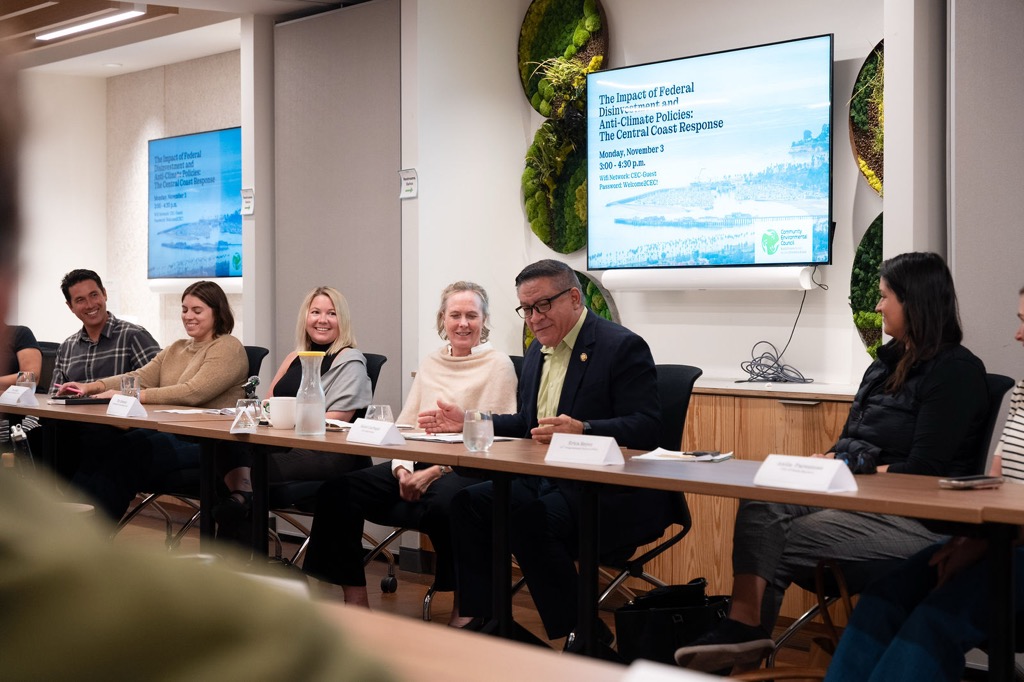
In downtown Santa Barbara, less than a block from where one of the first Earth Day festivals took place in 1970, we recently gathered environmental and community leaders around a single question: What happens when Washington, D.C. walks away? We were joined by environmental leaders, policymakers, researchers, city officials, youth leaders, and non-profit advocates. Some arrived carrying hope, others exhaustion, most both. All were there because they could feel something shifting — and not for the better.
Santa Barbara is known as the birthplace of the modern environmental movement. The 1969 oil spill ignited a national awakening, inspiring the creation of Earth Day and shaping the country’s environmental laws for generations. But the California Central Coast has also long been a stronghold of the oil industry. Today, 43 oil and gas companies operate in Ventura County and 25 in Santa Barbara County. In Ventura County alone, more than 8,000 residents live within 2,500 feet of an active oil well; roughly 60 percent are Latinx. This paradox – progress and pressure, innovation and extraction – has defined our history.
Now, the region finds itself at another turning point, and we are sounding the alarm — a canary in the coal mine for America’s climate future.
The Moment We’re In
Over the past year, abrupt federal rollbacks, rescinded or paused grants, and political pressure on climate programs have disrupted millions of dollars in local projects. Three of the Community Environmental Council’s federal grants – together worth more than $1.5 million – were terminated, halting progress on regenerative agriculture, clean transportation, and new green jobs for working families.
The loss of this funding doesn’t just hit CEC — it hits families across the Central Coast.
“This funding was directly invested in our low income and Spanish speaking communities, with a focus on helping lower the upfront cost of EV ownership for low-income households, creating clean-transportation jobs, and more. We’re losing an investment in affordability, equity, and access for our disadvantaged communities.” —Em Johnson, Director of Climate Programs, Community Environmental Council
Across the region, the cumulative impact climbs much higher.
“The City of Santa Barbara is literally having to choose which beaches can be protected from sea level rise.” —Alelia Parenteau, Sustainability & Resilience Director, City of Santa Barbara
But it isn’t just the loss of funding — it’s the instability and uncertainty created by abrupt policy reversals. University researchers told us about planning multi-year research projects only to have grants halted midstream. Local governments shared how paused contracts and shortened timelines make it nearly impossible to implement adaptation plans. Community groups noted that this policy whiplash disrupts their planning and operations, forcing them to prepare for one set of federal guidelines and then quickly adjust when they are abruptly rewritten.
“The Trump administration is moving us backward by decades, threatening to open the Pacific to new offshore drilling for the first time in forty years, exploiting our national forest, , and weakening the very safeguards that ensure public transparency and environmental protection.” —Maggie Hall, Deputy Chief Counsel, Environmental Defense Center
All of this is unfolding against a backdrop of rapidly accelerating climate impacts in a region facing nearly every major threat at once — heat, drought, wildfires, flooding, extreme storms, and sea-level rise.
What’s unfolding here is a preview of what communities across the country will face if federal climate commitments falter — places ready to act, but suddenly left without the resources to do so.
What We Heard
The listening session revealed four clear themes — challenges that can be felt nationally, and also the beginnings of a path forward.
Participants emphasized that resilience is increasingly built through collaboration. When federal support weakens, local partnerships strengthen. Cities, counties, universities, philanthropy, and nonprofits are stepping into roles once held by federal agencies.
“Each of these canceled or threatened projects is also an opportunity for deeper partnership. As researchers start thinking more locally, more about local problems and local solutions, there will be even more opportunities for collaboration with organizations in this community.” —Sarah E. Anderson, UCSB Bren School of Environmental Science & Management
A second theme was the need for steady, predictable funding. Climate action requires continuity. Leaders described the damaging effects of policy whiplash: grants rescinded, reinstated, paused, then quietly eliminated. Unpredictability itself has become a major barrier to progress.
Concerns about science, transparency, and the rise of green-hushing also came through strongly. Data is the backbone of climate policy. Yet many noted accelerating threats to that foundation: erased datasets, weakened reporting programs, and shortened public processes. At the same time, green-hushing is rising – the growing practice of organizations quietly continuing climate work but downplaying it publicly to avoid political targeting or controversy. When facts are buried and progress goes silent, communities lose trust, partners withdraw, and solutions stall.
Yet even amid these challenges, participants saw opportunity: new regional coalitions, innovative financing models, youth-led initiatives, expanded partnerships with university researchers, and a renewed commitment to local solutions resilient enough to withstand shifts in national politics.
Lessons From the Birthplace of Earth Day
More than 50 years after the oil spill that changed American history, the values born here – community, science, activism, and collective responsibility – still guide us. But the national landscape looks vastly different today. Public trust in federal climate leadership has been deeply shaken, and while federal policy has always shifted from administration to administration, there had been a throughline of protection that started in the early 1970s under Republican President Richard Nixon and continued for decades. The assault we’re experiencing now is unprecedented – and it risks setting us back 50 years.
And yet, the Central Coast continues to lead. What began here decades ago is still alive: an insistence that communities deserve clean air, resilient ecosystems, and a safe climate future — and that science must guide the way. The birthplace of the environmental movement has become a proving ground for its survival.
A Blueprint Forward
To move the country forward, we must take to heart the lessons from this region:
1. Build durable and innovative climate financing: Communities cannot build resilience on one-year grants. Federal commitments must outlast election cycles — and be complemented by bioregional funds, donor-advised fund activation, ecological credit markets, and public–private partnerships that reduce reliance on federal volatility.
2. Protect truth-in-climate infrastructure: Safeguard core federal datasets and ensure universities, nonprofits, and local governments can communicate science-based results without fear of retaliation.
3. Strengthen regional coalitions: A significant share of climate solutions must be implemented at the local and regional levels. The Central Coast offers a model for the nation: earlier this month, three dozen representatives from climate networks from Santa Cruz to Ventura convened to explore how to advance their work together.
4. Elevate community voice: Restore robust public processes, protect environmental justice tools, and ensure frontline communities remain at the center of climate action.
Fifty years after the first Earth Day, the Central Coast continues to lead – not because it is spared from climate impacts, but because it faces all of them. The canary in America’s climate coal mine is singing, not in fear, but as a call to act.
What began here once before can begin here again: a renewed era of climate leadership rooted in truth, community, and hope.

