

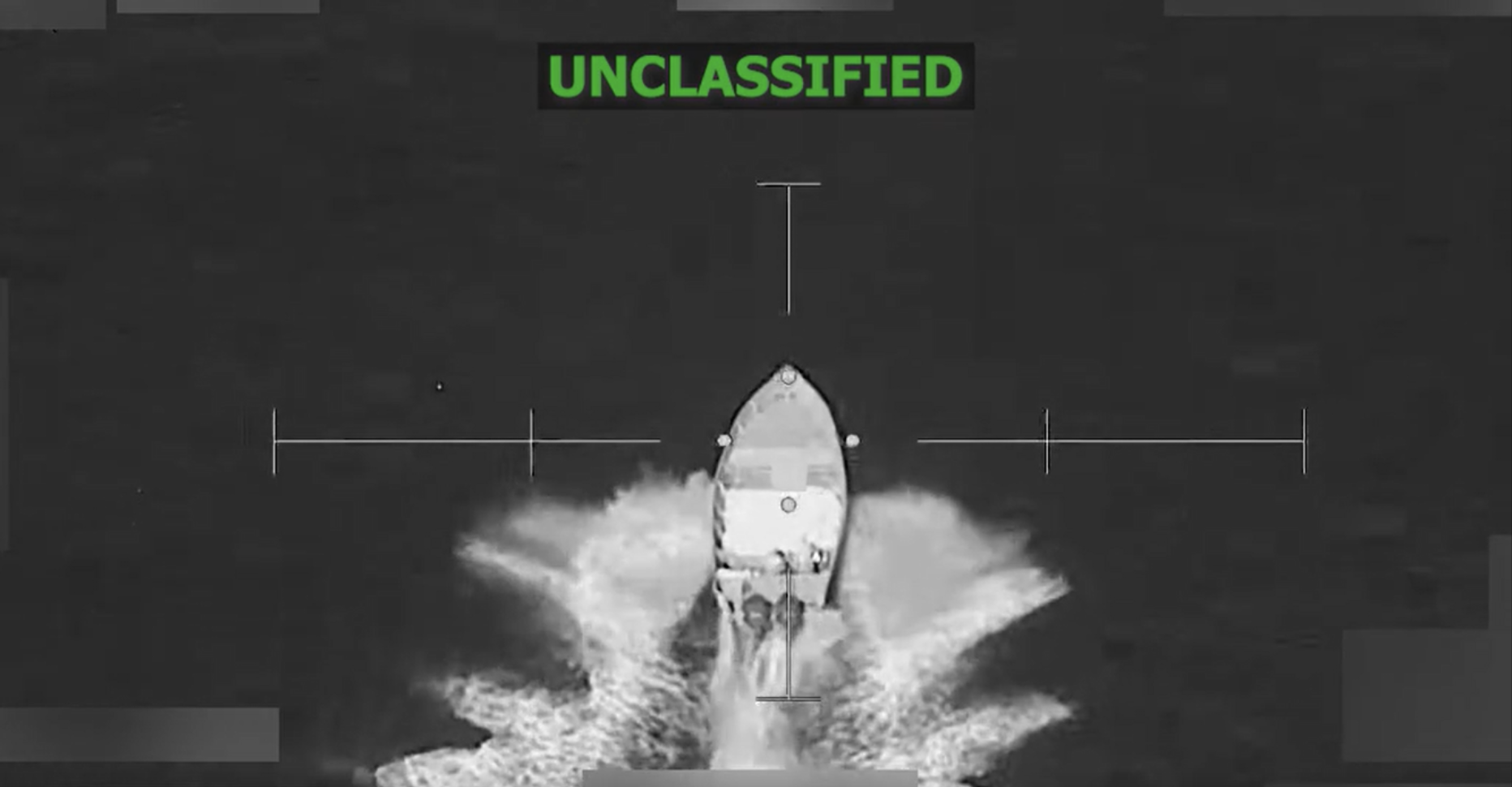
I spent 26 years in the United States Navy, including time in maritime interdiction operations; boarding vessels, counter-piracy, stopping smugglers, and enforcing U.S. and international law on the high seas. These missions are dangerous and complex, but maritime interdiction has always been a law-enforcement operation, not an act of war.
That is why the recent push to classify drug smuggling boats as “terrorist combatants” eligible for military destruction troubles me. Drug traffickers are criminals, but treating them as wartime targets crosses a line that has protected both human life and America’s legitimacy on the world’s oceans.
The United States already has all the legal authority it needs to interdict drug vessels. U.S. domestic and international maritime law empowers our forces to detect, stop, board, and seize vessels that are stateless or suspected of criminal activity. These frameworks, built over decades through painstaking diplomacy, have shut down smuggling routes, stopped the flow of weapons, terrorism financing, and contraband, and allowed us to operate far from home with the cooperation of other nations.
That cooperation depends on trust. It rests on the understanding that the United States is a responsible steward of maritime law, using force when necessary but preserving life whenever possible. When we begin treating drug boats as combatants to be destroyed on sight, we risk far more than the lives of the smugglers on board. We risk the international support that makes these operations possible. Other nations may limit cooperation or bilateral agreements, and a short-term show of force could inflict long-term damage on global interdiction efforts.
So why take this shortcut? Because maritime interdiction is difficult. It’s dangerous. It puts American servicemembers at risk. It is far easier to use aircraft to cover vast waters and press the “easy button.” But the easy button often conflicts with American values. In many cases, the individuals crewing these boats are not cartel leaders but poor, coerced people, including minors.
We should stop drug smugglers with the full force of our capabilities, but as criminals, not enemy combatants. That distinction is what keeps America credible.
None of this means the current approach is automatically unlawful. The President has the authority to conduct military operations for a limited time without explicit congressional approval. Since 2001, every president has relied on the post-9/11 Authorization for Use of Military Force to conduct strikes against groups they designated as terrorist organizations. The idea that this authority is unique to the current President is inaccurate.
The President has exercised his authority with clear intent, just as his predecessors did. If Congress agrees with the intent but disagrees with the execution, as I do, it is Congress’s responsibility to intervene, not to issue social-media videos asking the military to do it for them. Politicizing the armed forces by encouraging servicemembers to question lawful orders is irresponsible. The Constitution grants Congress, not the military, the authority to check executive overreach.
As someone who wants narcotics trafficking to end, I understand the urgency. Cartels are fueling a drug crisis that kills roughly 100,000 Americans every year. We should intercept these vessels, stop them at sea, seize their cargo, and when they violently resist interdiction, use deadly force.
Our congressmember, Salud Carbajal, co-sponsored legislation in 2023 calling on the Department of Defense to treat fentanyl trafficking as a national security threat and take more decisive action against narcotics networks. That standalone bill did not advance, though elements of its intent were later incorporated into the Fiscal Year 2024 National Defense Authorization Act.
At the same time, Congressmember Carbajal also supported the Biden administration’s broader open border and immigration posture, policies that coincided with a dramatic increase in fentanyl smuggling into the United States. It is difficult to reconcile calls for stronger counter-narcotics action with support for policies that weakened border security.
In 2025, President Trump acted aggressively to disrupt narcotics trafficking, tightening border enforcement and directing military action against groups designated as narco-terrorists. Whether one agrees with the tactics or not, this was an administration taking concrete action where Congress had limited itself to political rhetoric.
So why has Congressmember Carbajal responded with a symbolic War Powers resolution demand and public denunciations instead of engaging with the administration? If he believed in the intent of his 2023 bill, this moment should call for serious bipartisan collaboration to stop the flow of narcotics with clear legislation on executing it.
This is the difference between governing and messaging. The Central Coast deserves representation that prioritizes results over symbolism and security over politics.
Just as stopping narcotics trafficking is difficult, leadership is difficult. Authentic leadership means standing on principle, even when it requires crossing party lines. Senator John Fetterman represents a swing state and has demonstrated that integrity sometimes means defying his own party. Congressmember Carbajal, by contrast, represents a safe district and always defaults to reflexive anti-Trump positioning, even when the administration’s actions advance the very goal his own stalled legislation claimed to pursue. Congress does not need more partisan protests. It requires leaders willing to lead with integrity and results.
Bob Smith, Commander, U.S. Navy, Retired, is a candidate for the 24th Congressional District.

