

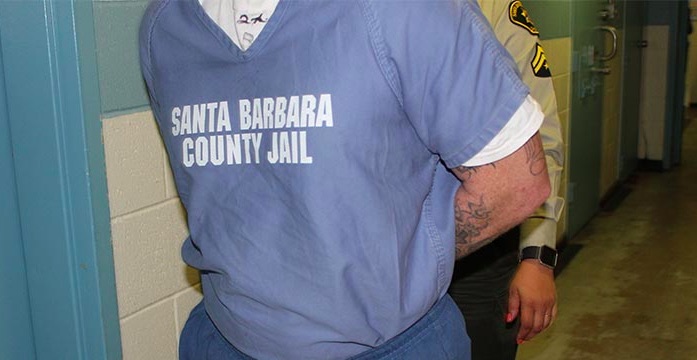
Over the past 10 years, the Sheriff’s budgets for Custodial Operations, or the jail, have more than doubled, even though the county crime rates have fallen and the average daily jail population has decreased by more than 200 people.
The Sheriff’s Office overspent its FY 2024-25 budget by $14.9 million. Now, cancelled federal funding will reduce our community’s safety nets in Public Health, Behavioral Wellness, and other essential services. The projected loss of funds is so severe that county supervisors have frozen hiring across departments.
Overall crime rates have declined over the past 10 years. In 2024, Sheriff Bill Brown said:
“The Sheriff’s Office is pleased to report that our County continues to have low levels of reported crime and that overall it remains a very safe place to live. In 2024 we saw a continued decrease in Part 1 crimes [which include both violent and property crimes] .… [O]ur county’s overall reported Part 1 crime total was the lowest it has been for more than 10 years.”
What is not working in the Sheriff’s Office, at astonishing expense, is Custodial Operations. Judges decide to hold dangerous defendants in jail to protect public safety, but less than half the people in our jails are classified as Part 1 violent felons. Jail is supposed to deter future crimes, but extensive research has established that costly incarceration is no better deterrent than community supervision, aka Probation.
A 2021 meta-analysis of 116 studies showed “that custodial sanctions [jail or prison] have no effect on reoffending or slightly increase it when compared with the effects of noncustodial sanctions such as probation. This finding is robust … All sophisticated assessments of the research have independently reached the same conclusion … Incarceration cannot be justified on the grounds it affords public safety by decreasing recidivism.”
Since FY 2021-22, our county has spent more each year to house people in jail than for countywide law Enforcement. Over 10 years — 2014-2024 — our average daily jail population has decreased by 200 while jail staff size has increasedby 90.
During Fiscal Years 2014-16, the average daily population (ADP) was 957 and the full-time equivalent (FTE) custodial staff was about 257. Then, Custodial Operations cost about $136 per jail resident, per day. For three recent years, FYs 2022-2024, the jails’ ADP was very close to 750, yet the average FTE Custodial staff was 347. For FY 2025-26, the budget for jail operations is an astonishing $107.78 million, about $394 per resident, per day.
Neither this analysis nor the hard budget questions asked here are intended to criticize the dedicated work of custodial staff and leaders, for whom I personally have appreciation and great respect. This analysis speaks to systemic problems that supersede the quality and conscientiousness of custodial staff.
The Sheriff’s Office has failed to deliver savings. A 2020 KMPG study of county criminal justice departments found “variable costs account for roughly 15-25 percent of the overall Custody Operations budget … .” As ADP fell from 957 to about 750, an approximate 22 percent decrease, the KMPG analysis implied savings, with a caveat: “cost avoidance … will only be realized in full if population reductions enable the closing of units or reduction in staff.” Since 2020, entire units of the South County jail have closed (solitary confinement cells, medium security barracks, and other areas). The Northern Branch Jail opened, designed for lower staff-to-resident ratios. Where are the results in terms of operational efficiencies and cost savings?
The Sheriff’s Office chronically runs over budget with “overtime” costs. In December, 2025 the County CEO released a “review” of the Sheriff’s overtime costs for FY 2024-2025. The review identified “hidden overtime” ($715,000), extensive use of a “leave to overtime” loophole ($5.9 million), and gross mandatory overtime inefficiencies (72% of mandatory overtime shifts exceeded 12 hours). In some instances, workers received overtime pay for 16, 19, or even 24-hour work periods. Some employees used vacation/sick time to meet 80-hour work period requirements while simultaneously collecting time-and-a-half “overtime” pay.
The Sheriff’s Office budget is about 60 percent of all criminal justice spending. There is a multi-million dollar mismatch between Sheriff’s jail spending, a reduced jail population, and chronic annual cost overruns. As our county faces a critical budget crisis, supervisors need to act proactively: Require bottom-up budget justification from the Sheriff’s Office for FY 2026-27 — no lock-step business-as-usual COLA increases on top of 10 years’ inflated figures. Be evidence based: It’s time to re-balance operational spending priorities and move away from outsized costs of housing people in jail who don’t need to be there to protect public safety.
One powerful budget strategy is to defer part of a planned jail expansion and use savings to help meet essential county services, allowing time for new initiatives and planned efficiencies to demonstrate additional jail beds are unnecessary.
The Sheriff wants 384 new beds at a cost of about $179 million. Deferring construction of 128 beds could save up to $44 million in capital costs and is justified, in part, by a county jail reduction study presented to the Board of Supervisors in early December. A second strategy: save millions in financing costs by allocating savings from pared-down jail operations budgets to help pay for new jail beds.
Correction: This piece was corrected on February 9, 2026, to state that the sheriff wants 384 new beds for the jail, not 312.

