

Press releases are posted on Independent.com as a free community service.
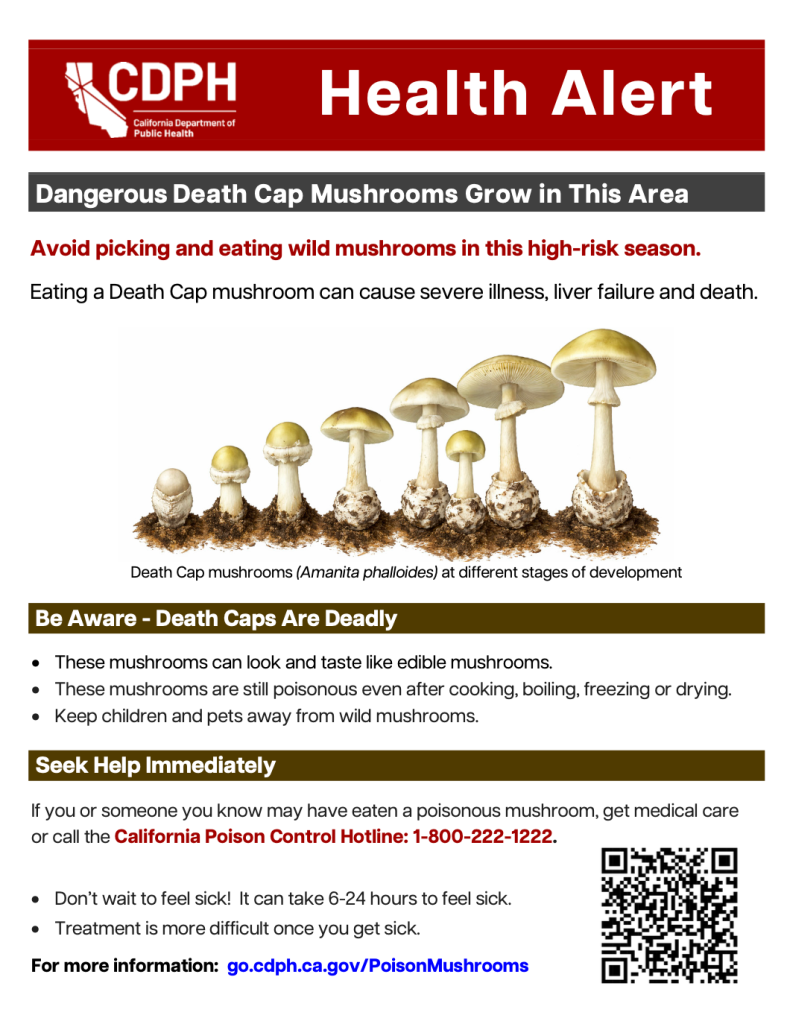
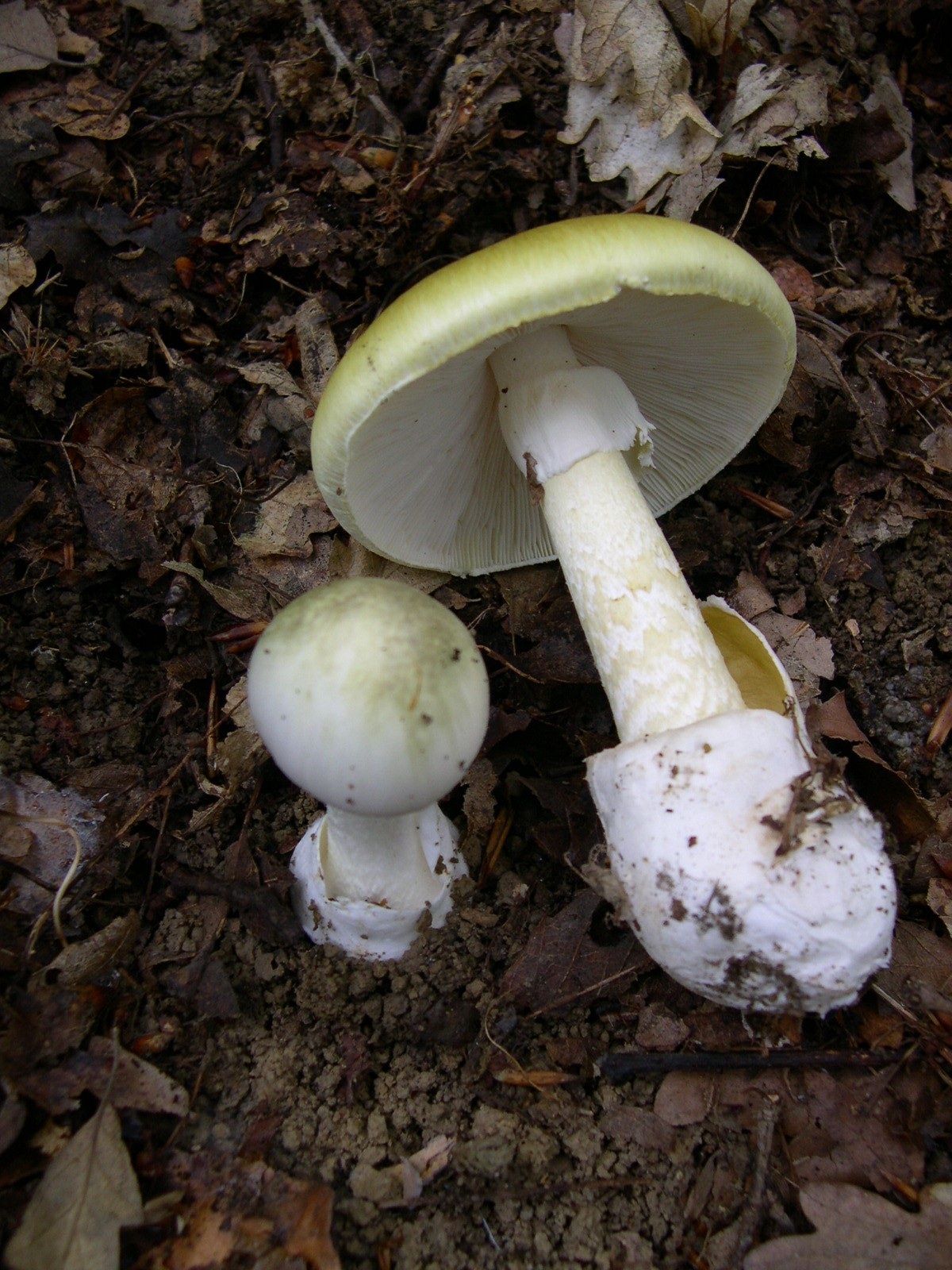
(SANTA BARBARA, Calif.) – The County of Santa Barbara Health Department is issuing an updated warning regarding the dangers of consuming foraged wild mushrooms after the California Department of Public Health (CDPH) reported that recent rainfall has contributed to widespread growth of toxic death cap mushrooms across California, significantly increasing the risk of accidental exposure. Since Death Cap mushrooms are easily confused for safe-to-eat mushrooms, all mushroom foraging should be avoided.
Between November 18 and January 18, the California Poison Control System (CPCS) has identified 39 hospitalized cases including 4 deaths, and 3 liver transplants linked to the ongoing outbreak. The cases have been reported across Northern California and the Central Coast, spanning regions from Sonoma to San Luis Obispo. Affected individuals range in age from 19 months to 67 years and include family groups and individual cases.
Poisonous mushrooms can look and taste like safe mushrooms. Some may resemble mushrooms that you buy in a grocery store. Additionally, people newly arrived to California who are accustomed to foraging in their home country may mistake poisonous mushrooms in California for safe mushrooms foraged or cultivated in their native country. Foragers in California face great risk.
“Even experienced mushroom foragers can make dangerous mistakes,” said Dr. Henning Ansorg, Public Health Officer. “Given the recent rain and the serious outcomes reported statewide, we strongly urge residents to avoid consuming wild mushrooms altogether during this high-risk period.”
How to stay safe:
• The best way to stay safe is to NOT EAT wild mushrooms
• Avoid eating mushrooms picked by friends or family
• Watch children when outside – Most poisonings happen to children under 6
• Keep pets away from wild mushrooms – animals can be poisoned too
• Buy mushrooms from trusted grocery stores and retailers
• Death Cap mushrooms are still poisonous after cooking, boiling, freezing or drying
Symptoms of mushroom poisoning
Symptoms of death cap mushroom poisoning typically begin 6 to 24 hours after ingestion and may include nausea, vomiting, watery diarrhea, abdominal pain, and dehydration. Symptoms may temporarily improve before severe liver damage develops. Anyone experiencing severe symptoms such as persistent vomiting, bloody diarrhea, confusion, or severe abdominal cramps should call 911 immediately.
What to do if you may have eaten a poisonous mushroom
• If mushroom poisoning is suspected, seek medical care right away or contact the California Poison Control Hotline at 1-800-222-1222, 24 hours a day.
• If a pet has eaten a wild mushroom, contact a veterinarian or the ASPCA Animal Poison Control Center at 1-888-426-4435.
• When you go to the hospital: Take any of the uneaten mushroom with you if you can. To preserve the mushroom, place it in a paper bag or waxed paper (not plastic) and refrigerate. If you don’t have the mushroom, photos of the mushroom (including its cap, stem, and underside) can be helpful.
How to handle poisonous mushrooms
• Though touching a poisonous mushroom usually does not pose a risk, always wash your hands after you touch one.
• To dispose of poisonous mushrooms: Put the poisonous mushroom into a sealed bag and place into the regular garbage. Do not place poisonous mushrooms in home compost.
County Health urges residents not to pick or eat wild mushrooms.
For more information, visit the CDPH Poisonous Wild Mushrooms page go.cdph.ca.gov/PoisonMushrooms.


You must be logged in to post a comment.