
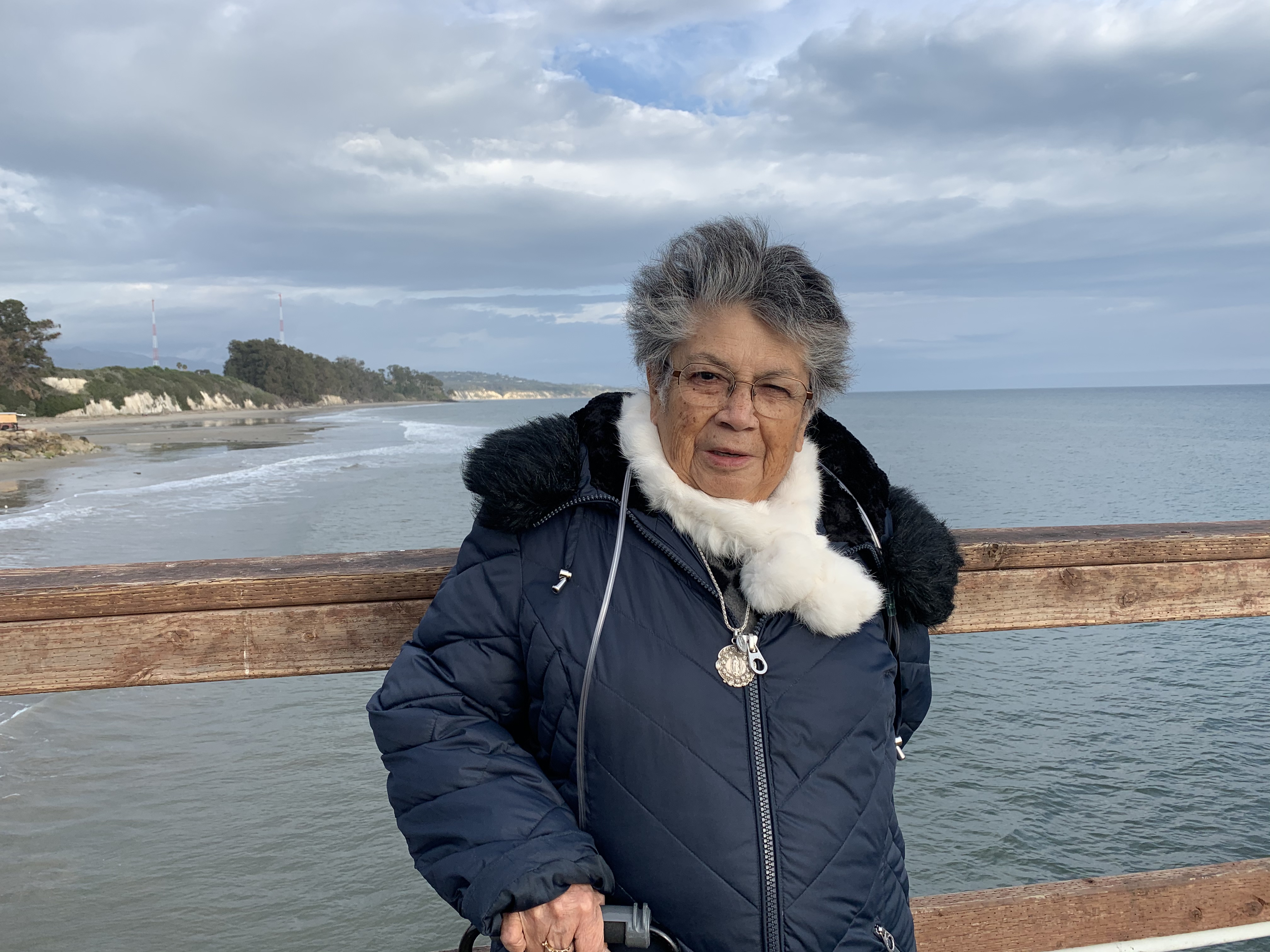
Ernestine Ygnacio-De Soto, who passed away at age 87, served as an important link to Santa Barbara’s Chumash heritage. A prominent leader and spokesperson in the Chumash community, she was the last member of her generation in her family. She was one of a kind, outspoken in her opinions and strongly motivated to protect and preserve Chumash heritage. Ernestine worked closely with others, whether Indian or not, promoting and preserving Chumash culture and history. She was deeply engaged with her Catholic faith.
Ernestine’s mother, Mary J. Yee, was born on the Indian Orchard Ranch along the creek that bears the name of her great-grandmother, María Ygnacia. She grew up speaking the language commonly known today as Barbareño Chumash. Mary was raised by her grandmother, Luisa Ygnacio, hearing the stories of her Chumash ancestors. When the family sold the ranch in 1905, they moved to Santa Barbara and lived at 214 East De la Guerra Street, now a city historical landmark. This was where Mary first met John P. Harrington when he began to document the Barbareño language.
Later, Mary fell in love with Henry Yee, a Chinese vegetable peddler. They were forced to marry in Washington State to avoid California’s miscegenation laws that would have prevented their union. Four children were born before divorce broke up the family. Mary soon met George De Soto, raised as an orphan in a California Indian family in Santa Cruz County. Their daughter was Ernestine, born in the Santa Cruz County Hospital.
Ernestine was a sickly child, born with a congenital heart defect that made her susceptible to various diseases. She almost succumbed to pneumonia at just two months old, and she later credited the “new wonder drug” penicillin as having saved her life. After the family moved back to Santa Barbara, while still a child, she experienced bouts of double pneumonia and rheumatic fever, ending up at the County Hospital for a five-month stay. A serious heart condition was finally resolved years later when she underwent corrective surgery as an adult. Ernestine’s interest in medical science, health care, and nursing developed from her personal experiences with medical treatment.
Later, her mother moved back with her former husband, Henry Yee. They lived in a household of 19 that included Ernestine’s sisters and their children. Their house at 132 West Canon Perdido Street no longer stands, but it ironically was located diagonally across the street from today’s Barbareño restaurant!
Ernestine remembered her great-uncle Tomás Ygnacio coming to visit and conversing with her mother in their native language for hours at a time. A longtime friend recalled visiting the family in the 1950s. She had assumed that the family was Mexican American, but when she arrived, she found Mary Yee and Tomás Ygnacio speaking a language she did not understand, with Harrington looking on. She realized immediately that her assumption about their ethnicity was incorrect.
After the death of her uncle Tomás, Mary Yee became the last fluent speaker of Barbareño, indeed the last known fluent speaker of any Chumash language. She worked extensively with Harrington and linguist Madison Beeler to preserve a record of her community’s language.
By her own admission, Ernestine was unlucky in choosing men. She quipped that she wished that her elders would have arranged her marriage, as had been done traditionally in Chumash society. After her mother died in 1965, Ernestine traveled to Wyoming with the man who became her last husband. They lived in a cabin next to a stream at a sheepherder’s camp and consumed fresh trout caught from the creek.
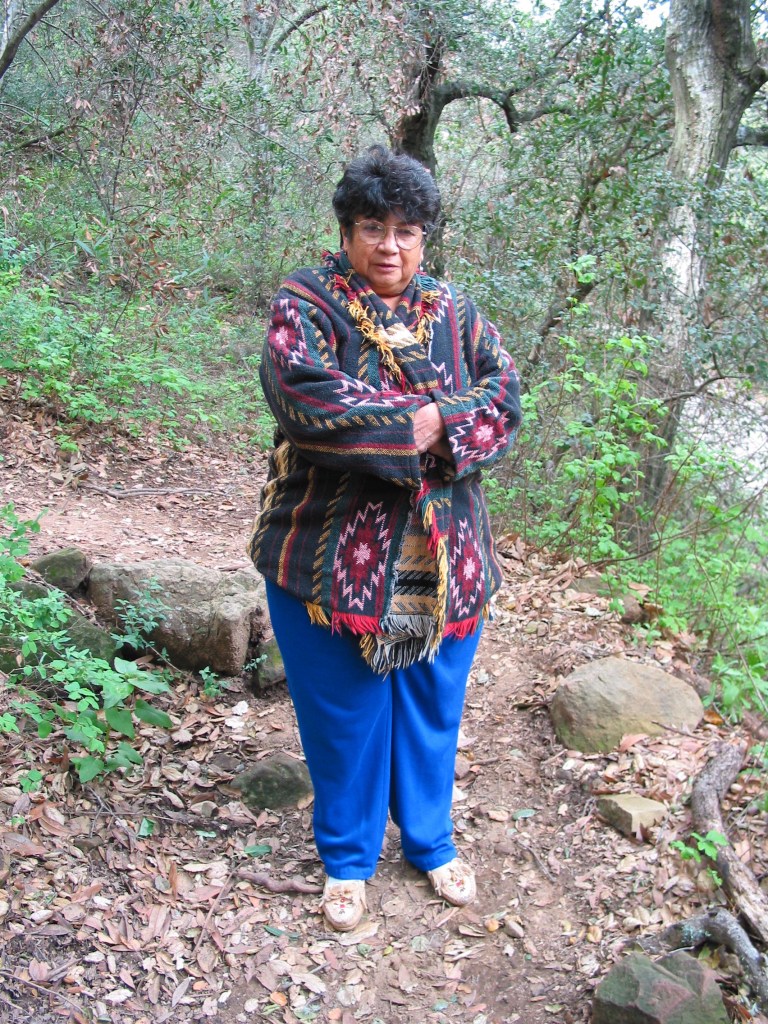
Returning to California, they were married, and Ernestine entered Santa Barbara Community College to study to become a nurse. Her marriage did not last, but Ernestine persisted with her education and became a registered nurse. While completing her degree, she enrolled in a class in American Indian history. For her class essay, she wrote a biography of her mother, leading Ernestine to pursue more information about her family history. Her college professor, Kristina Foss, recommended that she visit the Santa Barbara Mission Archive-Library to conduct more research on her ancestors. She met a person there whom she described as a “long-haired, long-bearded, Harrington-looking character,” in other words, the author of this article! I was conducting research for my dissertation on Chumash social organization, using material gleaned from mission registers. I shared with Ernestine what I had learned about her family tree.
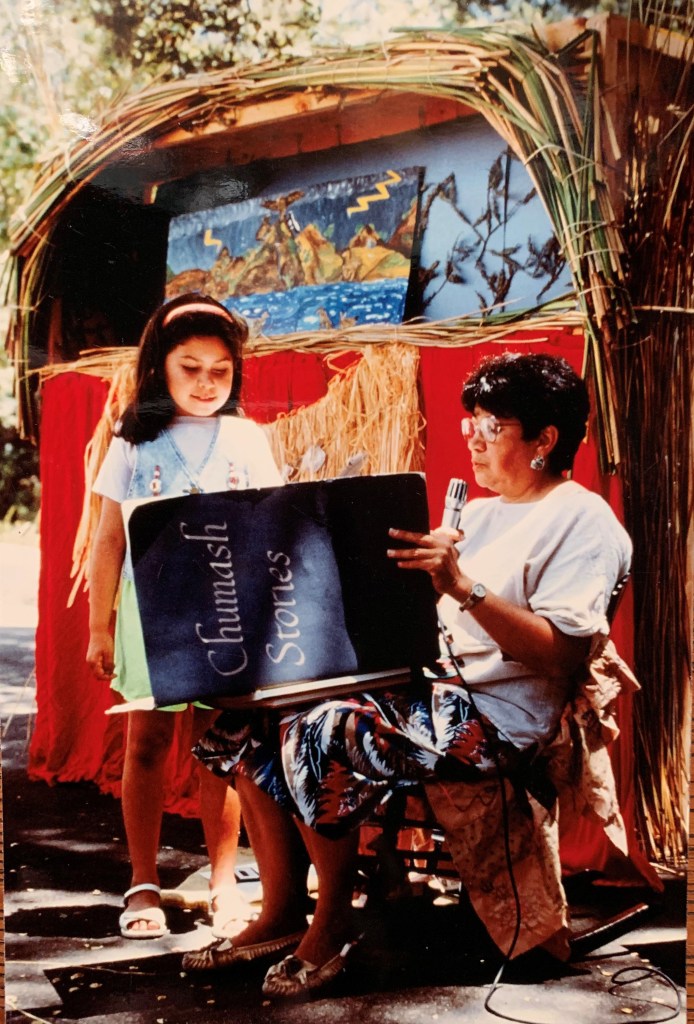
Soon, Ernestine became acquainted with a number of individuals engaged in researching aspects of Chumash cultural traditions. In 1981, Jan Timbrook asked if she would serve as the model for the Chumash Daily Life diorama at the Santa Barbara Museum of Natural History and she agreed. It is still there today.
Ernestine began learning the tradition of Chumash basket weaving by working with Anna Campbell, who had studied museum examples of Chumash basketry and used Harrington’s notes recorded from weavers in the early 20th century. Ernestine’s passion for learning this craft continued throughout her life, and she was a frequent participant in basket-weaving sessions organized by Timbrook at the museum and classes taught by Abe Sanchez, master basket weaver. She had a strong creative inclination and would gift her artwork to others.
In the late 1980s, Ernestine expanded her focus to statewide meetings, such as the California Indian Conference and Breath of Life language workshops. She particularly was attracted to language workshops, where she met speakers of other Indigenous languages and linguists who could give her a better understanding of her mother’s language. Marianne Mithun, linguistics professor at UC Santa Barbara, would remark on how accurate Ernestine was in pronouncing Chumash words and the cadence in which she would put together full sentences. These were based on her childhood memory of her mother’s speech.
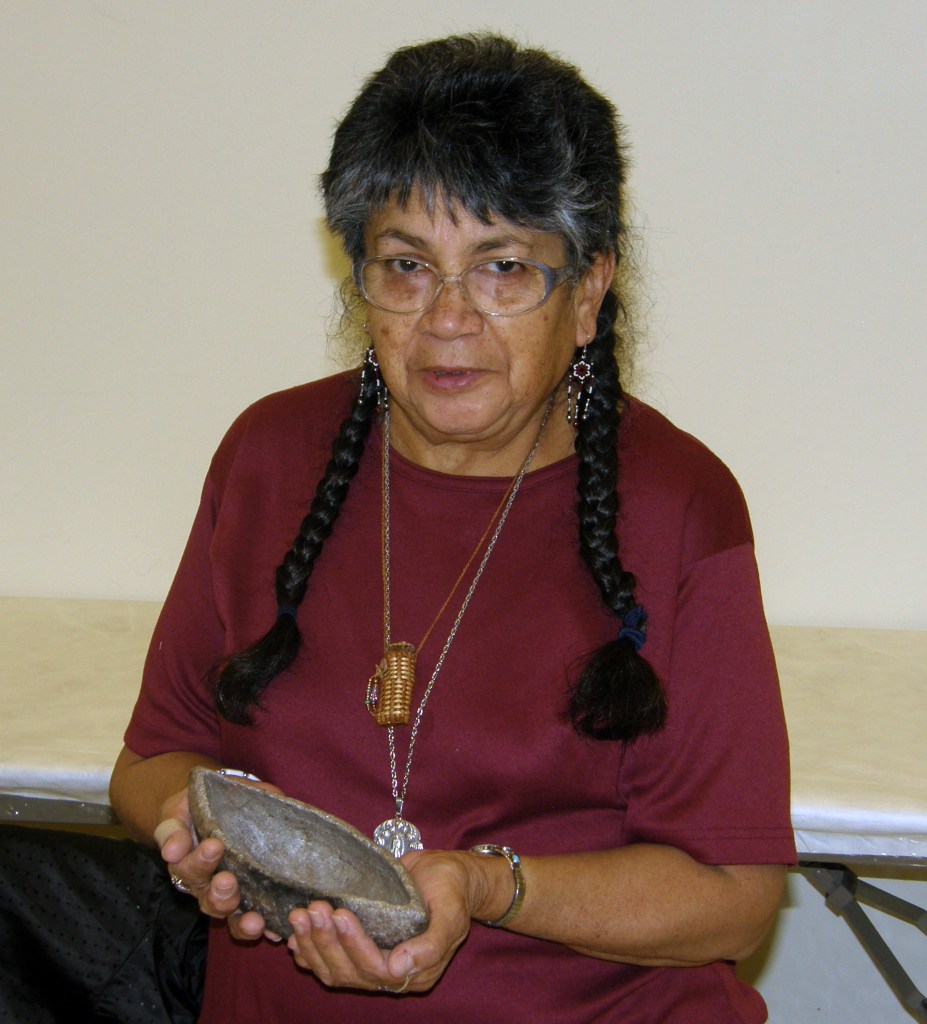
At one conference, Ernestine was inspired by a conference attendee portraying a California Indian historical figure, so she did the same, collaborating with me to tell the story of women in six generations of her family dating back to 1769. Using Harrington’s notes from her mother, grandmother, and great-grandmother together with historical documents, we prepared a script for Ernestine to assume the persona of each of those generations of women, including herself, and recounting the story of their lives. A presentation based on this script held at the Santa Barbara Mission Archive-Library formed the basis for a Santa Barbara Independent cover story in 1998. Many public performances followed at museums, university classes, and conferences. Paul Goldsmith, an award-winning cinematographer, worked with us to convert the script into the enduring documentary, which became 6 Generations. The film debuted at the Santa Barbara Museum of Natural History in 2009 and aired on PBS station KCET.
Ernestine began to be contacted by videographers documenting the Native American experience in California. She was interviewed in Native American filmmaker Daniel Golding’s Chasing Voices, a documentary about John Harrington’s work and the revitalization of Indigenous languages. She often spoke at conferences, museum programs, and university classes. She served as a consultant for museum exhibits at the National Museum of the American Indian, the Huntington Library, Old Mission Santa Barbara, Santa Barbara Museum of Natural History, El Presidio de Santa Bárbara, the Santa Barbara Historical Museum, and the Natural History Museum of Los Angeles County, among others. An outstanding experience was Ernestine’s participation in the Santa Barbara Symphony’s performance of Cody Westheimer’s original composition Wisdom of the Water, Earth & Sky in 2022.
Ernestine represented the Chumash community in Fiesta parades and served as Grand Marshal of Old Spanish Days in 2023. At the time of her death, she was working on a project to create story benches at UCSB based on narratives from her mother’s stories. In these ways, Ernestine became the link between the generations that came before her and the generations to follow.
Beyond her activities to share and preserve her Chumash culture and heritage, everyone who knew Ernestine will remember that she loved food! She reminisced fondly about the cooking of Henry Yee, her Chinese stepfather, and found most Chinese restaurants wanting in comparison. When I took her to lunch, she most often requested Flavor of India, where she could partake of the buffet and a mango lassi. At restaurants, she would often order more than she could consume so she could take home leftovers for the next day. For years, I would purchase a bag of oranges for her at the farmers’ market, which her daughter Gina would squeeze and freeze for her to use over the following week. Ernestine was especially drawn to California Indigenous cuisine, including acorn soup, dried seaweed, elderberry syrups, and other foods she would encounter at California Indian gatherings or receive from friends who prepared foods the Native way.
Ernestine held strong opinions and was not shy about expressing them. You always knew where you stood with her, which some found refreshing, but on other occasions, it worked to her disadvantage. We would jokingly call her ’eneq i wot, meaning “woman chief.” Artist Holli Harmon, who painted Ernestine’s portrait, remembers how “her eyes held both mischief and wisdom, and how easily she would make me laugh.”
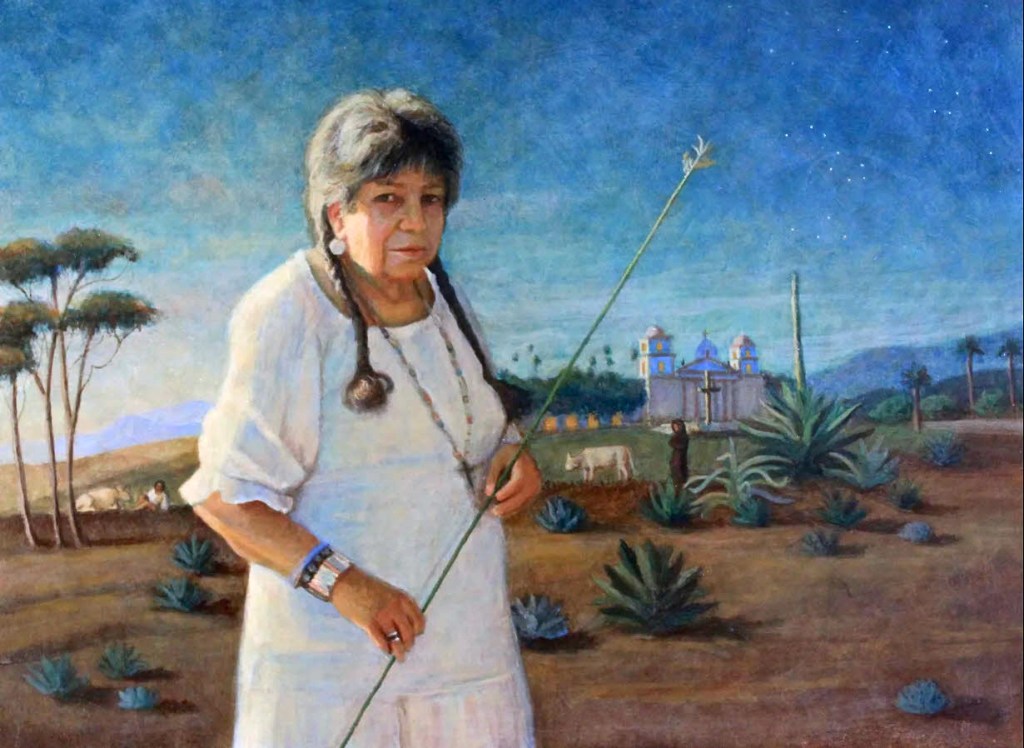
Ernestine cared for many human patients as a registered nurse for 40 years, but she also loved animals. She adopted a series of stray cats, bestowing whimsical names upon them: Denzel, Larson, Stretch, Sparkle, Casper, Chuckles, and Chica. Some of them were buried on the mountain property where I live, under the shadow of a statue of St. Francis, which Ernestine purchased and had blessed at the Old Mission.
She felt a special kinship with bears, regarding the Bear as her personal totem. Bears abound in stories in Ernestine’s family. One of these, The Sugar Bear Story, a bilingual children’s book in Barbareño Chumash and English illustrated by Ernestine, is based on a tale told by her mother. Another pertained to José Silinahuwit, a relative who lived at the Indian Orchard Ranch and disappeared into the mountains at the end of his long life. Ernestine’s great-grandfather followed his tracks, which transformed into those of a bear. According to this handed-down story well-known to elders interviewed by Harrington in the early 20th century, he had gone to live with his relatives: the bears. Ernestine’s love of bears resulted in her choosing the Bear as a symbol of leadership, wisdom, and strength when she worked with an artist to design a bronze sculpture at the Old Mission. This memorial was dedicated to the many Chumash interred in the mission cemetery, including those who lost their lives in the 1824 uprising.
The language of her ancestors was an important part of Ernestine’s life. Her nephew, James Yee, who worked with her in studies of their ancestors’ language, recounts that when he visited her on that last day, her parting words to him were a tender phrase she had memorized from her mother’s language: kaqšwalawiyuw, meaning “I love you all.” When leave-taking or saying goodbye, Ernestine would always use the phrase kiwa’nan, meaning roughly “I go now.” In reply, we would say, “Peleyep hi čʰo,” or “travel well.” So, it is appropriate that we now say “Ernestine, peleyep hi čʰo,” as you join your ancestors in šimilaqša.
Ernestine is survived by her daughter, Gina Unzueta; her sons Gilbert Unzueta, Ronald Gradias, and Paul Gradias; and her grandchildren, great-grandchildren, and many nieces and nephews. This article benefited from contributions by James Yee, Regina Gradias, Kathy Conti, and Holli Harmon.


You must be logged in to post a comment.