

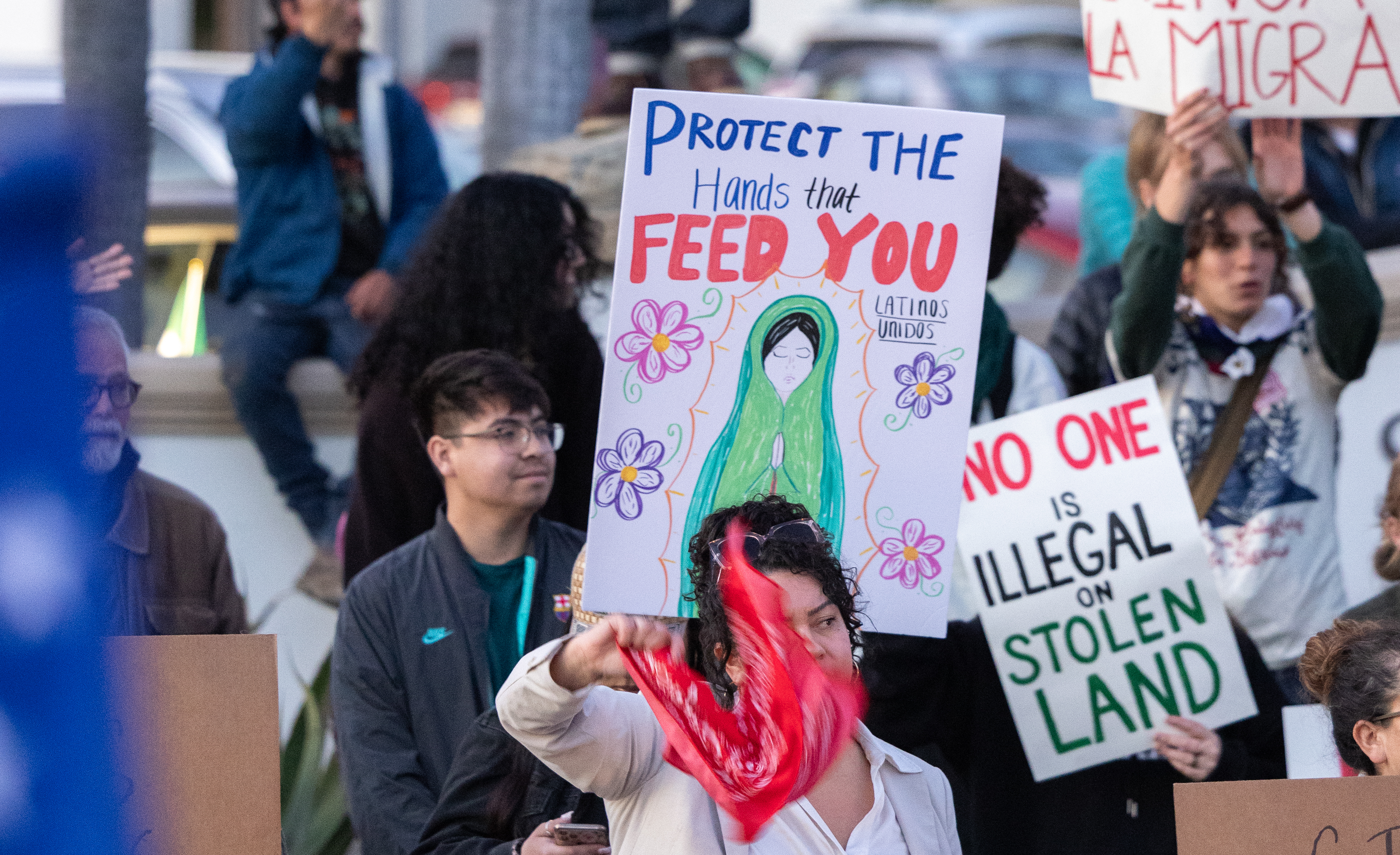
As resistance to the Trump administration’s violent immigration enforcement crackdown intensifies nationwide, Native American groups are uniting in support of immigrant rights. This solidarity is increasingly visible on the California Central Coast; the ancestral lands of the Chumash People.
ICE crackdowns disproportionately target immigrant people from Indigenous communities across Latin America. The racism of these attacks bring to light the shared struggle between Native and other people of indigenous heritage, whose histories and relationships transcend borders and predate European colonization. For many Native leaders, the administration’s extreme enforcement measures are not an isolated policy shift, but the latest chapter in a centuries-long story of violent colonization.
Since the Trump administration launched its nationwide Immigration and Customs Enforcement (ICE) operations in early 2025, Native American and intertribal organizations, from the Navajo Nation to the Barbareno Chumash Council of Santa Barbara, have spoken out forcefully against these policies. Early opposition centered on mounting reports of Native people being racially profiled, stopped, questioned, and in some cases mistakenly detained by federal agents targeting undocumented immigrants. Increasingly, however, Native leaders are not only condemning the abuses on Native communities, but are vehemently opposed to ICE raids for the fear they impose on all Indigenous communities.
In one notable case tribal members of the Prairie Band Potawatomi Nation responded with swift and forceful opposition to their tribe’s support of ICE efforts. After it became public that the business arm of the Potawatomi Nation had signed a $30 million contract to develop an ICE detention center on tribal land, Potawatomi Chairman Joseph Rupnick joined outraged community members in calling to “ditch” the agreement. The tribal council is now terminating the contract and has dismissed members of the Prairie Band LLC leadership responsible for the deal.
Tribal member Levi Rickert captured the broader sentiment in response to the contract: “Native people know oppression. We were forcibly removed from our homelands, locked in Indian boarding schools, and confined to reservations. Our history is one of systematic attempts by the federal government to erase our culture, our language, our existence. We cannot—we should not—profit from the oppression of others.”
Some Native leaders argue that current immigration enforcement policies violate fundamental principles of international human rights. Marcus Lopez, a Chumash community leader and chair of the Barbareno Chumash Council of Santa Barbara, made this case during a recent Santa Barbara City Council hearing. Lopez argued that the vast majority of undocumented people targeted by ICE in our region are themselves Indigenous and are therefore protected under the United Nations Declaration on the Rights of Indigenous Peoples. Lopez, who has previously given testimony before the U.N., framed the issue not as one of borders or citizenship, but as a continuation of policies that criminalize Indigenous existence and movement across ancestral homelands that long predate the modern nation-state.
Grounded in the worldview that all life is interconnected, Lopez called on “all indigenous peoples to speak out and defend the defenseless, the children, women and men; who are being rounded up, jailed and mistreated in violation of not only global human rights but the spiritual essence of our Indigenous culture.”
Numerous other Chumash community leaders also condemn the violent ICE raids as morally unjust and a direct attack on the long shared history of interconnectedness between Chumash and Mexican community members. Julie Tumamait-Stenslie, a Chumash elder and founding chair of the Barbareño/Ventureño Band of Mission Indians, points out that Chumash and Mexican families not only intermarried and lived as neighbors for decades, but often labored side by side. Like her father, many endured backbreaking agricultural work in dangerous, pesticide-laden fields.
Chumash, alongside Filipinos, Mexicans, Arabs, and others, marched with the United Farm Workers in the 1960s and 1970s, demanding fair wages, dignity, and basic rights. These struggles forged bonds of solidarity against exploitation—bonds that remain today. Tumamait describes her vehement opposition to the ICE raids saying, “For many of us, we believed then and believe today, you don’t just commit an injustice, like these ICE attacks, on some member of our community. You’re committing an injustice on all of us! We’re in this fight together.”
Several intertribal organizations, including the Mixteco Indigenous Community Organizing Project, have spoken out against the mass raids – advocating that local governments fund legal assistance for immigrant workers. They condemn the role local law enforcement has played in assisting ICE raids. Community volunteers with multi-racial immigrant defense organizations like the 805 UndocuFund, VC Defensa and SB Resiste, are protecting the community from ICE and have been invited to intertribal ceremonies to help heal from the trauma resulting from their work. ICE’s violent crackdown in Minneapolis has prompted the American Indian Movement to patrol the streets, monitoring ICE activities.
A growing number of Native leaders see their struggles as intertwined with those of immigrants from Latin America who share a history of displacement at the hands of settler colonialism. As residents of Southern California, this history echoes all around us. Street names, architecture, and vibrant centuries-old communities are all reminders that California was once Mexico; it was once Spain; but it has always been Native Land.
The racist propaganda shared on social media by ICE and the Department of Homeland Security (DHS) harken back to 1848, when the U.S. southern border was born from the Mexican-American War. This violent approach to westward expansion was grounded in the white supremacist ideology of Manifest Destiny. On July 23rd, 2025, DHS aligned itself with this historically racist worldview by posting a 19th century painting synonymous with Manifest Destiny. The painting, called “Westward Progress”, features an angelic white figure floating across the plains as Native people flee into the shadows. Their caption, “A Heritage to be proud of, a Homeland worth Defending” demonstrates that this administration sees both Native American and immigrant people as a threat to their project of ethnic cleansing. For this reason the slogan, “no one is illegal on stolen land,” resonates deeply with many people.
Indigenous author, recording artist and environmental activist residing in Ojai, Xiuhtezcatl, affirms this growing perspective –“What we’re seeing right now in these mass deportations, violent attacks against sanctuary cities, placing children in cages, and separating children from their families is all a continuation of the same violent systems that are responsible for the genocide, the land theft, and the forced removal of indigenous people which has taken place on all these continents – from Alaska down to Argentina.” Xiutezcaltl sees these oppressive actions as part of the continuum of colonization, including the epidemic of missing and murdered indigenous women, taking place across North America.
Native and other indigenous people recognize the ICE attacks as the next phase in an over 500-year long struggle against genocide and colonization. The recent murders of Renee Good and Alex Pretti have resulted in broad-based solidarity among Asians, Blacks, Latinos, Native peoples and white allies. In opposition, these people of conscience are coming together to form a resistance based on a vision for our collective self-interest; one consistent with the indigenous values of interconnectedness, reciprocity and protection of our earth, air and water. Today, the tools of this resistance include non-violent actions, such as mass protest, organized ICE monitoring, mutual aid, voter engagement, and policy advocacy and organizing. The people united will never be defeated.
Marcos Vargas is the former executive director of the Fund for Santa Barbara and founding Executive Director of the Central Coast Alliance United for a Sustainable Economy (CAUSE). A Chicano sundancer and pipe carrier in the Lakota tradition, he currently serves as the Regional Coordinator and Lead Organizer for the Peace and Dignity Journeys — Central Coast, a transcontinental indigenous peoples run.
Originally from Santa Paula, Canek Pena-Vargas has spent 16 years as a Los Angeles–based high school history teacher, curriculum author, and youth marathon coach, all for which he draws deeply from his Chicano activist roots and Rarámuri heritage. He is the son of co-author Marcos Vargas.

