

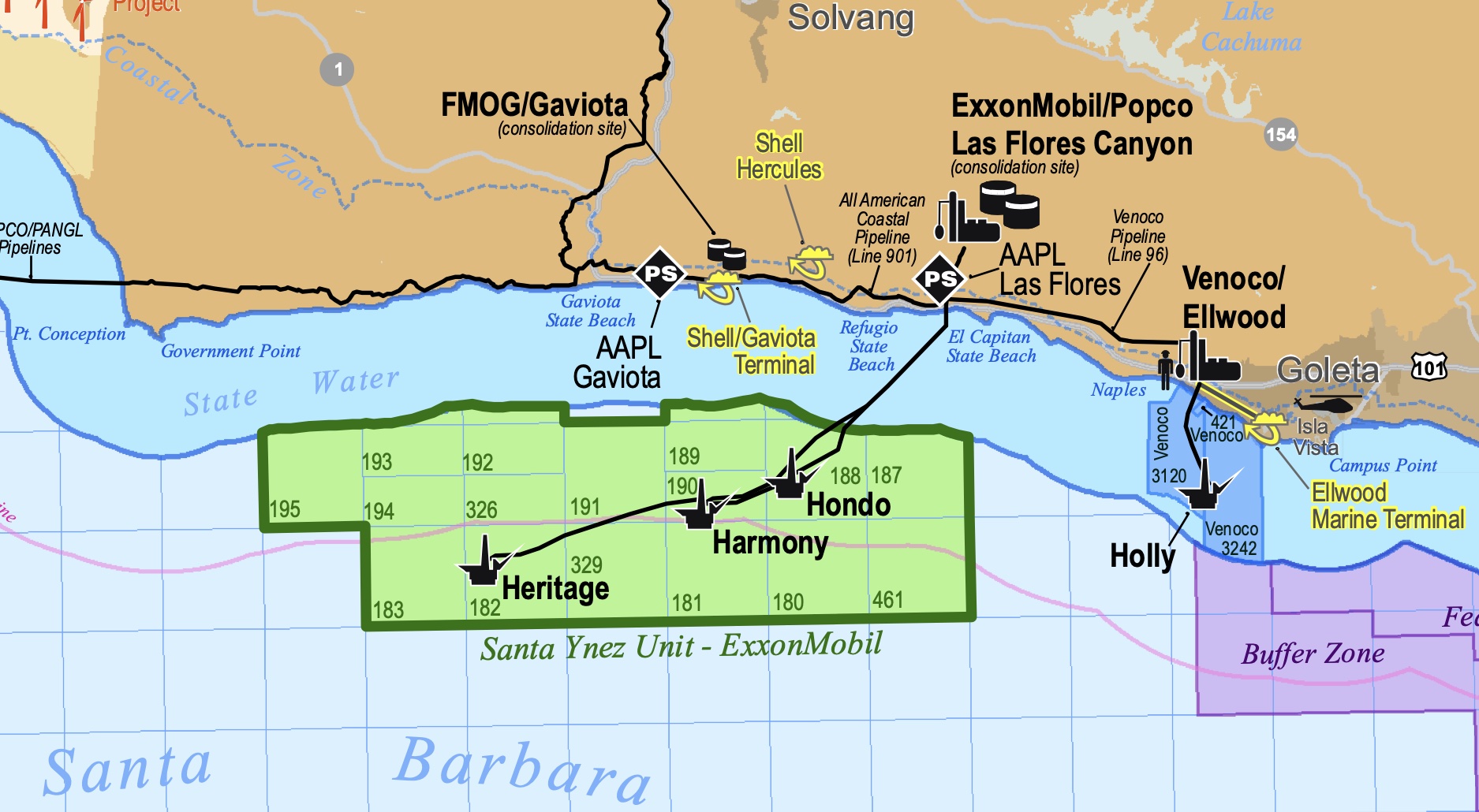
On Saturday, March 14, Sable Offshore restarted the pipeline that ruptured in 2015 and poured 142,000 gallons of crude across the Gaviota Coast. It did so under direct orders from the President, who invoked the Defense Production Act to override two active state court injunctions, a pending federal appellate case, a federal consent decree, and the express opposition of the Attorney General, the State Fire Marshal, the Coastal Commission, State Parks, and the Santa Barbara County Board of Supervisors.
Every institution of California state and local government that had jurisdiction over whether this pipeline could safely restart said no. Every single one.
As a Santa Barbara civil litigator for 35 years, I want to focus on what this means for the rule of law — because that is what is at stake here, not just for environmentalists, but for every person who has ever relied on a court order to mean something.
Judge Donna Geck’s preliminary injunction was issued last July after full briefing and argument. It was narrowly crafted: Sable could not restart until it had obtained all necessary approvals and permits and had filed a verified notice, signed under penalty of perjury, identifying each approval. The ruling turned on the California Pipeline Safety Act, which requires the State Fire Marshal to discuss the factors it considered significant before granting a safety exemption. Judge Geck found the State Waivers contained no such discussion. She found petitioners had established a reasonable probability of success on the merits.
This was not judicial activism. It was the careful application of a specific state statute to specific facts by an experienced, nonpartisan jurist — appointed by a Republican governor, registered decline-to-state, board-certified as a civil trial specialist. Her ruling invited compliance, not confrontation.
The administration chose confrontation. And in doing so, it did something that should alarm every lawyer, every judge, and every citizen who believes that court orders are not suggestions.
The 2020 Federal Consent Decree — entered in the Central District of California — specifically requires State Fire Marshal approval before any restart. That decree was agreed to by the United States Department of Justice. It is a binding federal court order. The DPA invocation does not mention the consent decree. It does not modify it. It does not ask the district court to amend it. It simply ignores it.
A consent decree can be modified only by the court that entered it. The executive branch cannot unilaterally override a judicial decree by invoking emergency powers. To hold otherwise would mean that any court order that inconveniences the executive branch could be swept aside by saying the words “national security.”
And consider who is being rescued. Sable Offshore is a SPAC — a blank check company — that bought this pipeline system with a $625 million loan from ExxonMobil. Its CEO’s last company filed for bankruptcy. Sable has $97.7 million in cash, burns $25 million to $30 million per month, is contesting an $18 million Coastal Commission fine, and is facing criminal prosecution by our own District Attorney. This is not a pillar of national energy infrastructure. It is a leveraged bet by Houston investors that went sideways, and the President of the United States is bailing it out.
The manufactured-crisis rationale makes it worse. Trump started the Iran war. Gas prices spiked. Now the crisis he created is the justification for overriding California’s sovereign regulatory authority. A UC Santa Barbara analysis found the restart would not reduce foreign oil imports and would increase global greenhouse gas emissions.
For those of us who live in Santa Barbara, this is personal. We watched the Refugio oil spill destroy our beaches. We watched the community come together to demand accountability. We watched the regulatory and judicial process work — slowly, imperfectly, but work. And now a president has ordered a company to restart the same corroded pipeline over the objection of every institution that was supposed to protect us.
But the implications extend far beyond Santa Barbara. If the DPA can be used to override state court injunctions and state regulatory authority whenever a president declares a favored industry essential to national security, there is no limiting principle. Water regulations. Air quality standards. Labor protections. Land use authority. All of it becomes subject to executive override.
In 1975, President Ford refused to bail out New York City, and the Daily News ran perhaps the most famous headline in American newspaper history: “Ford to City: Drop Dead.” Ford’s sin was neglect. What is happening here is domination — the affirmative use of federal power to override our courts, our regulators, and our laws on behalf of a private corporation.
The courts are still open. The lawsuits are still pending. The injunctions remain in force. California will fight this. But oil is flowing through a corroded pipeline today because the President decided a Houston oil company’s balance sheet matters more than the rule of law.
David S. Secrest is a plaintiff-side employment and civil rights attorney in Santa Barbara. He writes the Substack newsletter “When History Rhymes: A Regular Reckoning.”

