

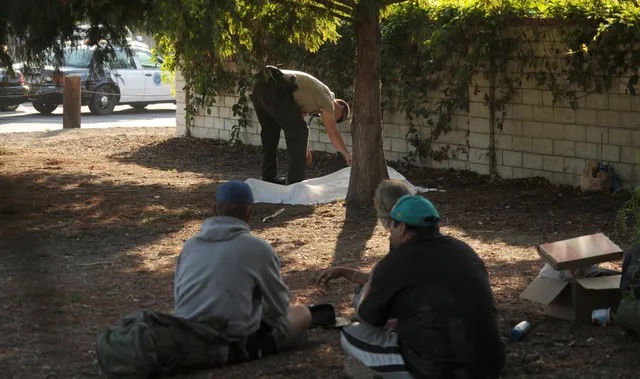
On the longest night of the year, December 21, 2025, about 75 people gathered beneath the archway of the Santa Barbara County Courthouse to call out the names of 69 neighbors who had died homeless in our county during the past year. One name was Timothy John Largent, a 31-year-old man from Bakersfield who died of a fentanyl overdose at the bottom of Mission Creek. He just wanted, as I said that night, one night when his skull wasn’t screaming. One night of rest without terror scratching the inside of his skull. Instead, he found death at the bottom of the creek.
Sixty-nine names. And that number is almost certainly an undercount. The county’s systematic tracking of homeless deaths has lapsed in recent years. The dead go unnamed in the public record. They simply vanish.
This is a moral emergency hiding in plain sight in one of the wealthiest communities on Earth.
According to a report presented to the Board of Supervisors in June 2023, 143 homeless people died here during 2019-2020. This was nearly double the 85 who died in 2017-2018. Unhoused people in our county die at more than five times the rate of housed residents. The average age of death for a homeless person here is 54. For housed residents, it is 76. People living on our streets are losing 22 years of life.
As Supervisor Laura Capps said, “It is literally a matter of life and death.” She was right. A preventable mass death event is unfolding beneath our magnificent mountains and beside our gleaming ocean.
The county has roughly 3,000 unhoused residents. Building permanent supportive housing in California costs between $400,000 and $600,000 per unit; housing these residents would require an estimated $500 million-$750 million.
Housing alone is not the entire answer, either. People also need mental health care, addiction treatment, and sustained support. But housing is the indispensable foundation. You cannot stabilize someone’s life if they are sleeping in a creek bed.
That sum sounds enormous until you look at who lives among us.
At least 10 billionaires with a combined wealth exceeding $160 billion had homes in our area in 2023, according to the Montecito Journal. The fortune of Oracle cofounder Larry Ellison is now more than $175 billion. Former Google CEO Eric Schmidt: $16.2 billion. Raising $750 million would require less than a half-percent of local billionaires’ combined wealth.
This is not sacrifice. It is a rounding error on a balance sheet.
The Kogevinas real estate analysis identified an additional 82 centimillionaires — individuals worth at least $100 million — and more than 12,000 millionaires in the Santa Barbara–Montecito corridor, all within a short drive of homeless encampments.
Santa Barbara has raised funds like this before. When The Granada Theatre needed restoration, this community raised $60 million through a coordinated capital campaign. Major donors stepped forward. Community members contributed. In 2008, the Granada reopened as a world-class performing arts center.
As Sara Miller McCune said during the campaign, “They don’t know Santa Barbara.”
We raised $60 million to restore a theater. We can raise $750 million to restore human lives. Call it the Santa Barbara Home Fund. Launch it with a $100 million anchor gift and build from there. Public funding alone has proven insufficient. Philanthropic leadership is now essential.
The billionaires of Montecito are known to give generously to worthy causes. But Timothy Largent did not need a future endowment. He needed a door that locked. A bed. Stability. He needed what we already know how to provide.
The very wealthy own multiple homes on multiple continents. They fly private to properties in Malibu, Lake Como, and Hawai‘i. Yet their neighbors sleep under the Milpas Street underpass.
The moral logic is not complicated. If extraordinary wealth exists alongside preventable death, the question is not whether solutions are financially possible. They are. The question is whether we will act.
The standard deflection is that this wealth is not liquid. This is true. It is also irrelevant. Appreciated stock can be donated directly to a charitable foundation. Gifts can be structured over time. None of this requires sacrifice. It requires only moral seriousness.
This is not an indictment. It is an invitation.
Santa Barbara has never lacked generosity. It has lacked urgency. We need a philanthropic campaign commensurate with the scale of the crisis — one that recognizes housing not as charity, but as essential infrastructure. Research is unambiguous: Housing reduces emergency room visits, incarceration, and public expenditures. It saves lives and saves money.
In the coming months, our community’s leaders and philanthropists will decide where their resources go. Some will fund buildings. Some will endow institutions. Those things matter. But none of them will matter to the person who dies tonight under the Cabrillo Boulevard bridge for want of a roof and someone who knew their name.
Sara Miller McCune was right: They don’t know Santa Barbara. Let’s show them.
House our neighbors.
Not in our wills.
Now.
How You Can Help Address Housing and Homelessness in Santa Barbara County
Community leaders are exploring bold solutions to expand housing and reduce homelessness in Santa Barbara County. If you are interested in learning more, supporting this effort, or participating in future discussions, please contact:
Santa Barbara Foundation
http://www.sbfoundation.org
(805) 963-1873
Together, we can build lasting solutions for our community.
Wayne Martin Mellinger, PhD, is a scholar, substance abuse counselor, and longtime homeless advocate. He serves on the county Behavioral Wellness Commission and Continuum of Care, conducts weekly street outreach, and organizes the annual Longest Night Homeless Memorial Vigil.

