
The Landscape of
Phoebe Brunner’s Mind
Visionary Painter’s New Show,
A Radiant Solitude,
Comes to Sullivan Goss Gallery
By Roger Durling | Photos by Ingrid Bostrom
January 29, 2026
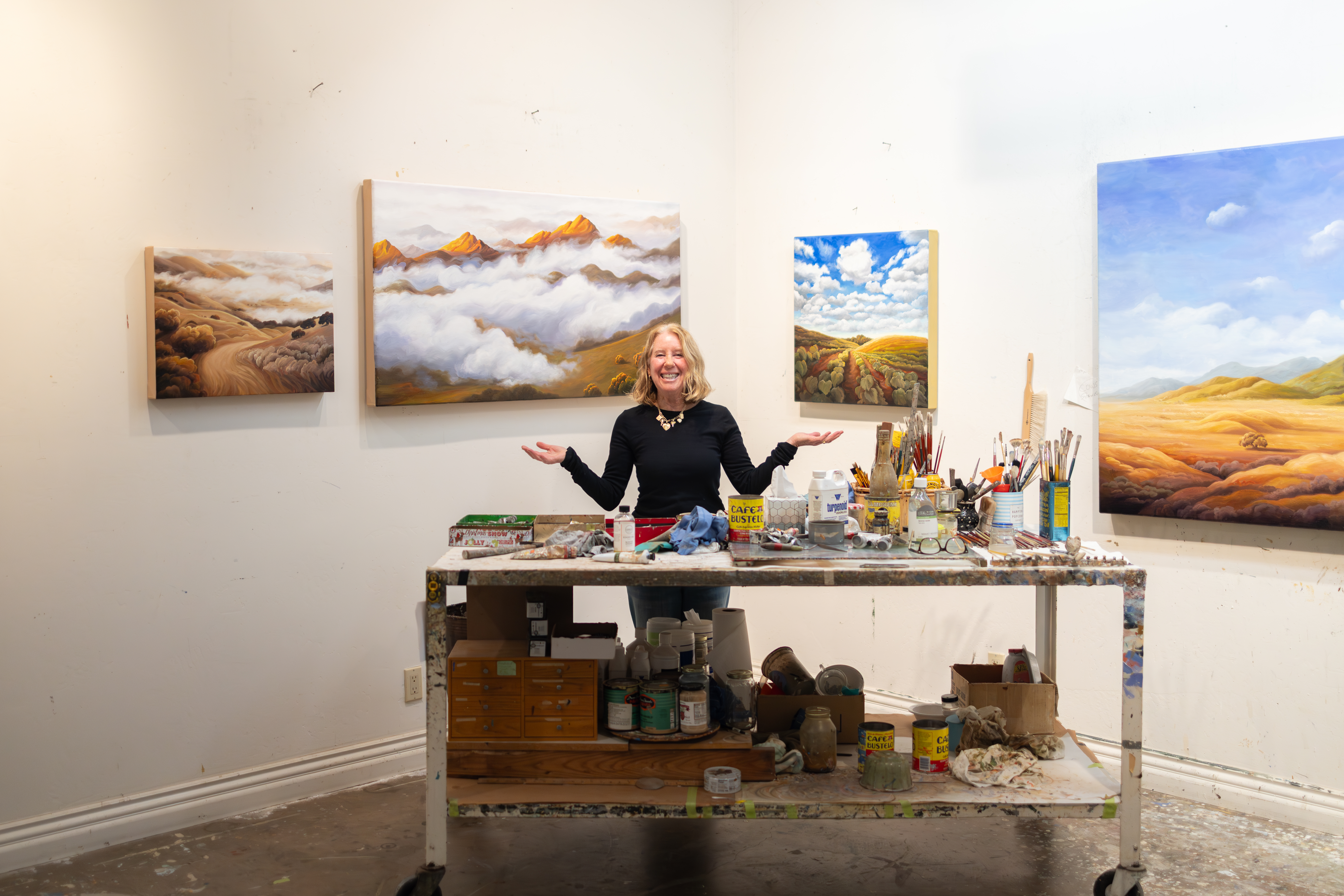
Phoebe Brunner’s enlivening new show at Sullivan Goss Art Gallery — titled A Radiant Solitude — surveys the hidden, transcendent and emotional depths within our familiar Santa Barbara scenery. She uses dream logic and unexpected juxtapositions to reveal the true fundamental nature of a place we think we know so well. Within this extremely mature, cohesive, and sophisticated exhibit, she explores the universal cycles of life, death, and rebirth — making nature’s mystery and beauty palpable and disquieting. She combines surrealism with her innate quixotic connection to the land — using magic realism to represent inner experiences and resonance.
“In the history of Santa Barbara painting, Phoebe’s vision is unique,” said Nathan Vonk, owner of Sullivan Goss. “She creates scenes that are a fascinating and beguiling combination of the familiar and the imagined. We look at her work and could swear we recognize the place, but in fact, her subjects are rarely specific places. She is able to capture the essence of this area through entirely imaginary locations.”
Studying her paintings, in particular the show’s centerpiece, “Where I’m Bound,” — a big canvas with mountains in the distance and a sprig in the foreground blowing in the wind — the viewer is compelled to interpret the natural elements as metaphors. The mountains may be construed as symbols for challenges ahead, and the lack of trails urge you to discover your own paths and the clouds may be emblematic of emotions. Her colors reflect internal feelings rather than external reality — warm tones for joy or cool, dark tones for heaviness and solitude.
“I’m constantly aware when I’m doing paintings for an exhibit of having a cohesiveness,” explained Brunner. “This group of paintings is an extension of what I have been doing philosophically. The land, the distance, the lighting. I want people to wake up to nature.”
In Brunner’s paintings, her landscapes function as representational theaters where inner life meets outward existence, encouraging exploration of personal significance, or even spiritual realms, in the way that indigenous cultures feel about sacred places.
“Her paintings feel rooted in reality yet elevated by imagination,” said Nora Hurley, philanthropist and art collector. “She captures the essence of a place while inviting the viewer to move beyond strict realism and engage emotionally and imaginatively. Her work is transportive, fantastical, yet deeply true.”
Brunner’s work suggests landscapes are not just attractive scenery but dynamic environments for processing emotions and philosophies, blurring lines between the real and imagined. Reflecting on her work, Brunner said, “These paintings are elevated. They have another layer other than just a landscape. They have a spirituality. They’re an invitation to a journey.”
She continued, “For me, art is a genuine expression of one’s self. With luck, the manifestation of that expression will find its way into the world and affect many people’s lives. It will somehow expand the consciousness of people I will never meet. It will tell stories and encourage people to see beyond their normal everyday idea of life, our natural surroundings, and our humanity.”
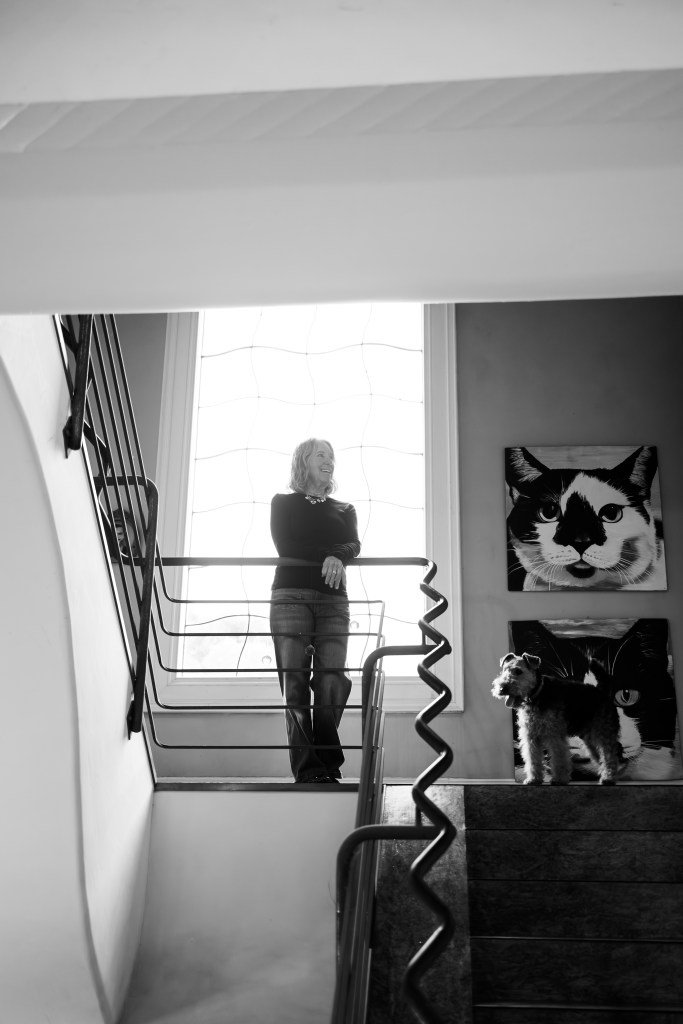
In early November 2025, I drove to Phoebe’s home on the Mesa for the first of three gatherings for this story. Her residence is one of the quirkiest, endearing, and artistic homes I have visited. Every detail, from the gate to the doorway, invites you in — while simultaneously making you aware that this is not your typical home. The shapes and architecture are slightly askew, and the colors are unexpectedly bright — recalling something out of Lewis Carroll’s world.
Did I just go through the looking glass?
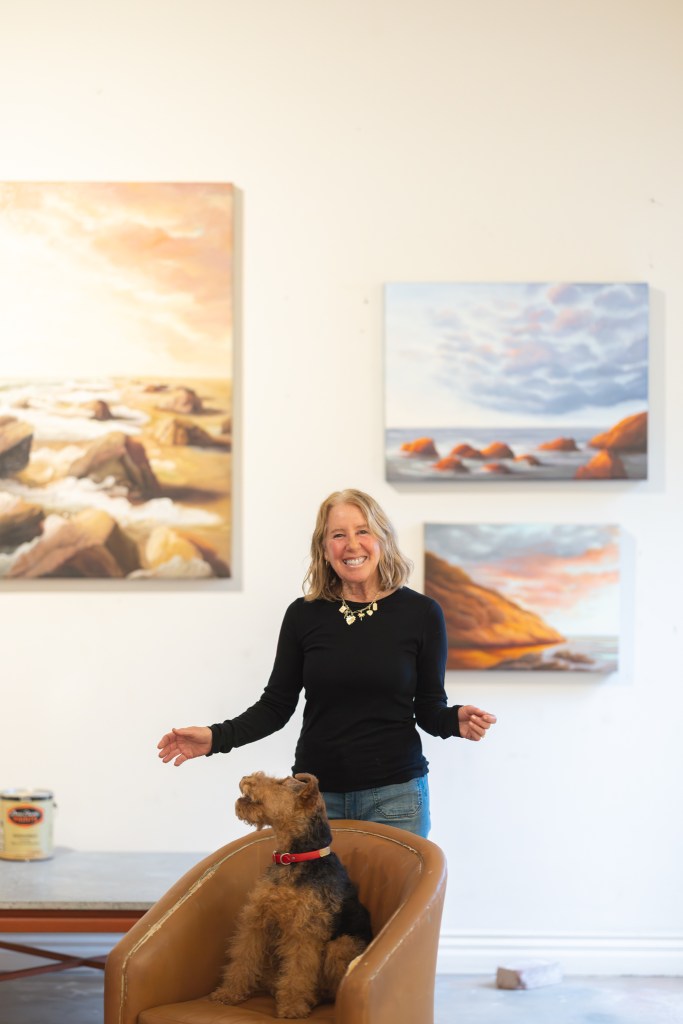
I was greeted by a rambunctious Welsh terrier named Buster, who was full of energy and happy to interact. Brunner kept apologizing for his behavior. She’s a formidable character, and one of the most fascinating people I have met in this town. She speaks softly but with an intensity, especially when it is directed toward her work.
“I do feel that 50 percent of whatever I am currently working on derives from all the art I’ve done up to now,” she said, with a distinctive combination of confidence and vulnerability. “A continuum. An organic thread that I hold on to. A connection to what is me and what is the natural world out there. What’s new and what’s fresh is often a surprise to me. Maybe a new pattern, an unusual plant, or an odd way of lighting appears, and then becomes part of my repertoire… . I consider myself an instinctive painter. So, much of the time, the painting speaks to me and guides me, and I trust it and go with it. But there are plenty of times when I am completely lost and empty. I put the paint on all day, then scrape it off and have to wait for those internal instructions, for that vision to reappear. This is the process. There is magic involved here.”
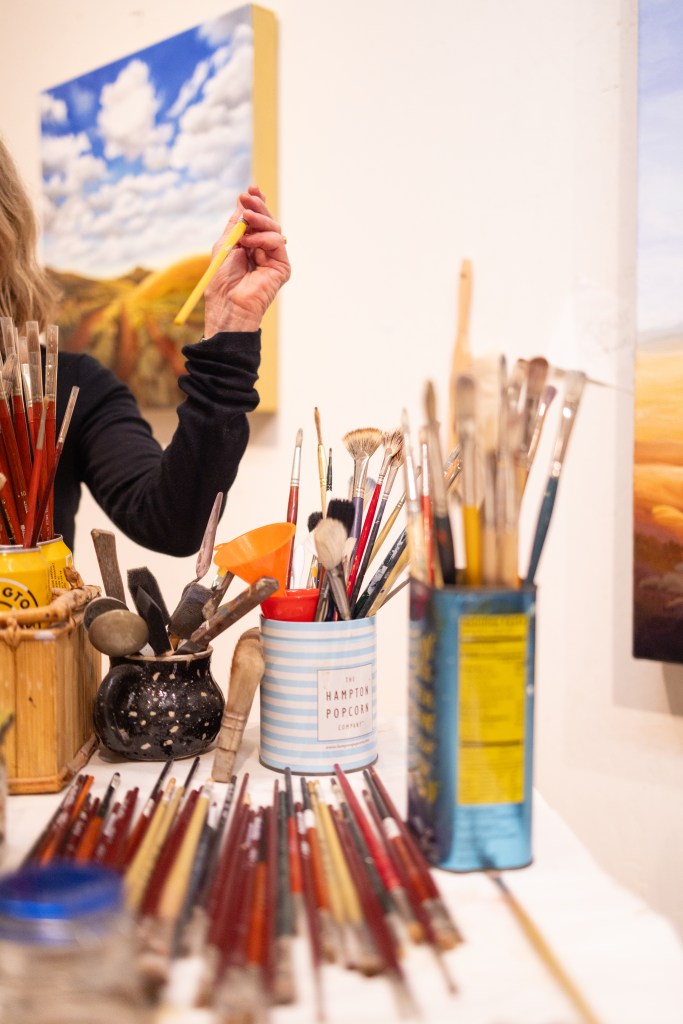
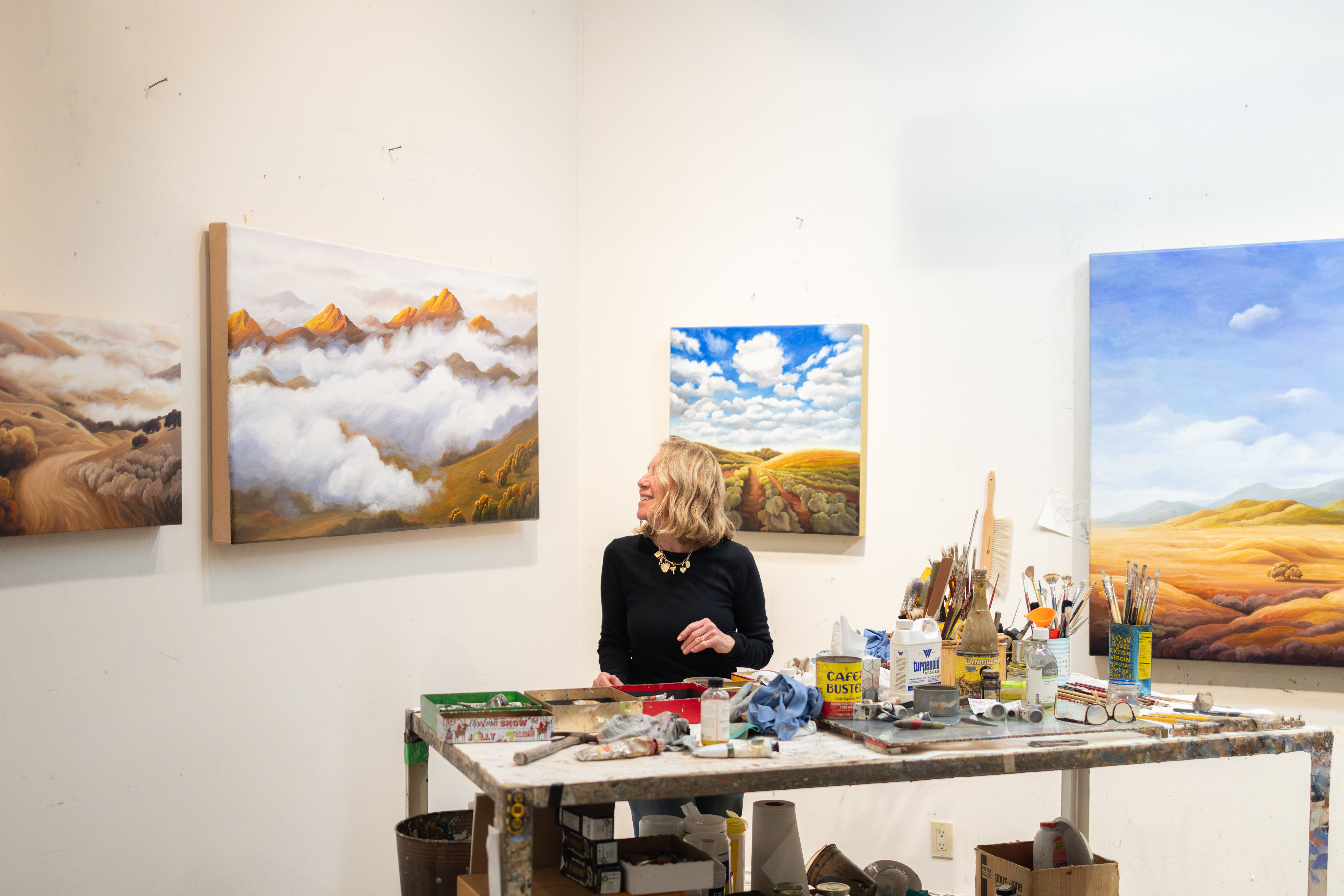
Brunner and Buster led me to her paint studio — a high-ceilinged room with plenty of light. It looks like a gallery space with its white walls — and all of the paintings that are going into her exhibit at Sullivan Goss are on display.
“Phoebe’s profound dedication to her practice is evident in everything she paints,” said Patricia Rovzar, owner of her namesake gallery in Seattle, which showcases Phoebe’s work. “Over the years, Brunner has thoughtfully refined and adjusted her process, consistently raising her own bar. This maturity and development have allowed her work to speak to a much broader audience than earlier in her practice.”
Brunner, Buster, and I sat in her studio, studying her paintings. “The most formative experience of my life happened when I was 9 years of age,” Brunner said. Born in N.Y.C., she went to live with the Hollister family on their 15,000-acre coastal cattle ranch, one of the original Spanish Land Grant ranchos near Santa Barbara.
“My fondest memories,” she reflects, “that inform my art today are roaming alone on horseback for hours and hours, up and down the canyons, seeing the land go on forever, absorbing the colors and patterns of the natural world around me.”
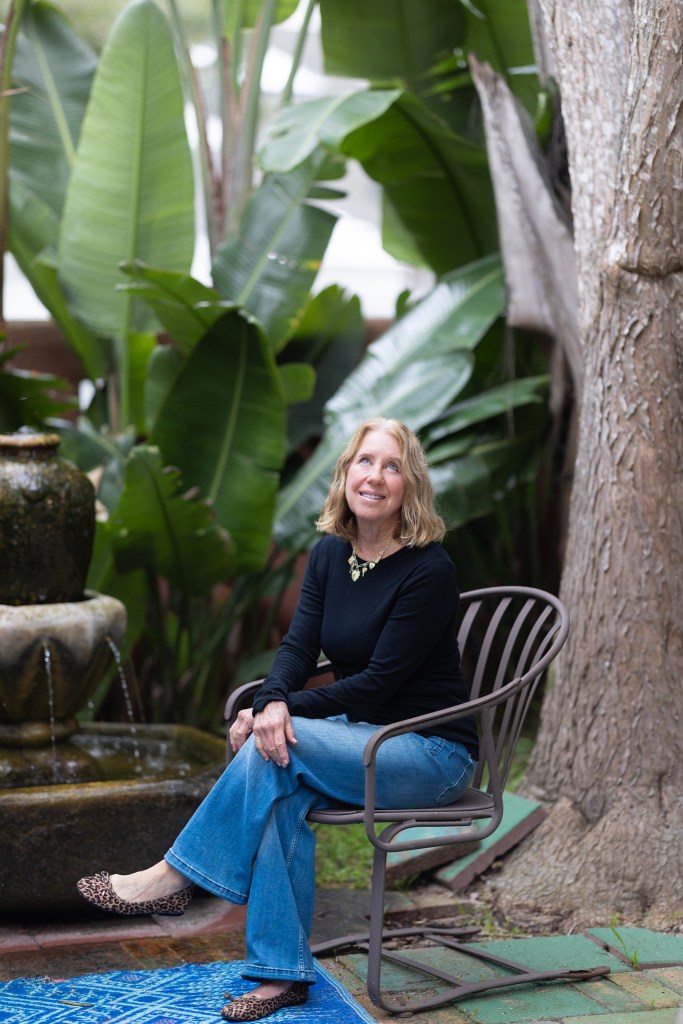
One of the ranchers would saddle a horse for her. There were no buildings, no paved roads. Young Phoebe felt connected to nature and was impressed by how serene it all was, how quiet. For her, nature was a refuge, and it was full of spirituality. The landscape was her family; it was her friend. She loved traveling through those hills.
“My paintings are rooted in memory and experiences,” she said. “The contemporary landscape paintings that I still do today are tied to those memories and experiences in a deeply primal way.” It is worth noting that in her work, you rarely see people or buildings. “In my paintings, the most I put in is a road,” she said. “I want to wake up people to nature.”
The title of the exhibit, A Radiant Solitude, alludes to this seminal time in Phoebe’s life. “I think the works in this show celebrate moments of solitary wonder,” Nathan Vonk said. “They try to capture the magic of a longed-for seclusion, where the fact that you are alone heightens the beauty of the world around you.”
“I have never been a realist,” Brunner tells me. “I started with my own vision from the beginning. I listen to the painting. You have to have courage and confidence, and be open to let the painting guide you. There are no rules in art. It’s good to have some base, to have technique, but then break the rules — bend them.”
In putting together her dream landscapes, she said she combines a real location that she has visited with dream images. She also uses photographs that she then enhances. The work remains recognizable enough to the viewer that it tricks them into thinking that what they’re seeing is an actual place — or in some other instances, it makes them question what they’re seeing. They find enough familiarity in the work that it speaks to them. Brunner is conscious that her work has to be rooted in an actual place, and then she adds the artifice to extend the reality. The result is an emotional work that recreates a memory or an experience, like the physical feeling of a breeze on your skin.
“I seduce the viewer with beauty,” Brunner said. “There is a physicality that allows the viewer to travel through the painting, beckoning — it’s an invitation.”
She uses forced perspective; vanishing points; a strong composition exploiting foreground, midground, and background; and a balance of light. “The light — I want the light to draw the viewer in like the moth to the flame,” she said. “With it, I create the sensuality you see in the work. I’m getting better at making the light more powerful.”
We spoke about how she’s able to generate a contrast of temperatures within the paintings with her usage of lighting. It’s very cinematic and intense. Brunner explains that she uses multiple layers of paint, and that is how she’s able to convey a sense of depth and luminosity. “I have a love affair with oil paint,” she said. “It allows me to have a richness. I’m intrigued by what it offers me … a juicy depth.”
Brunner confesses that she feels like a third-generation Santa Barbaran. She attended Laguna Blanca School for 5th and 6th grade. She recalls her art teacher, Natalie Hansen, and hanging out in her classroom, for all she wanted to do was art. Hansen provided young Phoebe with the space and the outlet she needed. Brunner lived for a while in San Francisco with renowned theater actress Kathleen Chalfant (a Tony nominee as part of the original cast of Angels in America) and her husband, the painter Henry Chalfant.
In 1968, Brunner graduated from Santa Barbara High School, where beloved art teacher Jack Baker further encouraged her creativity. Immediately after, she went to Chouinard Art School (before it became CalArts) from 1968 to 1970. She acknowledges that she had a difficult time in art school. She wasn’t doing the assignments, and she was adamant about sticking to her own vision. In 1970, she returned to Santa Barbara and enrolled in the College of Creative Studies at UCSB. She worked with biologist Dr. Beatrice Sweeney on a notebook of wildflowers as one of her graduation requirements.
After graduating in 1972, she returned to Mexico, where she had spent the summer of 1970 in the Escuela de Artes Plásticas in Guadalajara. She was intrigued by the folk art. “I loved the bright colors,” she said. “It’s hard for me to be subtle.” At 21 years old, she had her first show in a gallery in the Upper Village in Montecito, where she sold paintings. For many years, she was represented at the Ellen Easton Gallery, in addition to numerous other galleries up and down the West Coast, and has won several awards. She had her first show at Sullivan Goss in 2015.
This uncommon artist has been painting for more than 50 years.
I am intrigued by a series of paintings in this exhibit of wildflowers that seem to be mutating into agaves. “I am starting to explore cactus forms,” she said. “When I pick a flower, it has to be indigenous, or there has to be something wild about them. They’re attached to something thorny.”
The flowers depicted are strong, fierce creations — defiantly in the foreground with a landscape in back of them. Phoebe tells me that during the drought, she did a series called The Seeding. She no longer paints the seeds but has continued with the flowers. There is a human characteristic to these works. They come across as portraits. They are fluid — swaying with the wind or because of some internal necessity. I cannot help but think of the painter as I admire these works: Phoebe the uncompromising artist dancing to the beat of her own drum.
“She has a remarkable ability to interpret nature in all of its vibrancy, movement, and power,” said Nora Hurley. “Her subjects seem to breathe and pulse with life, whether she is painting rolling valleys, coastal hills beneath enchanting skies, dramatic clouds releasing rain, spiraling floral blooms, or crashing surf reaching toward the shore. Each element feels individual and full of character.”
Phoebe Brunner: A Radiant Solitude is on view at Sullivan Goss Gallery (11 E. Anapamu St.) January 30-March 23. Meet the artist at a 1st Thursday opening reception on February 5, 5-8 p.m. See sullivangoss.com.




You must be logged in to post a comment.