

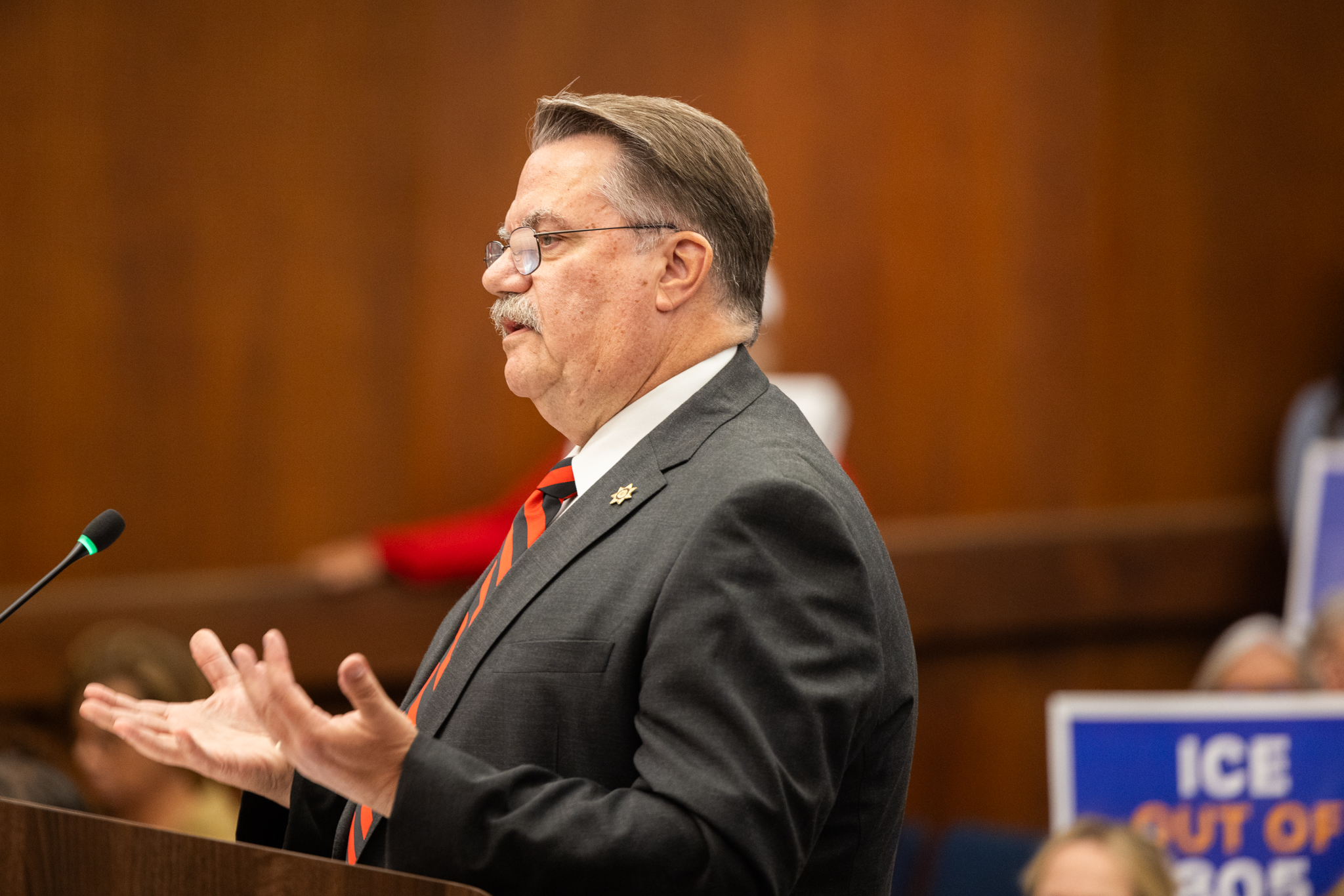
Last week at the U.S. Capitol, in one of my final duties as president of the Major County Sheriffs of America (MCSA), I presented Senator Amy Klobuchar of Minnesota with our organization’s Legislator of the Year Award for her commitment to public safety and her record of collaborative problem solving. In accepting the award, Senator Klobuchar said, “I always believe that courage is not standing by yourself yelling at people in the Chamber, but courage is whether you’re willing to stand next to someone you don’t always agree with for the betterment of this country.”
In a statement I wrote on the recent events in Minneapolis, I said the tragic shooting deaths of Renee Good, a 37-year-old mother, and Alex Pretti, a 37-year-old nurse, were gut-wrenching tragedies. I also said the investigations into both should be allowed to conclude before judgement is cast, and I expressed concern that inaccurate and provocative remarks made by political leaders on both sides of the aisle exacerbate polarization and make the goal of achieving bipartisan immigration reform even more elusive.
At a subsequent protest rally held in Santa Barbara, several local elected officials demanded I speak out against federal law enforcement actions and explain how the Sheriff’s Office can protect the community from immigration enforcement. In response to my statement, 2nd District Supervisor Laura Capps told the crowd, “I disagree with the Sheriff. This is not a moment for both side’s language.”
Actually, there should always be room for differing perspectives. Differences matter. All voices should be heard and considered — especially now — without demonizing one another. Two things can be, and often are, true at the same time. We should be cautious of groupthink, and understand that alternative ways of thinking don’t cancel each other out.
During the past year I have spoken about immigration enforcement publicly and repeatedly, at Board of Supervisors meetings, during an in-depth interview with a respected local journalist, at community meetings, and, most recently, I released the above-referenced remarks on the troubling events in Minneapolis. Contrary to the rhetoric, I have not been silent on this issue. I just haven’t said what some people have wanted to hear.
In all of my communications I have made it crystal clear that the Sheriff’s Office protects and serves everyone in our community, regardless of their immigration status. We do not want anyone who is undocumented to hesitate to call us if they are a victim of crime, or if they witness to a crime. We do not enforce or assist in enforcing federal immigration law in our community, except as sparingly permitted by state law in our jails. I have also said — numerous times — that local law enforcement does not have authority over federal agencies carrying out their duties in our county. Accordingly, we do not interfere with federal law enforcement operations, just as we expect that they will not interfere in ours.
Anger at the aggressiveness and scope of the federal government’s immigration enforcement actions is understandable. The surge in these operations and the two shootings in Minneapolis have heightened emotions and outrage across the nation and here at home. I share many of the concerns that have been expressed about the shootings and intensified enforcement actions.
The fear and heartbreak experienced by undocumented people in our community, especially those whose loved ones have been detained or deported, is real and distressing. Across political lines, many of us recognize that people who entered this country in violation of immigration law, or who were brought here as children but have otherwise been law-abiding, often for decades, are usually good, productive people who contribute very positively to our communities and economy. Many have become business owners and reliable employees who work in agriculture, construction, the hospitality and service industries, in providing child and medical care, and in other trusted positions. They have become our neighbors, colleagues, and friends. Some have given birth to children who are American citizens. Given their situation, current law should be changed so that these long-term residents and Dreamers could be properly vetted and offered a path to legal residency and work approval. As both Presidents Clinton and Obama have stated, “We are a nation of immigrants, but we are also a nation of laws.”
At the same time, we must always be willing to acknowledge difficult truths. While the vast majority of those who have entered this country illegally did so in search of a better life and have remained otherwise law-abiding, there have also been many serious crimes committed by unlawful entrants. Americans across our nation worry about criminal activity by members of violent gangs, organized theft groups, smugglers and dealers of illicit and often lethal drugs (which killed almost 350 people in our county in just the last three years), and other serious and violent crime committed by undocumented criminals. These have included some notorious homicides here in Santa Barbara County, including the brutal murder of Marilyn Pharis, a 64-year-old Air Force veteran who was sexually assaulted, strangled, and fatally beaten with a hammer by a repeat undocumented offender who broke into her home in Santa Maria in 2015. The following year, during a sting called Operation Matador in Santa Maria, 13 of the 16 suspects arrested for the MS-13 gang-related murders of 10 victims — and the attempted murder of 14 others — were identified by ICE as undocumented. These heartbreaking tragedies underscore the need for immigration law and enforcement reforms that protect public safety while still upholding our collective values.
Over the past two years, while president of the MCSA, I engaged directly and candidly with members of both the Biden and Trump administrations, as well as with members of Congress and other law enforcement leaders, on the issues of border security, immigration enforcement, their impact on local jurisdictions, and the urgent need for reform. As MCSA president, I was present at the White House when the bi-partisan supported Laken Riley Act was signed into law in January 2025. This law was named after a 24-year-old nursing student who was assaulted with intent to commit rape and beaten to death by an undocumented, repeat offender in Georgia in 2024. The Act requires the Department of Homeland Security to detain undocumented criminals who are arrested for certain crimes like burglary, assault on a peace officer, and some thefts, several of which her killer had previously committed. Although I recently passed the gavel to a new MCSA president, I’ll continue my efforts as a member of its executive board, advocating for secure borders and fair, effective, and humane enforcement practices that will keep our nation and its communities safe.
It’s important to remember that Americans don’t think alike on undocumented immigration. A Harvard CAPS (Center of American Political Studies) / Harris Poll on January 20, 2026, of 2,000 likely voters, divided almost equally between Democrats, Republicans, and Independents, showed that the vast majority favored the deportation of undocumented immigrants who have committed violent crime (82%), any crime (73%), and a majority of them (52%) still supported the deportation of all immigrants who are here without legal status. With our nation split in half on the issue of immigration enforcement, there is plenty of contention on both sides.
Even though we are polarized, we are all part of the same democratic republic. Again, listening to one another is important. Each side has valid points to make, and both sides matter. Although our country is deeply divided on immigration, sooner or later we must find a solution to this problem. This complex and deeply emotional issue will only be resolved through meaningful changes to existing immigration law, with related changes in enforcement policy, training and practices. I believe there are some areas where consensus or compromise is possible. That change should include thoughtful reform that properly addresses border security and public safety, while at the same time ensuring fairness, proportionality, and humanity in enforcement and detention operations. That reform should also allow federal authorities appropriate access to our nation’s jails, so they can safely take undocumented criminal offenders into custody there, instead of doing so unsafely and alarmingly in our neighborhoods.
In the meantime, everyone should adhere to the law, and it should be enforced fairly, courteously, and professionally. We can support the law, or we can work to change it, while still having empathy and compassion for others. We must support the right to peaceful protest and civil discourse, whether we agree or disagree with what’s being said. Respect and decency must remain the standard.
Abraham Lincoln once warned that “a house divided against itself cannot stand.” While the challenges before us are complex and difficult, we owe it to one another to engage on issues respectfully, seek common ground, and urge our congressional leaders to work together in good faith to compromise, and craft and pass comprehensive bipartisan immigration reform. That is the key to meaningful change in the immigration quandary.

