
Finding ‘The One’ Can Make You
a Stranger to Yourself
Surviving the Pressure to Choose the Perfect Dress
By Tiana Molony | February 26, 2026
Read more from the 2026 Wedding Guide here.

Someone once told me, though I can’t remember who, that a wedding dress is the most important dress of a woman’s life. It is not a statement I necessarily agreed with, though the line has followed me around since I got engaged, repeating itself like a stubborn virus I can’t shake.
I began to feel it most acutely in the back of an Uber in New York City in December, on a girls’ trip with my mom, sisters, and niece, on my way to one of the three wedding-dress appointments I had scheduled that day.
The pressure to choose the perfect dress — loved by you and your family, accompanied by the perfect moment — is reinforced in pop culture, in movies such as Bride Wars, where Kate Hudson slips into a Vera Wang gown and simply knows it’s the one. No hesitation, no committee, no second-guessing — just a clean, cinematic certainty.
When the elevator opened onto the SoHo bridal salon, it looked less like a place where people actually shopped than a set for a scene. An elegant pinstripe couch, pleated fabric walls, a landscape painting, and a faint floral smell greeted us. Immediately, I felt the pressure to deliver for my sisters and mother. I wanted to give them the reaction we all expected — the moment every bride hopes for when she finally finds “the one.”
We would be in the blue room, the stylist told me. It was as it sounds: pale blue walls, soft lighting, and warm drapery. As I slipped into the first dress, a two-piece ensemble with a structured corset, vaguely Grecian — I have never been to Greece, though my name actually means “princess” in Greek, so if I were a Grecian princess in my past life, this is what I would have worn, but — I knew it would be too bold a choice for us all to agree on, so it was a no.
As I tried on this and other dresses, every time I stepped out of the dressing room, I didn’t peer at my own reflection first. Instead, I looked at my family’s faces — scanning for approval, waiting for the sides of their mouths to curve upward. Quickly, everyone’s opinions — “too matronly,” “too modern,” “not very you,” — started circling me as a shark circles its prey. One of my sisters was actually circling me.
The next dress was a ball gown, picked by my sister, who often harps on about her wedding-dress shopping experience and her eventual regret. Donning the ball gown, I suddenly felt like I was wearing the wrong skin.
It is a vulnerable thing, standing half-stranger to yourself in front of a mirror while opinions fly at you like darts at a board. The insecurities I had thought were buried resurfaced. I hadn’t cared about the keratosis pilaris on my arms until now. Was that a new mole? But my family loved the dress, so much that I thought they must be right. And I began to think this was the one.
I could fool my family and even myself, but the stylist wasn’t having any of my self-deceptions. “Look,” she told me, “I can tell you don’t like this ball gown. Don’t get it.”
Damn, I thought. She’s good.
“I’m watching your reactions,” she said. Noted.
By late afternoon, the sun was sliding down over SoHo, washing the fitting room in pink and orange light. I stood in front of the mirror, watching the color change on my skin, wondering which version of myself I was meant to choose.
Right then, the stylist helped me into a dress. I’ll admit, it was beautiful, and when I walked out, the room seemed to inhale at the same time, and I felt something rise in me — not a thought, exactly; more like a cue I had been waiting for. I started crying before I understood why. Maybe it was relief. Maybe it was the sense that I was finally delivering the reaction the day had been building toward.
I walked out to the larger mirror at the center of the store, past another bride turning slowly in her own dress, and I gave her a small, conspiratorial smile, the kind meant to say, “This is the moment; yours will arrive soon enough.” Everyone trailed behind me. My sisters were smiling, my mother was already teary, and their faces explained, more clearly than any mirror could, what I was expected to feel. I was almost certain it was the dress, if only because their certainty was so loud.
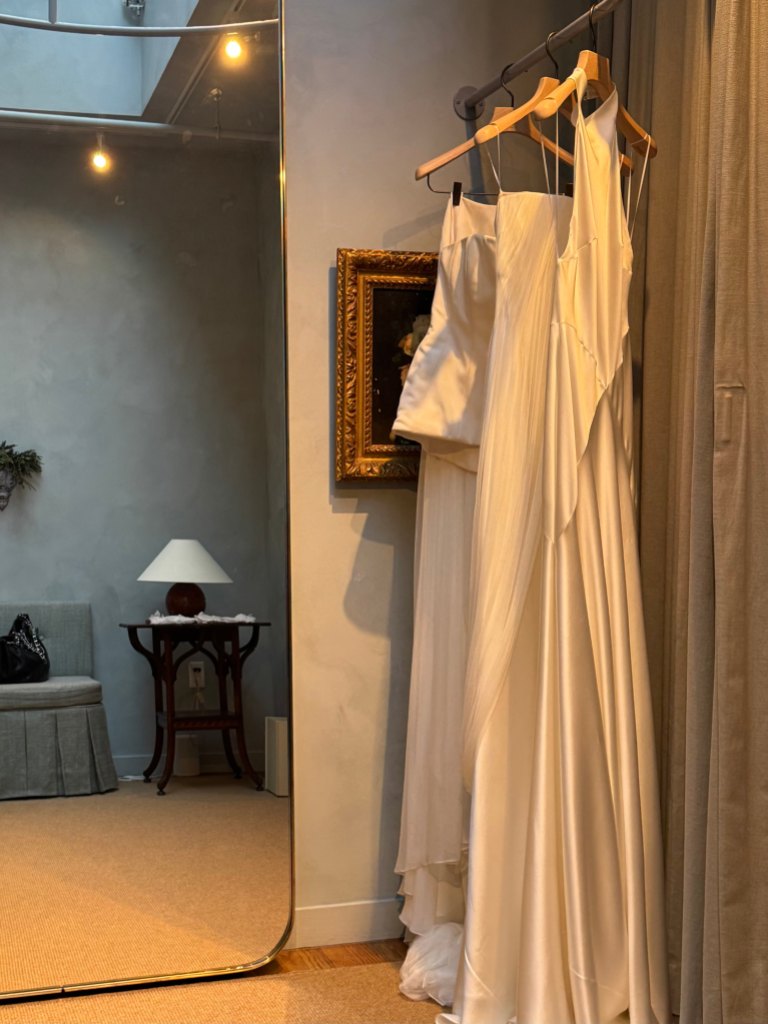
The stylist smiled at me and handed me a box of tissues.
I felt like I’d accomplished something. I’d delivered the moment expected of me. Back in the dressing room, I put back on my street clothes, hardly as elegant, and was smacked back into reality.
That night, unable to sleep, I scrolled through photos from the day. Decision paralysis set in like a fever. I thought I had found “the one,” but it was impossible to hear my own instincts over the chorus of voices still echoing in my head. That’s why I love nighttime — even with the cries from New York below: sirens, horns, interminable yells. When the world shuts off, I find it’s one of the only times I can actually think clearly.
And here is what I concluded while hiding beneath the crisp hotel sheets, face illuminated by my phone screen: I had cried in that dress and decided that the tears were proof it was the one. I was swayed by other people’s voices. I had not, as it turned out, thought very much for myself. I had actually spent most of my time in that dress looking at my family rather than looking at myself.
The dress was beautiful. In another life, she and I might have been very happy together. But I realized that it actually wasn’t “the one.” I changed my mind, and in doing so felt as if I were committing a crime.
A few weeks later, I went to another appointment in Los Angeles, the New York dress stored somewhere at the back of my mind like a fact I had not yet decided what to do with. The stylist zipped me into a gown I had not expected to like, and I did. I really did. I waited for the familiar swell — the cue to cry, the thunderclap of knowing.
It did not come.
What came instead was quieter: a calm, almost ordinary contentment, a feeling I can only describe as akin to turning your pillow to the cold side. I looked in the mirror and recognized myself without first checking anyone else’s face. No chorus. No darts. No performance. Just a small, unremarkable certainty.
That was the dress.
It had been unrealistic to expect a spectacle and to blame the silence when the spectacle failed to arrive. The truth is, most decisions don’t come with fireworks. They feel like a long exhale after breaking the surface, after time spent being tussled by the waves.
A wedding dress is hardly the most important dress of your life. It is only a dress — silk and thread and a few clever seams. What matters is something less theatrical: choosing individual certainty over flattery in a room full of people.
I chose a dress. In eight months, I’ll wear it. I’ll walk down the aisle and get married. Then, I’ll take it off. I’ll send it off to be dry-cleaned and preserved, then put it on a shelf. One day, maybe I’ll have a daughter, and maybe she’ll get married, and I’ll take it down and try it on again. Then, unless she decides to wear it, I’ll pack it up and place it back on the shelf.




You must be logged in to post a comment.