

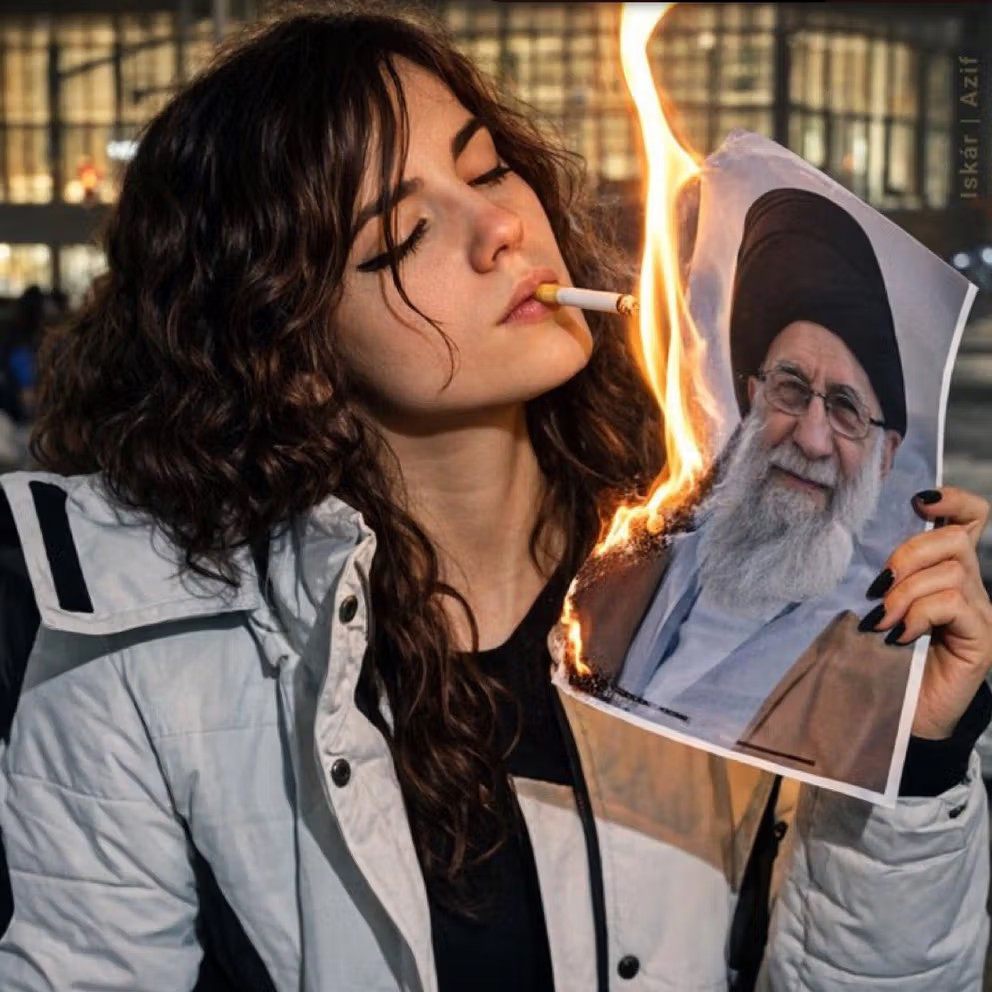
Boghz. The Farsi word for the lump in the throat just before tears come — that tightening the body knows before the mind can form words. Many of us in the Iranian diaspora, and many more who are watching with open hearts, have been sitting with boghz as the events in Iran and throughout the Middle East unfold. The tears come over and over again, washing over us in waves.
I am the daughter of Iranian parents who immigrated to the United States in the 1970s, before the Islamic Revolution of 1979 transformed their homeland into something unrecognizable. Growing up, I carried a particular kind of sorrow that is the texture of diaspora life: loving a country overflowing with poetry, music, and ancient beauty, while watching it be stifled and silenced. The richness was always there. The access to it was constrained by an oppressive regime and, in me, by a helplessness I could not explain.
What I did not yet have a name for was moral injury.
A Wound to the Moral Core
In December 2024, the American Psychiatric Association formally recognized “moral problem” in the DSM-5, a landmark step that validated what trauma researchers have long observed: Some of our deepest wounds are not simply about fear or danger, but about the violation of what we hold sacred. Researchers at Harvard’s Human Flourishing Program have proposed a “moral trauma spectrum” that moves from moral distress (the acute suffering that arises when our sense of goodness in the world is violated) to moral injury (when that distress becomes persistent and severe) to moral injury disorder (when it is both profound and unremitting).
This spectrum describes what many in the Iranian diaspora — and countless Iranians inside the country — have been living with for decades. We watched the Islamic Regime crush the Iranian Green Movement in 2009, when many risked everything for basic freedoms. Then came the Woman, Life, Freedom Revolution of 2022, a wave of raw courage that the world witnessed and that the regime again crushed with brutality. Each time: a glimmer of hope, a surge of life force, a massacre, a silencing. Moral distress, snowballing into moral injury.
And then, in 2026, the largest uprising yet, with an estimated 1.5 million Iranians taking to the streets, followed by the massacre of what may be up to 40,000 people by the Islamic Regime in a matter of days. Shortly afterward came the bombings by U.S.-Israeli forces, dismantling some elements of the regime while simultaneously spreading destruction throughout the wider region. The grief is staggering. The moral weight is almost unbearable.
Research on politically induced moral distress tells us that this suffering is both physiological and psychological. The prolonged stress of living under — or witnessing from afar — an authoritarian regime that violates human dignity produces chronic fear, depression, helplessness, and a deep disruption of one’s faith in the goodness of institutions and of the world. For diaspora communities, this is compounded by intergenerational trauma: The wounds do not begin with us. They are carried in the body, passed down through families across generations, reactivated every time the cycle of violence repeats itself.
The Life Force That Cannot Be Contained
And yet there is something else I keep noticing, something that moves me as profoundly as the grief does.
If you watch the videos of the Iranian protesters in the streets — even those filmed while the risk of being shot was real — what you see is extraordinary. There is music. There is poetry recited aloud. There is dancing. There is a vibrancy and luminosity that seems almost impossible under such conditions, and yet there it is: an insistence on beauty and aliveness that no regime has ever managed to extinguish, because it lives too deep in the people themselves.
I have a persistent feeling that something has been irrevocably cracked open. Too many lives lost. Too many people have looked each another in the eyes and said: we will not go back to invisibility. The opening that exists now — however incomplete, however dangerous — carries an energy that feels even stronger than the uprisings before it.
Holding the Light
Research on resilience in the face of political trauma tells us that what sustains people through collective suffering is the experience of being witnessed: of knowing that others see them, that their pain and their courage are not invisible to the world. For those of us in the diaspora, and for all who are watching with open eyes and open hearts, this is something we can offer.
I feel the boghz as I write this. The lump in the throat, the grief that lives just below language. And then I return to what I know: that holding space for hope is not naïve. It is a moral act. It is how we honor the dead and accompany the living.
So we continue to hold the light for the people of Iran. To say, with all the steadiness we can gather: We see you. Keep going. We are here with you, all the way.
All eyes on Iran.
Anahita Navab Holden, PhD, is a somatic psychotherapist and meditation teacher in Santa Barbara. She teaches through Yoga Soup (yogasoup.com) and Mindful Heart Programs (mindfulheartprograms.org).

