
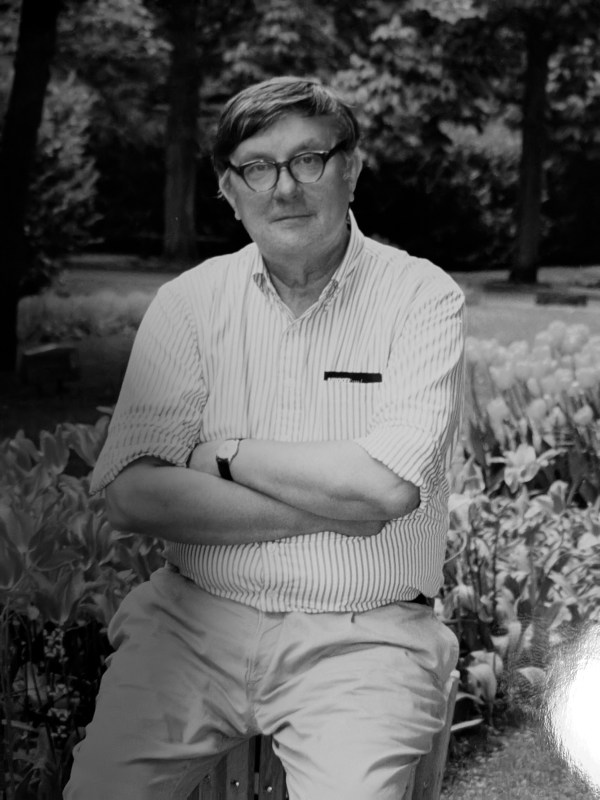

J. S. A. Elisonas
J. S. A. Elisonas, known to most of his American friends as George Elison, died on September 17, 2025, at the UCLA Medical Center in Santa Monica. It was 1:33 on a sunny California afternoon. The proximate cause of death was respiratory failure. He was 88, and had lived a full, well- examined life.
He was a scholar and a gentleman of many parts. He held strong opinions about food, drink, art, books, music, and sports (as well as most other things). What he liked he liked with great enjoyment. Possibly more than anything else, he enjoyed big helpings of words. At Indiana University, where he taught for many years, he was once introduced with the line, “He speaks every language in the world but English.” For the record, the one thing about his English that might have struck a university president as odd was a sort of exacting correctness. He spoke and wrote Lithuanian, German, and Japanese with ease and aplomb; did scholarly work in Latin, Portuguese, Spanish, French, Dutch, and Chinese; and could get by—or confidently improvise—in many other languages. In his later years especially, his favorite thing was to hold court at the table among his family and friends, telling stories that would characteristically feature lines in song, multiple accents, and big belly laughs.
Jurgis Saulius Algirdas Elisonas was born on January 6, 1937, in Kaunas, Lithuania, to Jurgis Elisonas, a prominent zoologist, folklorist, and aviator, and Ona Kunskaitė-Elisonienė, a physician. Inevitably, his childhood was defined by the Second World War. In 1944, the family tried to flee the return of the Soviet army on a boat bound for refuge in Sweden. They were intercepted in the Baltic by a German naval vessel and taken to the Reich where, settled alongside other Europeans of various nationalities, they were put to work within the Nazi labor system. Liberation by the US Army in 1945 was followed by their resettlement at a series of sites within the American zone of occupation under the official designation of Displaced Persons. Jurgis would remain in Germany until after the passage by Congress of the Displaced Persons Act of 1948. This milestone in refugee law opened the United States to 200,000 immigrants from Europe. Among them was Jurgis, who crossed the Atlantic in 1949 with his aunt and sister to a new home in Williamsburg, Brooklyn.
George S. Elison was enrolled at the College of St. Francis Xavier in Manhattan (now known as Xavier High School). His Anglicized name would become official with his naturalization in 1955 as a US citizen. Following his graduation in 1953, he went to study at the University of Detroit— like Xavier, a Jesuit institution—before transferring to the University of Michigan, where he earned an A.B. in History and German Literature in 1957. From 1957 to 1959 he served as an officer in the US Army. He received an A.M. in History from Michigan in 1959.
Lieutenant Elison completed the bulk of his service with the First Field Artillery Battalion of the 31st Artillery, Seventh Infantry Division, stationed in Korea just south of the Demilitarized Zone. It was while on leave in Tokyo, attending a kabuki performance, that he met the woman who would become his wife, Toshiko Nakabayashi, a native of Kyoto. To this period of military service can also be dated the start of a second lifelong romance—with the study of Japanese history and culture.
In 1959, he entered the Ph.D. program in History at Harvard University. George wed Toshiko in a civil ceremony in Cambridge, Massachusetts on April 11, 1962. Two sons arrived in 1968 and 1970: William Noboru and Antony Hayami. Right in between, in 1969, George managed to complete his thesis, “Deus Destroyed: The Image of Christianity in Early Modern Japan,” and was awarded his doctorate. Harvard University Press would publish a revised version of the work under the same title in 1973; it was to be his best-known book.
Professor Elison got his start in 1965 at Colby College in Maine, where he was based for ten years. In 1975, he took up an appointment in the Department of East Asian Languages and Cultures at Indiana University, which would remain his academic home through to his retirement in 2001. But his many visiting appointments over this course tell a story in themselves. He held positions in this country at Harvard, the University of Hawai’i, and (post-retirement) Williams College; at Kyoto, Tenri, and Rikkyo Universities in Japan; and at the University of Leiden in the Netherlands. He won many research grants, and continued publishing scholarly work nearly up until the end of his life. He cultivated ties with the academic community in Japan and also in Holland and Portugal, countries whose early contacts with Japan were one area of specialization. His interests as a historian ranged wide, but the research method never strayed: he was a meticulous reader of primary texts, whether Jesuit archives, kabuki plays, or the chronicles of samurai warlords. Through his life, one constant was his favorite book: Don Quixote, read and reread in Spanish and in many translations.
In 1990, Lithuania reclaimed its independence from the Soviet Union. George marked this long- anticipated restoration with a personal gesture: he filed to be legally recognized by his birth name. On March 3, 1993, the name change went into effect, and George S. Elison once again became, officially, Jurgis Saulius Algirdas Elisonas. He and Toshiko continued to make their home in Bloomington, Indiana, for many years, enjoying travel to destinations including Lithuania and Korea as well as Japan and elsewhere in Europe, Asia, and the Pacific. In 2019 they moved to Santa Barbara. The lush beauty of their new surroundings was a continual source of happiness. Jurgis developed a special fondness for the jacarandas, never failing to say the word in a Portuguese accent.
He was a big presence, and his departure leaves a big absence. Jurgis Elisonas is survived by his wife Toshiko; his sons William and Tony; his daughters-in-law Elizabeth and Yasuko; and his grandchildren Charles, Catherine, Raphael, and Georgina. This June 20, his family convened a memorial dinner at the Ellwood at Goleta Beach to celebrate his life. Among the many friends who assembled from distant corners, former students were well represented. Donations may be made to Refugee Council USA, Refugee Empowerment International, or CARE.

