

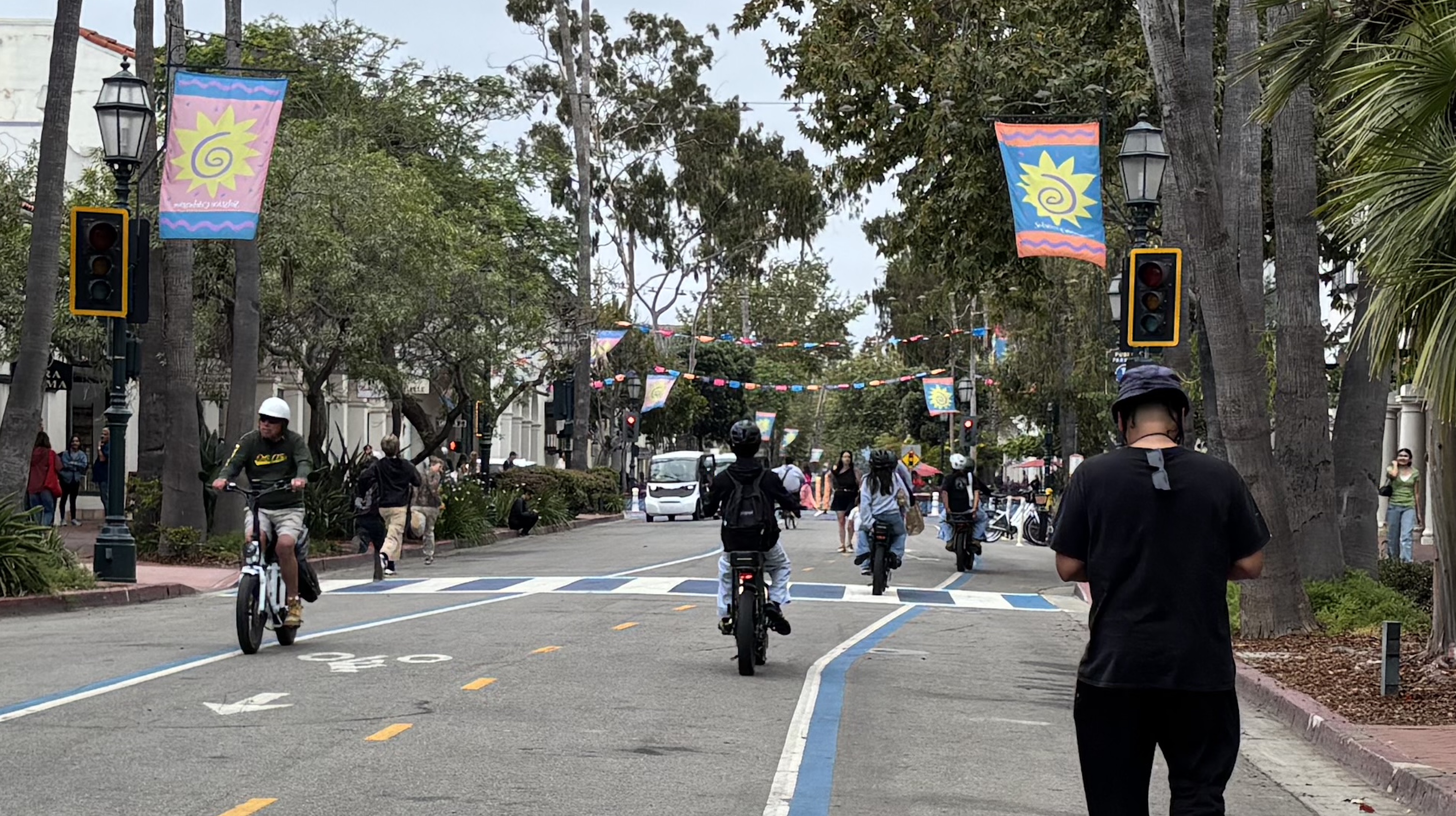
As Santa Barbara considers extending the State Street closure through Title 31, the community faces an important question: Are we making a permanent decision before the conditions for success exist?
The recently released State Street Master Plan presents an ambitious vision for downtown—a vibrant pedestrian-oriented district supported by 2,000 to 3,000 new housing units, greater residential density, improved public spaces, enhanced transportation options, and a stronger mix of businesses and amenities. It is a compelling vision. The question is whether Santa Barbara has reached that point today.
Six years after State Street was closed to vehicles, the answer remains unclear.
Several of the outcomes that proponents anticipated have yet to materialize. Storefront vacancies remain a concern, the residential density envisioned by the Master Plan has not been achieved, and conflicts between pedestrians, bicycles, and e-bikes continue despite the absence of regular vehicle traffic. While State Street has become an important venue for events and public gatherings, the closure has not yet demonstrated that a permanently car-free corridor can consistently deliver the economic vitality and activity needed to sustain downtown year-round.
That does not mean the vision is wrong. It means the sequence may be.
Supporters of permanent closure often frame the debate as a choice between cars and people. It is not. The real question is how to create the safest, most functional, and most economically sustainable downtown while the city works toward its long-term goals.
Today’s State Street is not exclusively pedestrian. Pedestrians, bicycles, e-bikes, scooters, delivery vehicles, maintenance vehicles, and emergency vehicles already share the corridor. While vehicle traffic has largely disappeared, conflicts remain. Many residents and visitors report feeling uncomfortable navigating around fast-moving bicycles and e-bikes in what appears to be a pedestrian space.
A flexible shared-street model deserves serious consideration. Low-speed vehicle access, clearly defined bike lanes, designated pedestrian crossings, and mid-block pedestrian signals could improve safety and predictability while preserving the ability to close portions of the street for farmers markets, festivals, parades, and community events.
This approach is also consistent with the goals of Santa Barbara’s Safe Streets for All Action Plan, which seeks to reduce traffic-related injuries and improve safety for pedestrians, bicyclists, transit users, and motorists. By creating clearly defined travel zones, enhancing pedestrian crossings, improving bicycle facilities, and incorporating traffic-calming measures, the city can create a safer and more predictable environment for all users. Importantly, the Safe Streets initiative focuses on achieving safer outcomes through design, engineering, education, and enforcement—not on permanently closing streets to vehicle access.
Such an approach would also be fiscally responsible. Santa Barbara faces significant budget challenges, and many of the long-term improvements envisioned in the Master Plan remain unfunded. Reconfiguring the street through striping, signage, traffic-calming measures, and targeted safety improvements would cost far less than permanent reconstruction while allowing the city to evaluate results and adapt over time.
The success of downtown will not be determined solely by whether State Street is open or closed to vehicles. Through the Downtown Santa Barbara Improvement Association, property owners are investing in enhanced maintenance, beautification, safety initiatives, marketing, lighting, and community events that strengthen downtown’s appeal and support local businesses. These ongoing efforts demonstrate that revitalization requires a comprehensive strategy focused on economic vitality, housing, public spaces, and a welcoming environment—not simply a permanent decision about street access.
Most importantly, it would allow Santa Barbara to focus on the foundation that the Master Plan itself identifies as essential: housing.
Residents—not tourists or special events—provide the daily activity that supports restaurants, retail stores, and neighborhood services throughout the year. If 2,000 to 3,000 new housing units are critical to creating a successful pedestrian district, then accelerating housing development, streamlining permitting, activating vacant storefronts, and strengthening downtown’s economic base should be the city’s immediate priorities.
This is not an argument against the State Street Master Plan. It is an argument for implementing it in the right order.
Santa Barbara should pursue a flexible, adaptive strategy that improves safety, restores accessibility, and supports economic vitality while the housing and density needed for long-term success are built. Permanent decisions should follow demonstrated success—not precede it.
The Master Plan provides a vision for where downtown can be. Until the housing, activity, and economic foundation necessary to support that vision are in place, State Street has not yet earned permanence.

