

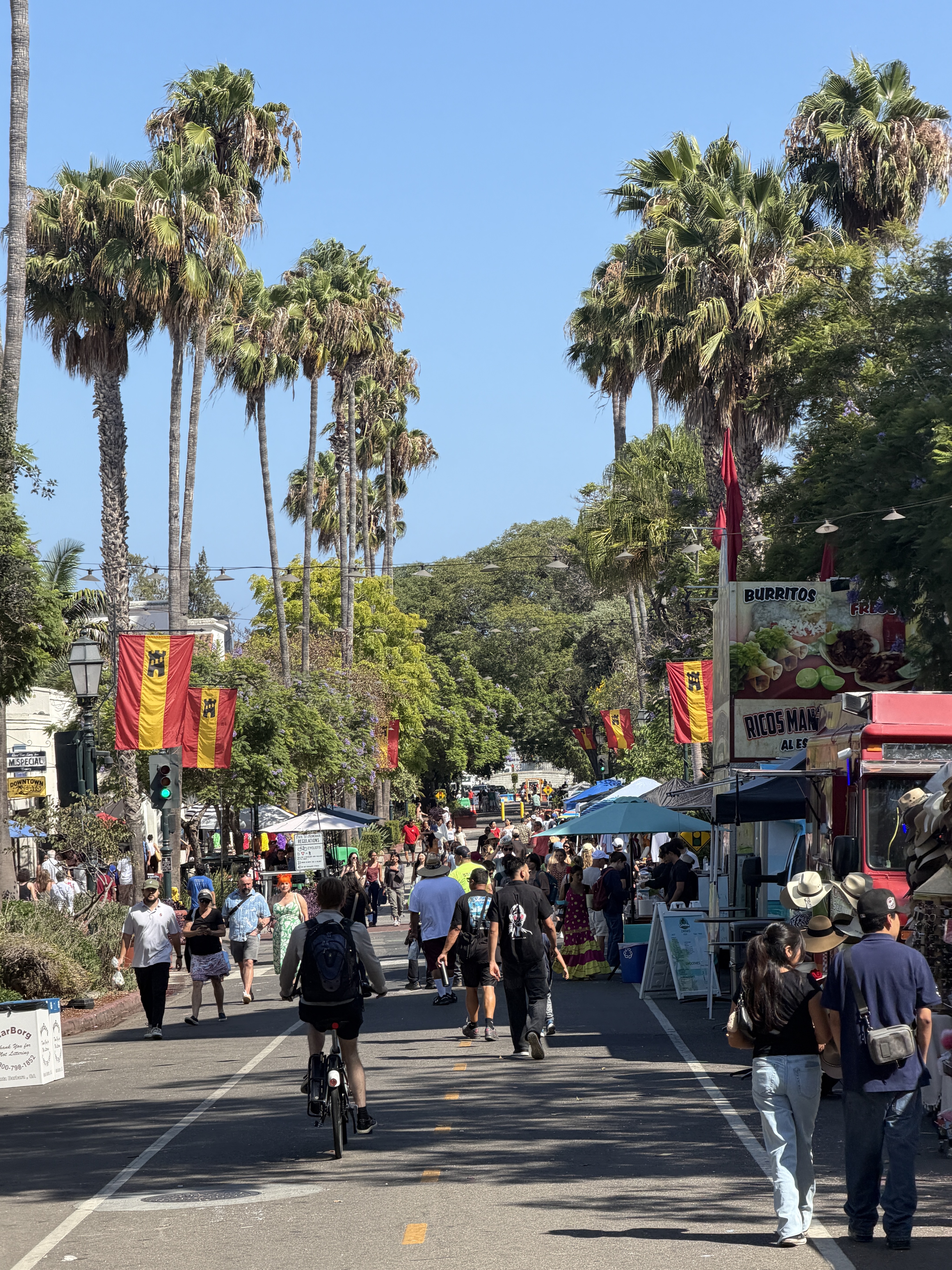
On the morning of August 7, during Fiesta week, a young girl visiting her grandmother’s vendor booth on State Street stepped into the pedestrian path and was struck by an e-bicyclist. She suffered a serious leg injury and was rushed to Cottage Hospital. It was a frightening moment for her family, and an entirely foreseeable one for anyone who has watched how the City of Santa Barbara manages e-bike traffic downtown.
As a Downtown Ambassador for the city, I walked six to seven miles a day along State Street, and I watched this problem build for months. Weeks earlier, I had witnessed a group of roughly two dozen e-bikers, most between the ages of 10 and 16, ride onto the sidewalks and into the Paseo Mall corridor during a farmer’s market, scattering pedestrians who ran to get out of the way. When a police officer eventually approached the group, he spoke with them briefly, then left. Within minutes, the e-bikers were back at it. What I witnessed looked less like enforcement than public relations.
During Fiesta week, the city issued an unusually high number of vendor permits along the closed portion of State Street, and booths spilled directly into the shared bike-and-pedestrian path. The city did nothing to require cyclists and e-bikers to dismount and walk their bikes through the crowd, a basic precaution given the volume of foot traffic. The faded bike lane markings that remain on State Street have not been repainted in years, so riders and pedestrians alike are often unsure where one lane ends and another begins. The August 7 collision happened in exactly this kind of overcrowded, poorly marked stretch.
After the collision, I filed a report urging the city to place sandwich-board signs in the corridor directing cyclists to dismount. When I returned to my shift the next day, nothing had changed. Meanwhile, several parking enforcement officers assigned to the corridor spent the week in their air-conditioned vehicles rather than out among the crowds asking riders to slow down.
I understand the argument for a lighter touch. Many e-bikers downtown are teenagers, and no one wants a viral video of an officer citing a 12-year-old, or a City Hall inbox full of angry calls from parents. Enforcement also costs money and staff time in a city that already stretches its resources across a long list of priorities. These are legitimate concerns. But the cost of inaction is higher: a child in a hospital bed, a family’s trust in downtown safety shattered, and a corridor that residents and tourists alike are starting to view as unpredictable. A policy built around avoiding uncomfortable confrontations with minors is not a safety policy, it is an image campaign, and Santa Barbara can no longer afford to run it at pedestrian expense.
The fix does not require reinventing city government. Santa Barbara should repaint and clearly mark bike lanes along State Street, starting with the blocks most affected by vendor and foot traffic. During Fiesta, farmers markets and other high-density events, the city should post temporary signage and station staff to require cyclists and e-bikers to dismount within the pedestrian corridor, and it should direct the parking enforcement officers already posted there to actually enforce it. For repeat youth offenders, citations should go to the parent or guardian responsible for the bike, not just a verbal warning that evaporates the moment the officer walks away.
None of this is complicated or expensive by the standards of a city with a budget in the hundreds of millions of dollars. What it requires is the will to prioritize a visiting grandmother’s granddaughter over the discomfort of confronting unruly cyclists. State Street belongs to everyone who walks it. It is time the city started acting like it.

