

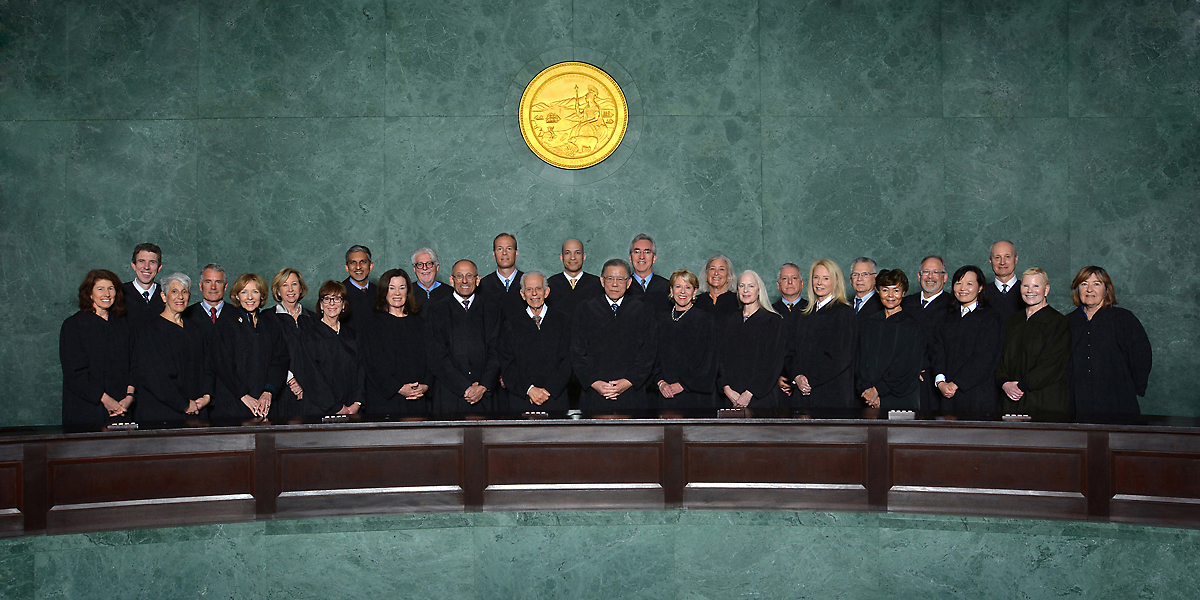
I am writing to respectfully ask for your “yes” vote to retain all sitting appellate court justices whose names will appear on your ballot for the November 2026 election. Before you decide, however, you might be interested in knowing more about how we got our jobs and how the retention process works. I hope you will find this information useful.
Who Am I? I am the Presiding Justice for Division Six, of the Second District Court of Appeal of California. Before then I was a Ventura County Superior Court judge for 22 years. I became an appellate justice in 2023. The Division Six courthouse is located in downtown Ventura.
Why Are Appellate Justices on the Ballot? All California Appellate Court Justices, at some point, must go before the voters to be “retained.” This means you will see the names of many Second District appellate justices on your ballot. By law, no one can run against us. Instead, voters are asked to vote “yes” or “no” as to whether we can remain in our positions. We must each receive a majority of “yes” votes from the votes cast.
What Is the Second District Court of Appeal? The Second District Court of Appeal for the State of California is the appellate court that hears appeals from decisions made in the superior courts of Los Angeles, Ventura, Santa Barbara and San Luis Obispo counties. There are eight divisions in the Second District.
How Is a California Appellate Court Justice Appointed? The process can be long and extensive. An appellate court justice must have practiced law for at least 10 years. A candidate must submit a detailed application to the governor’s office. If the governor wants more information the candidate’s application is sent to one of eight regional Judicial Selection Advisory Committees (JSAC) for vetting. JSAC members are judges and lawyers from diverse backgrounds. JSAC interviews people who have worked with or know the candidate. Based upon the interviews and application, JSAC summarizes its assessment of the candidate and submits a confidential report to the governor. The assessment includes a final “rating” of either “not qualified,” “qualified,” “well qualified” or “exceptionally well qualified.”
From there, the governor can advance the candidate to the next phase by submitting the candidate’s name to the Commission on Judicial Nominees Evaluation (JNE). JNE is comprised of up to 38 non-partisan public members, lawyers and former judicial officers. JNE conducts its own independent and extensive investigation of the candidate by sending out confidential questionnaires to hundreds of judges and lawyers and by contacting up to 75 people who have worked with and know the candidate. Three members of JNE are assigned to compile this information and interview the candidate. The interview can take hours. After the interview the three JNE members present their results to the entire JNE who then vote by rating the candidate. JNE uses the same ratings as JSAC.
After the JNE evaluation, if the governor is still considering the candidate, the governor’s Judicial Appointments Secretary will interview the candidate.
Finally, if the governor concludes the candidate is qualified, the governor will nominate the candidate to the Court of Appeal. The governor’s nomination triggers a final round of information gathering by the California Department of Justice. The Department of Justice interviews people who know and have worked with the candidate and compiles a report that is presented to the Commission on Judicial Appointments (COJA). COJA is comprised of the California Chief Justice, the California Attorney General and a senior Presiding Justice. A public hearing is held. Members of the public may speak in favor of or against the candidate. A JNE representative offers the results of JNE’s assessment of the candidate. The candidate may speak and is available to answer questions. After receiving all the evidence, COJA votes on whether to approve the governor’s nominee. A vote of at least two COJA members is required approve the nomination.
How Do You Know If the Appellate Justice Is Doing a Good Job? An appellate justice is bound by ethical rules governing what we can do and say (beyond what we say in our court orders and judicial opinions). The California Code of Judicial Conduct requires us to be “faithful to the law, regardless of partisan interests, public clamor, or fear of criticism.” An appellate justice is subject to discipline for a violation of these rules. The California Commission on Judicial Performance (CJP) reviews complaints about judges and justices and can impose punishment including removal from office. The CJP’s public discipline decisions are publicly available. None of the appellate justices on the ballot have been disciplined by the CJP.
Commitment to Service and the Rule of Law: I, like all of the appellate justices whose names will be on your ballot, have gone through this process. We have taken an oath to “support and defend the Constitution of the United States and the Constitution of the State of California against all enemies, foreign and domestic.” We care deeply about our judicial system, about serving the public, about access to justice, and the rule of law. We humbly ask that you vote to retain us by marking “yes” next to our names on your ballot. Thank you.
Tari Cody is a justice of the California Court of Appeal, Second District, Division Six, which sits in Ventura.

