Most Santa Barbara homeowners don’t know the term “Goleta Load Pocket”. Yet it describes one of the most consequential features of our local energy system.
Goleta, Santa Barbara, Montecito, and Carpinteria sit inside a roughly 70-mile stretch that depends heavily on a single transmission corridor. About 40 miles of that corridor cross mountainous, fire-prone terrain in and around Los Padres National Forest. If that route is disrupted, the region has limited alternatives for bringing in electricity.
This vulnerability is not theoretical.
In December 2017, when the Thomas Fire damaged that same transmission system, more than 85,000 customers lost power, some intermittently for two days. In January 2025, Southern California Edison shut off power across Goleta, Santa Barbara, and Montecito during a multi-day wind event, with roughly 9,000 customers under consideration for a shutoff. Ultimately, only a portion lost power, but the scale of the warning illustrated how widely a single weather event can threaten local service.
Wildfire is only one risk. California’s grid is also under the greatest strain between 4 and 9 p.m., when household demand climbs, and solar production tapers off. During a 2020 heat wave, statewide demand grew so high that California’s grid operator ordered rotating outages for two days.
Winter brings a different set of threats. El Niño conditions forming this year, expected to strengthen into a strong event by winter, bring their own risk: although El Niño does not guarantee damaging storms in Santa Barbara, it increases the possibility of heavy rain and high winds that can damage electrical infrastructure. And on hillsides burned in past fire seasons, that same rain raises the risk of mudslides.
Santa Barbara therefore faces two periods of elevated outage risk: a hot, dry one in the fall and a wet, stormy one in the winter.
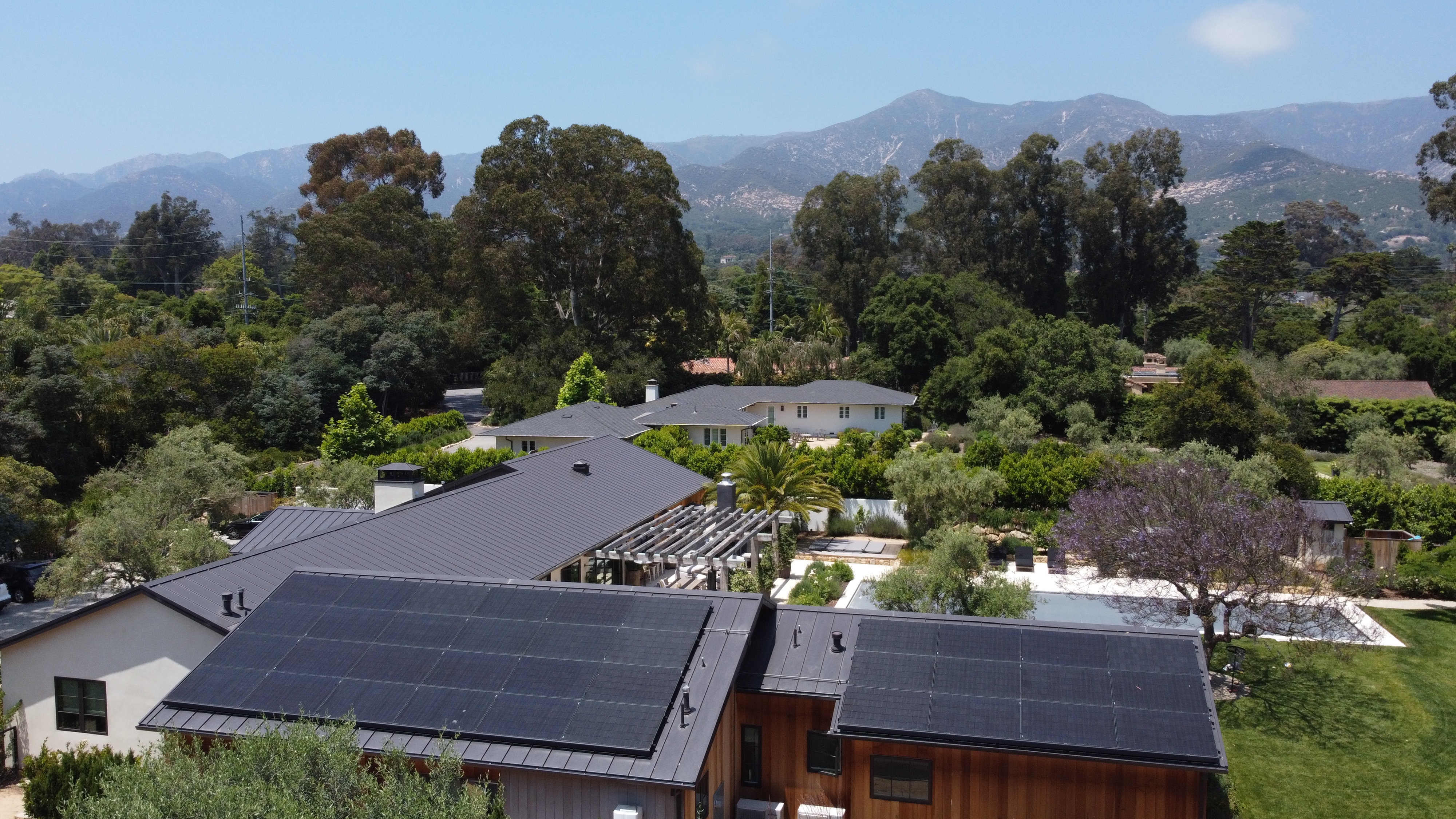
The larger issue is structural. A region supplied through a geographically constrained transmission corridor will remain vulnerable regardless of how carefully the grid is managed. Utilities can harden infrastructure, improve forecasting, and reduce wildfire risk, but they cannot eliminate every disruption. For homeowners, the most direct way to reduce that exposure is to reduce dependence on the grid itself. Producing and storing energy on-site, through solar and battery systems, means not relying entirely on a single transmission corridor to keep the lights on.
Here’s where timing becomes relevant. Since 1980, California has provided a property-tax exclusion for qualifying solar energy systems. Unlike many other improvements that add value to a home, installing a solar system has not triggered a property tax reassessment. That protection has always come with a sunset date that the Legislature has repeatedly extended. Except this time. The bill that would have extended it again, AB 2389, didn’t survive the Assembly’s budget process and was shelved this past May. As of now, there’s no active legislation to extend the exclusion past its current cutoff: January 1, 2027. Once established, the exclusion generally remains in place until the property changes ownership.
The practical deadline may arrive well before December 31. Designing, permitting, installing, inspecting, and completing a solar and battery project can take months. As more homeowners attempt to finish before the same cutoff, permitting departments and contractors may face additional pressure. For most homeowners, the realistic deadline to actually make it in time is closer to early fall than New Year’s Eve.
Santa Barbara’s transmission corridor is unlikely to change anytime soon. The weather will remain unpredictable. And a property-tax protection that has existed for more than four decades may soon disappear.
Whether a home remains entirely dependent on the grid is still a choice.
Lea Manzetti Tavira works as a marketing and sales assistant at Brighten Solar Co., a Santa Barbara-based solar and battery storage installation company.