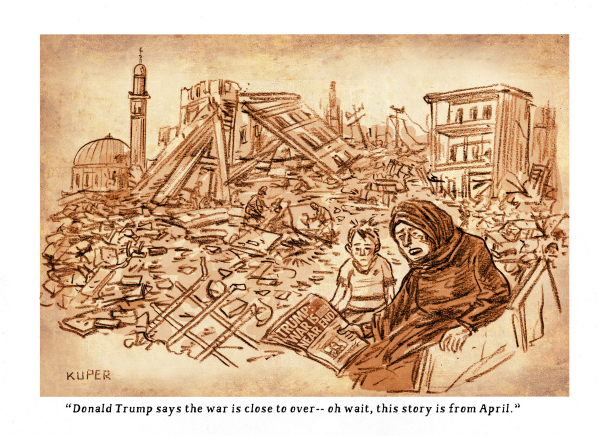
Anger is an uncomfortable emotion, rarely one we welcome. Yet it is vital that we keep it alive in our society, because it serves as a force that holds systems accountable. Anger is dangerous to those in power precisely because it can compel people to question authority and demand change. Those in power benefit when people become disconnected from the truth, when atrocities are minimized, and when public outrage fades into indifference. For many, the daily struggle to make ends meet and meet the demands of everyday life leaves little energy to engage with the injustices unfolding beyond their immediate circumstances.
As a privileged citizen of the United States, I recognize how easy it is to become desensitized to the death and wrongdoing committed by our nation. But there comes a point when the desensitization must be confronted. We can’t allow incapacity to become indifference. We must remain angry, consciously — not merely to condemn, but to question and to refuse to accept injustice as an inevitable part of the world we live in.
On June 29, 2026, I watched Japan face Brazil in the World Cup at my best friend Maya’s house. Our friend Nathan had also come over, and we all played video games; Maya was freshly out of surgery and couldn’t walk. On a day that I recall as one of the best in my last summer before college, a Palestinian goalkeeper Saleem Al-Ashqar was shot by Israeli forces. I urge anyone who is reading to sit with this and just ponder that this is the world we live in. In what world is this young man’s life worth less than the lives of those watching soccer safely from their homes? How could the world just continue the next day and watch another game?
On February 28, 2026, I was accepted to San Diego State University, and 120 children died from a strike at an elementary school in Iran. The U.S.-Israeli war with Iran is morally and ethically wicked. U.S. and Israeli strikes killed Iranian Supreme Leader Ali Khamenei, but you don’t hear about his 14-month-old granddaughter, who also perished.
The justifications offered for the military campaign have included protecting the Iranian people from their own government and preventing Iran from developing nuclear weapons. These justifications falsely portray this war as an uncomplicated act of liberation while dismissing its human cost. How can a government claim to be acting for the well-being of a population while subjecting that population to devastating war?
Our own president has repeatedly demonstrated a willingness to dismiss the concerns of Americans who disagree with him. Why, then, should we accept without scrutiny his claims to be acting out of concern for the well-being of an entire separate nation?
Iran did not launch the attack that initiated this war; the United States and Israel struck Iran first. It raises the question: What evidence and authority can justify initiating a war, and who is held accountable when its consequences fall on ordinary people, whom the military define as “collateral damage”? Or does none of that matter when you’re White and the president of the United States of America?
Do we have the right to claim we are liberating other countries from their tyrannical leaders when our own president is a convicted felon? At what level of wealth, privilege, and power do the rules and laws of society stop applying to us?
We cannot demand accountability from powerful governments abroad while ignoring the questions of accountability at home. If the suffering of civilians overseas has failed to make us angry enough, the unanswered questions surrounding Jeffrey Epstein and his connections to the powerful lead me to wonder how much more we are willing to ignore. The year Trump first took office, Mr. Sherrod was my third-grade teacher. He asked us to promise that we would grow up to be the kind of people who stood up for what was right, even when everyone else stood by and watched. Now I understand why he, and the adults around me, were stressed about the future of our nation.
Why aren’t we angrier? I think part of the reason is because honestly, it’s not our problem. Why should we bother? We are fortunate enough to live in relative safety, with the privilege of treating distant suffering as something separate from our own reality. For now, it is someone else’s family grieving, someone else’s home being destroyed. The issue lies not only in the suffering we choose to ignore, but in the precedent we create by ignoring it. When we accept that certain lives are expendable in the name of “national security,” we normalize a standard of justice in which human rights become conditional rather than universal. Injustice should not have to reach our front door before it deserves our outrage. By the time it does, we may have already helped create the conditions that allow it to flourish.