

To the Newly Elected and Returning Supervisors, Mayors, Councilmembers, Planning Commissioners of San Luis Obispo and Santa Barbara Counties, and All Who Care About the Future of the Central Coast:
Congratulations, and thank you. Whether this is your first term or your fourth, you’ve stepped forward to serve at a moment that will shape the Central Coast for generations.
We write to you as a group of 21 organizations across both counties: chambers of commerce, economic development partners, community foundations, housing providers and others working every day for a thriving region. We come to this from different places and perspectives, but we share a deep love for the Central Coast and a common hope: that the people who call this place home can keep building their lives here. The people here today need a tomorrow here, too.
Many of you, and those who served before you, have made hard decisions in recent years, often over loud objections. Santa Barbara County rezoned land for thousands of new homes. San Luis Obispo County approved one of the largest housing projects in its history. Major developments have broken ground in places like Santa Maria. None of those votes were easy, and we are grateful for each one.
Those yeses matter. And while those homes work their way through, the need keeps growing, so what happens next matters even more.
Yes Here, Yes Now
Nearly everyone on the Central Coast agrees we need more attainable homes: for the teachers and nurses who care for our families, for the workers who keep our businesses and essential services running, for the seniors who want to stay in the communities they helped build, and for the kids who grew up here and want to come home. Then a project is proposed on a specific street and the answer becomes “Not here. Not now.”
“Not here” pushes homes somewhere else. “Not now” pushes them to some other time. Years pass between a first proposal and a final approval, and every delay creates new hurdles. A plan is not a project. Approved is not built. The space between them is where too many homes get stuck.
It’s always easier to say yes over there, and yes later. We understand the pressure behind that: neighbors raise real questions, there are competing priorities, and you hold all of those voices at once. Yet “over there” and “later” have become the default that too often means no homes at all. Accepting it is a choice we don’t have to make. The Central Coast only works if we also say yes, here and yes, now.
On any one project there will always be a reason to say no. We are here to bring 10,000 reasons to say yes.
The Gap Between the Homes We Need, and the Homes We Build
The Central Coast has a lot going for it: strong communities, world-class colleges and universities, growing industries, and some of the most beautiful places anywhere. But the gap between the homes we need and the homes we build is growing, and it is widest for working families.
For many families, that gap is already deciding who stays. In San Luis Obispo County, only about one in seven households can afford the median-priced home, which sells for $950,000. In Santa Barbara County, it’s about one in eight, at $1.24 million. Buying one takes a household income of roughly $242,000 in San Luis Obispo County and $316,000 in Santa Barbara County. (California Association of Realtors, Traditional Housing Affordability Index, Q3 2026.) Across both counties, employers tell us the same story: they hire and train local talent for years, only to lose them when rent or a first home is out of reach. Recruiting new talent is harder still.
There’s the clinic with a waiting list because it can’t hire enough nurses, the child care center that cuts hours because its teachers live an hour away and the manufacturer that can’t staff a second shift. When the people who make this region run can’t stay here, every business and every family feels it.
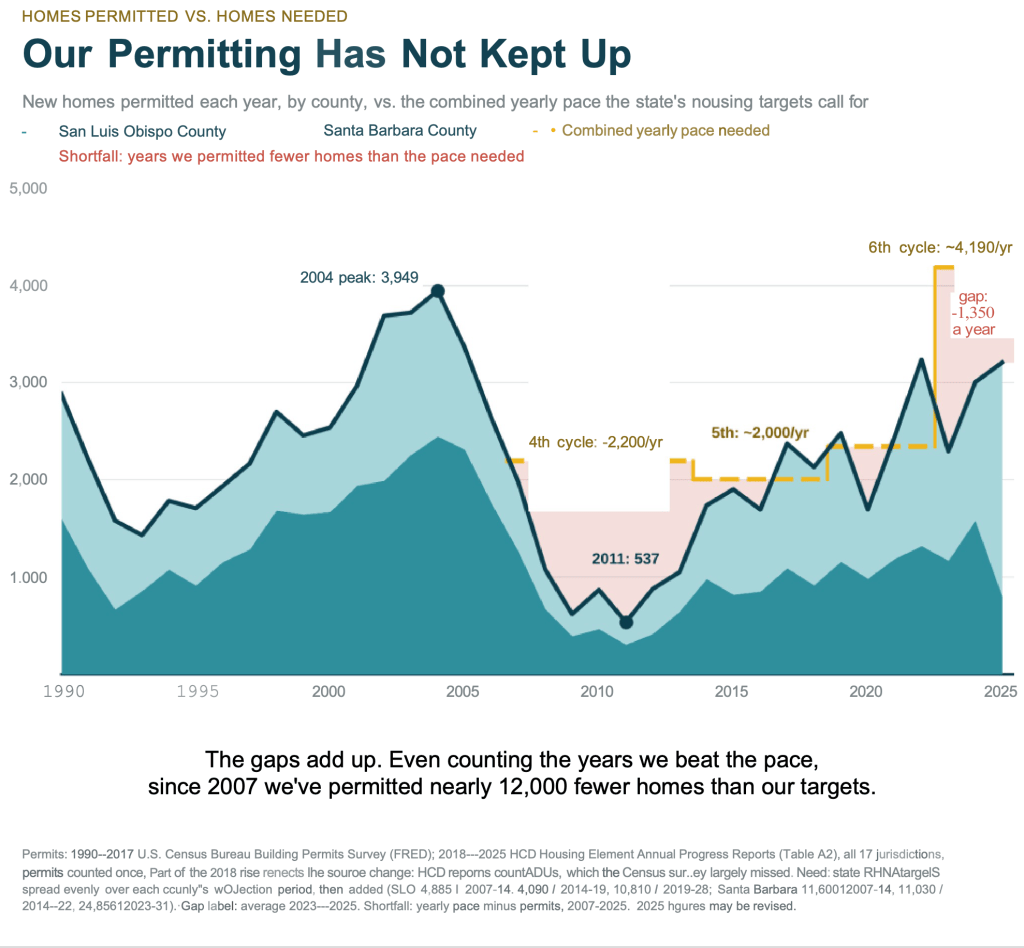
The Need Is Clear: The state sets a housing target for every community through the Regional Housing Needs Allocation (RHNA), which is the number of homes each city and county must plan for. Across our two counties, that number more than doubled from the last planning cycle to the current one. That increase partly reflects how far behind we already are: since 2007, our two counties have permitted about 12,000 fewer homes than we targeted. That shortfall shows up in prices. Building a home here now costs more than many homes can sell or rent for, so projects stop penciling out. The options that are left place pressure on households with families stuck with limited options for upward mobility. Without major community investment, the homes they can afford don’t get built, and the gap keeps growing. That’s why we’re asking for more than planned housing areas. We need actual permits, for the families doubled up today, the residents struggling to pay more than they can afford, and the young people hoping to start households of their own.
Building to Meet It: Permitting across our region dropped sharply in the 2010 recession and has never recovered. Year after year, we permit fewer homes than we plan for, and the shortfall lands hardest on the homes working families can afford: last cycle, the two counties permitted only one in four of the lower-income homes and just over half of the moderate-income homes they planned for. In recent years, we’ve permitted about 1,350 fewer homes a year than the state’s current targets call for, and the gap keeps adding up. The answer isn’t to trade one kind of home for another. It’s to build more of every kind, and faster: affordable homes, apartments and townhomes for middle-income families, and homes people can buy. That’s how the teacher, the nurse and the young family get a real chance to stay.
The Homes We Need Are Within Reach
The obstacles are familiar. Approvals that are long and hard to predict, with layers of review along the way, often slowed further by appeals and lawsuits. Fees and conditions that keep adding up.
Specific plans and rezonings that open new land for housing can take a decade to finish. Roads, water and wastewater systems that aren’t in place. Every month of delay adds cost, and every added cost puts a home further out of reach for the people we’re trying to keep.
Too often, we work the problem one jurisdiction at a time. Questions of annexation, water and tax revenue can turn neighbors into competitors, when people live, work and play across every one of those lines. Housing is a regional need, and solving it means getting in the room together and working across jurisdictional boundaries, political aisles, and generational divides.
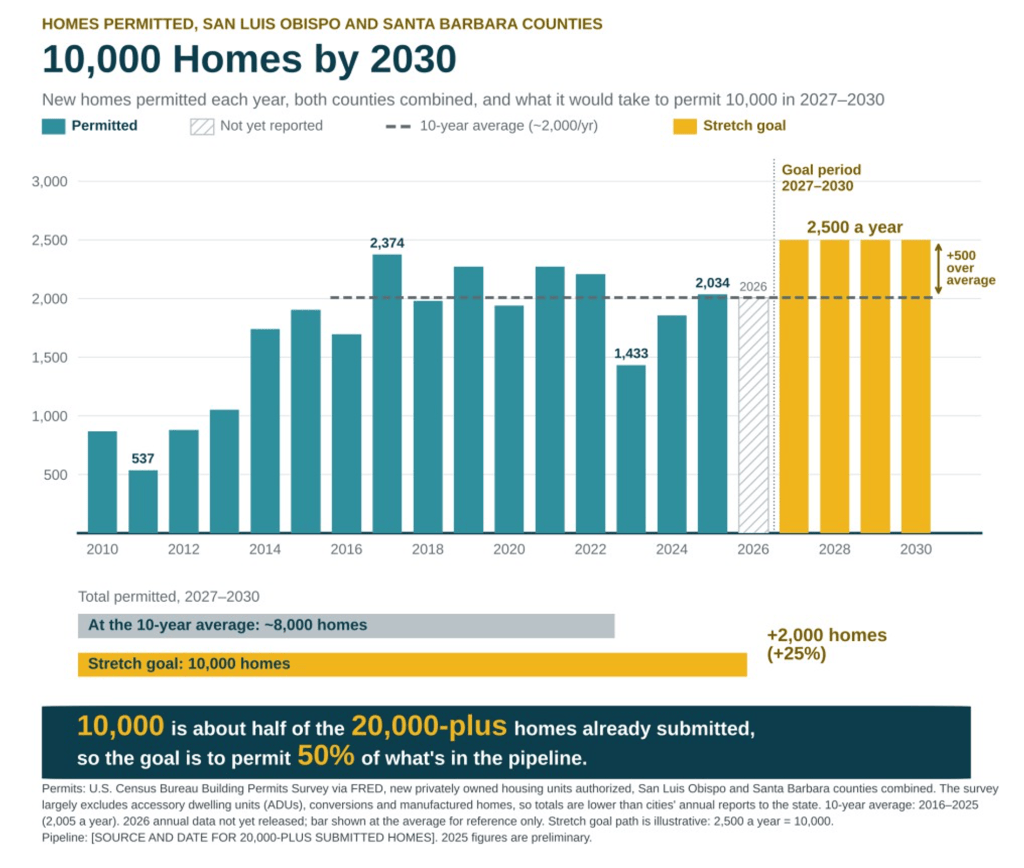
But there is real cause for optimism. Over 20,000 homes are already proposed across both counties, most on land already planned for growth. They don’t need new plans. They need timely decisions, simpler rules and your leadership. Our goal is to see 10,000 of them permitted by 2030.
From Plans to Front Doors
Turning those proposals into homes runs through dozens of agendas: 15 cities, two counties, nearly 90 elected officials and more than 70 planning commissioners. Every week, a housing decision is on one of those agendas, and each one is a chance to say: “yes here, yes now”. Your leadership sets the pace.
Getting housing built will take years of work on many fronts: infrastructure, fees, financing, clear and predictable approval processes. We don’t expect anyone to solve it all at once. But we can start, together, with four practical steps in your first 100 days:
- Know your pipeline. Ask your staff for a briefing on every housing project in front of your jurisdiction: how many homes, what stage it’s at and what’s holding it up. You can’t move what you can’t see. Then ask the question that matters most: what would it take to say yes here?
- Pick a few and unlock them. Choose a few stuck projects or pieces of public land that could become homes, and make them a priority. Often what’s in the way is the water, wastewater or road work that opens a site to homes. Put those projects first, using the regional priorities already identified, and be open to new ways to fund them.
- Speed up the system. For projects on sites already planned in your housing element, make one change in your first 100 days that saves time on every one of them, like setting time limits on advisory reviews, adopting clear, objective design standards that let projects that meet them move faster, or holding off on new fee increases while they move forward.
- Work the problem as a region. Commit yourself or your staff to a standing regional housing and infrastructure table with the neighbors you share water, roads and growth with. San Luis Obispo County has a model to build on: its cities, the County and SLOCOG created a shared regional framework together. With Vandenberg’s growth ahead, Santa Barbara County, the northern cities and SBCAG have the chance to create their own. We’ll help convene and make sure employers and builders are part of the conversation.
Our Part: 10,000 Reasons
We won’t ask anything of you that we aren’t ready to take on ourselves. Together, our organizations are working toward a shared goal: 10,000 homes permitted across both counties by
2030. We know that’s ambitious. But it’s within reach. It’s grounded in housing already planned and proposed. It means keeping a steady pace and clearing what’s stuck.
Why 10,000? It’s about half of the homes already submitted across both counties, and it’s a number we can track together, community by community and year by year. It won’t close the whole gap the state’s targets describe, but it’s a clear first step we can all hold ourselves to.10,000 is not just about units. Behind that number are the people who make this place work: the graduate who wants to stay, the young family ready to put down roots, the worker who shouldn’t have to choose between a job here and a home somewhere else. They are the reasons, and that’s why we call this effort 10,000 Reasons.
Reaching the goal will take all of us. We’ll track housing projects across both counties and share with you what’s moving and what’s stuck on a regular basis. We’ll bring the right partners in early, help convene regional tables in both counties and connect you with people who have worked through problems like the ones on your desk.
We’ll also hold ourselves to the standard we’re asking of you. It’s easy to support housing in principle and harder when it’s the block next door. Employers and advocates, including many of us, too often stay quiet when it’s close to home. We intend to change that. When housing decisions matter most, you’ll hear from us, and from the employers, workers and families with the most at stake.
Read the reasons of employers, workers and families across both counties, and add your own, here.
Let’s Get to Work
This work is hard, and no one should do it alone. We intend to be steady, honest partners through the hard decisions as well as the easy ones. If you’d like to talk through a stuck project, the plans on your desk, or where the region can work as one, reach out to us. We’d also welcome the chance to sit down with you in your first weeks. We know this is simply a place to start, and we look forward to working alongside you as this work advances.
You stepped forward because you believe in your community. So do we. Plans alone don’t house people. Decisions do, and you will make dozens of them this year. Each one is a chance to make sure the people here today have a tomorrow here, too.
We have a choice. Let’s choose to build together.
Signed,
Melissa James, President & CEO, REACH
Christine Dawson, CEO, San Luis Obispo County Community Foundation
Ermina Karim, Interim CEO, SLO Chamber of Commerce
Jocelyn Brennan, Interim Executive Director, Home Builders Association of the Central Coast
Kenneth Trigueiro, CEO & President, People’s Self-Help Housing
Mackenzie Dias, President, Generation Build
Melanie Lindley, Executive Director, Lompoc Valley Chamber of Commerce
Marciela Morales, Director, The Home Team Santa Barbara County
Jim Duffy, Building a Better SLO
Jackie Carrera, President & CEO, Santa Barbara Foundation
Kristen Miller, President & CEO, S.B. South Coast Chamber of Commerce
Michael Boyer, President & CEO, Santa Maria Valley Chamber of Commerce
Michelle Pedigo, Executive Director, Housing Authority of SLO
Dawn Smith, CEO, Habitat for Humanity SLO County
Josh Cross, President & CEO, Atascadero Chamber of Commerce
Scott Haigwood, Region 31 Chair, Region 31 of the California Association of REALTORS®
Jefferson Eckles, CEO, SLO County Housing Trust Fund
Kimmie Ngyuen, Co-Lead, SLOCo YIMBY
Kathy Vreeland, Executive Director, Buellton Chamber of Commerce
Nash Moreno, CEO, Economic Alliance of Northern S.B.anta Barbara County


You must be logged in to post a comment.