
Santa Barbara Music Club
**Events may have been canceled or postponed. Please contact the venue to confirm the event.
Date & Time
Sat, Nov 08 3:00 PM - 5:00 PM
Address (map)
305 E. Anaapamu Street at Garden, Santa Barbara
Venue (website)
First United Methodist Church
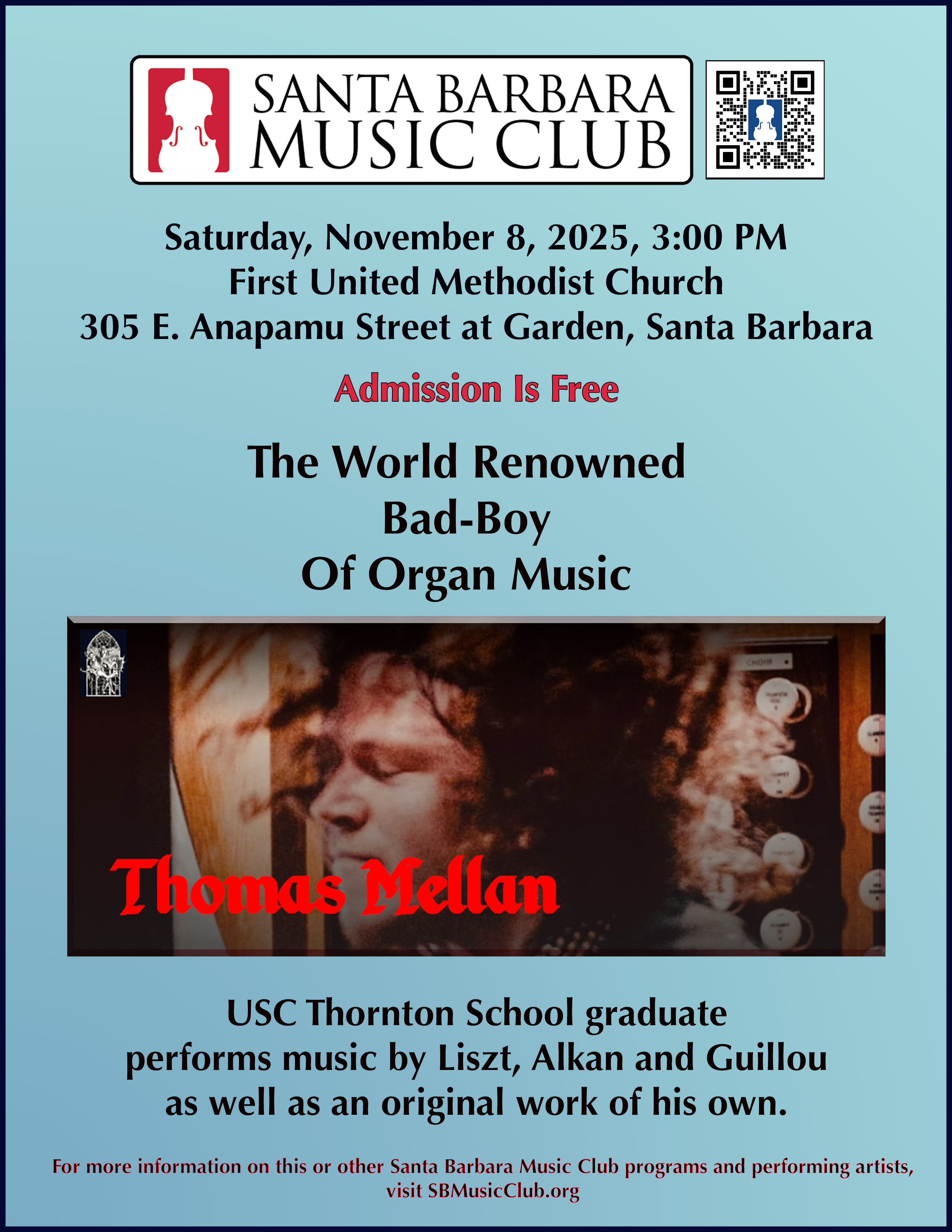
The Santa Barbara Music Club, in collaboration with the First United Methodist Church of Santa Barbara, presents another program of great organ music on Saturday, November 8, at 3:00 PM, at the First United Methodist Church, 305 E. Anapamu Street, Santa Barbara. The University of Southern California Thornton School Wunderkind graduate Thomas Mellan performs works by Charles-Valentin Alkan, Frédéric Chopin, Franz Liszt, Jean Guillou, and a recent work of his own.
The concert will begin with nineteenth-century French composer Charles-Valentin Alkan’s Étude No. 10, which is the final movement of his Symphony for Solo Piano, transcribed for organ by the performer.
At the height of his fame in the 1830’s and 1840’s, Alkan was, alongside his friends and colleagues Frédéric Chopin and Franz Liszt, among the leading pianists in Paris. His Symphony is of great musical and technical complexity, abounding in skillfully concealed, interrelated themes, while evoking the broad palette of timbres and harmonic textures available to an orchestra. As the critic Jose Vianna da Motta remarked, “The very art of composition is transformed in this work.”
Following Alkan, is Chopin’s Étude No.3 in E Major, a celebrated solo piano piece, transcribed for organ by the performer.
Famous for its beautiful and poignant melody, the étude is also known by the unofficial nicknames “Tristesse” (Sadness) or “Farewell.” Of all his works, Chopin reportedly considered the melody of this étude to be the most beautiful he ever composed, and he thus dedicated the piece to his close friend Franz Liszt. This selection’s tender, poetic character is a significant departure from the pure virtuosity of earlier études. The primary challenge for the performer is to bring out the prominent melody while simultaneously playing the softer inner voices in the same hand, definitely a challenge for an organist.
Then follows Franz Liszt’s Transcendental Étude No. 5, the fifth of his twelve Transcendental Études, a notoriously difficult piano composition. Its title “Feux follets” (Will-o’-the-Wisp) evokes the image of a will-o’-the-wisp, a flickering, ghost-like light that dances and disappears. The music captures this mood with its unpredictable, quick, and ethereal character. Considered one of the most challenging pieces in the entire set, “Feux follets” is distinguished by its lyricism and demanding technical elements.
Then comes Liszt’s Transcendental Étude No. 10 in F minor, also known as “Appassionata,” a famously difficult piano piece, written in sonata form with an explosive coda. It features complex left-hand arpeggios, right-hand octave passages, and challenging right-hand figurations using only the thumb, third, and fourth fingers. The piece is characterized by sudden and intense changes in rhythm and dynamics, including a dramatic climax followed by a soft passage, thus creating a creamy, scintillating texture.
Next we hear Nocturne, composed by Thomas Mellan in 2021, which he has performed during his international tours, most recently in Germany and France this past September. He describes the piece as a work influenced by the night, in the tradition of the musical genre of the same name. Mellan was influenced by the Ukrainian composer Borys Lyatoshynskyi and thus dedicated the piece to him: Hommage to Lyatoshinskyi.
While Mellan’s piece fits within the nocturne tradition, his unconventional style infuses it with a modern, experimental quality. Mellan is known for a style that blends classical and avant-garde influences. Today, composers like Thomas Mellan continue to write nocturnes, often for different instruments, while retaining the form’s historical connection to the moods and feelings of night.
Mellan will continue with Toccata by twentieth-century French composer Jean Guillou, with whom he studied composition in Paris for five years. Guillou was organist at the church of Saint Eustache from 1963 to 2015, succeeding André Marchal. Born in 1930, he became one of Paris’s most popular concert organists for almost three quarters of a century, performing major works as well as his own compositions, symphonic transcriptions and improvisations almost weekly. Guillou’s Toccata, composed in 1963, is representative of his dense, chromatic, and highly rhythmic style. Three themes are presented and used to build tension leading toward the percussive finale.
The concert concludes by returning to Franz Liszt for his masterwork Fantasy and Fugue on the chorale “Ad nos, ad salutarem undam,” an organ work composed in 1850. It was dedicated to Giacomo Meyerbeer, who was the composer of the chorale “Ad nos, ad salutarem undam,” which Meyerbeer had incorporated in the Act I of his opera Le Prophète and on which Liszt based his monumental organ composition.
Known to be one of the most virtuosic and demanding works for organ, Liszt’s Fantasy was described by Camille Saint-Saëns as, “The most extraordinary organ piece that has ever been written.” The piece is structured into three main sections: a fragmented fantasy, a lyrical adagio, and a chromatic fugue that evolves into a free contrapuntal fantasy, culminating in a grandiose conclusion. Like Liszt’s piano compositions, this work is known for its lyricism, extreme virtuosity, dramatic contrasts, and the way Liszt explores and transforms the source theme, leading to comparisons with his own Piano Sonata in B minor.
About the performer:
Described in the press as “manically unpredictable” and “the bad-boy of organ music,” Thomas Mellan is an organist, pianist, producer and composer based in Los Angeles. In 2012, he played his first recital at Église Saint-Eustache in Paris. He is featured in the official Walt Disney Concert Hall organ DVD. In 2018, his European tour included a residency at the Lviv Concert Hall, where he gave the Ukrainian premier of Messiaen’s Livre d’Orgue on the largest organ in Ukraine. In 2023, he performed in the international festival on the historic Schnitger organ at the Jacobikirche in Hamburg. As performer, he specializes in virtuosic repertoire from the nineteenth and twentieth centuries as well as French baroque music. His compositions have been performed in North America, Europe and Asia by musicians including the Sakura Cello Quintet, Orest Smovzh, Stephen Tharp and Jared Jacobsen.
His output features « impossible » organ music that attempts to push the limits of organ technique, but also includes a forty-minute set of inventions for solo violin, a concerto for five cellos, piano sonatas, pieces for chamber ensembles and electronic music which straddles the lines between avant-garde classical music, experimental dubstep and death metal.
In 2025, he performed Pierre Boulez’s Second Piano Sonata for the Los Angeles based series Piano Spheres to commemorate Boulez’s 150th birthday. He contributed harpsichord and synthesizer parts on Delirium Musicum’s debut album Seasons, released in 2023 by Warner Classics and produced by Fred Vogler.
Mellan graduated from the USC Thornton School of Music in 2017 with a BM in organ performance and composition. And in 2020, he completed an MM in organ and an MM in composition. He attended Thornton for seven years on full-tuition scholarship. He is currently the organist at First United Methodist Church in Santa Barbara. He will be performing on that church’s magnificent Aeolian-Skinner/Schantz 54 rank, 2,500 pipe organ, one of the finest instruments between Los Angeles and the Bay Area.
. . . . .
This and all concerts offered by the Santa Barbara Music Club are open to the public with free admission. For more information about this concert as well as future and past concerts, see our website www.SBMusicClub.org.
The mission of the Santa Barbara Music Club is to contribute to the musical life of our community through the following:
- Presentation of an annual series of concerts, free to the public, featuring outstanding performances by Performing Members and invited guests;
- Presentation of community outreach activities, including bringing great music to residents of area retirement homes;
- Aiding and encouraging musical education by the disbursement of scholarships to talented music students whose permanent address is in Santa Barbara County.
For more information about programs, to join, or to donate, please visit our website, http://sbmusicclub.org.

