
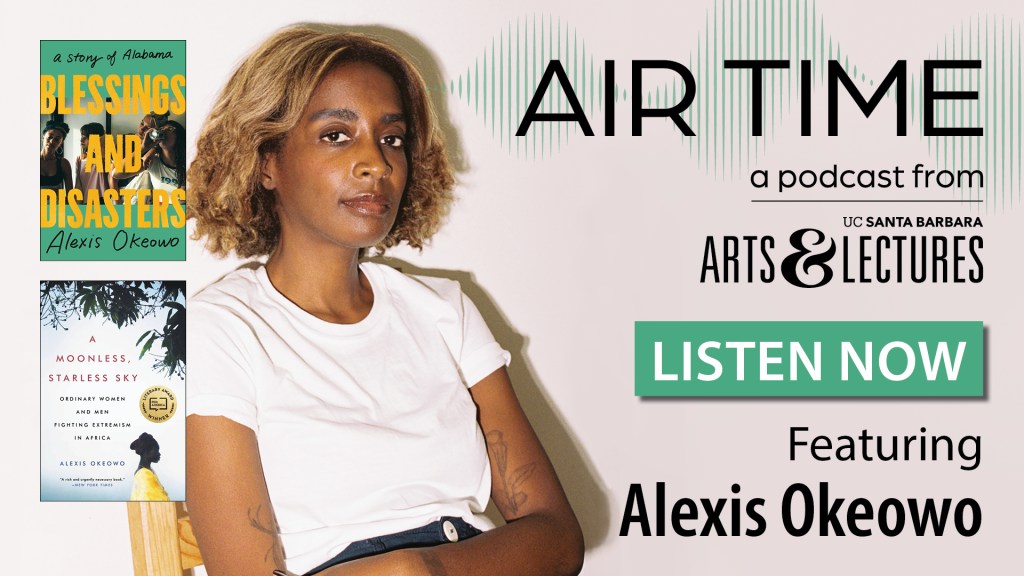
Alexis Okeowo, New Yorker staff writer and author of the new book Blessings and Disasters: A Story of Alabama, will kick off the 2025-2026 season of UCSB Arts & Lectures’ Justice for All programming initiative on Tuesday, October 14, at 7:30 p.m. at Campbell Hall. Charles Donelan, Senior Arts Writer at Arts & Lectures (A&L), spoke with Okeowo about the book in advance of her appearance. For more information, and to purchase tickets, which are $20 general admission and FREE to UCSB students, go to artsandlectures.ucsb.edu.
Below is a transcript of the episode
Charles Donelan
Hi from UCSB Arts & Lectures. This is Air Time. I’m Charles Donelan, and in this episode, I’m speaking with Alexis Okeowo, a New Yorker staff writer and the author of a new book, Blessings and Disasters: A Story of Alabama. Alexis kicks off the 2025-2026 season of an A&L’s Justice for All programming initiative on Tuesday, October 14, at 7:30 at UCSB Campbell Hall. Recent national elections have us all looking at America as a patchwork map of red and blue states. What happens when we go beneath the contrasting colors of the Electoral College map? In Blessings and Disasters, Okeowo, the daughter of Nigerian immigrants and a native of the American South, returns to her home state of Alabama to explore the fascinating histories and complex emotions of an unexpected array of ordinary people. Her conclusion? There’s a lot to learn from Alabama.
Thank you so much, Alexis Okeowo, for writing. What a wonderful book! I was able to finish it this morning by getting up early, and it was honestly thrilling to feel your light as an individual shining through such an incredible mosaic and sort of stained glass vision of this place. Why don’t you tell me about the impulse to write it? What was the attraction to sort of reverse from being an intrepid war reporter to going home? What was the logic to that decision?
Alexis Okeowo
Well, first, thanks for having me. It’s nice to be here and, well, it’s interesting, because Alabama, the South, is a place I feel comfortable, but I started the book at a time when I felt like many people didn’t feel comfortable with and still don’t feel comfortable with Alabama as a place, with the Deep South as a place. I can’t tell you how many times I’ve had heard people say that they were afraid to go there, or they were, you know, asking me why people even lived there, why my family lived there. And so, because of the portrayal of the South of that time, I started this book around 2018 of it being portrayed, actually, as a pretty extremist place. And so I think that was what first got my radar going. I was thinking, “Wait, this is my home.” This is a place that I know has had in some ways, an extreme history, but the way it’s being portrayed now as this “no-go” place, it didn’t feel right to me, and I thought, “How can I sort of help to write that unfair portrayal of this place, not as a defense, but as a sort of loving critique and a hopefully more nuanced portrayal,” right?
Charles Donelan
And thank you for clarifying, not as a defense, because I will say that I came to the book with expectations, which some of the marketing copy made me think, well, you know, “Oh, this is about how Alabama is not what it used to be,” right, but your book is full of how it used to be, because it is just loaded with history — the most difficult things to know about this place. I’m going to compare it to my favorite television program, which is called Finding Your Roots with Henry Louis Gates Jr. And I love that show, first of all because he was my college professor of African American studies, so I’ve known him since I was a kid. But really the reason I love the show is because everyone who comes on is always really surprised, like no one knows their own story. And I find that increasingly, as I grow older, and I’m approximately the same age as — I think I’m maybe a couple years younger than, like, your mom — but I’m the same age as many of the characters — Mary, Tina, you know. And I feel like in this decade of my life, I am more stunned by how ignorant I have been, personally, of where I’m from, what that place was about, how everyone got there. There’s just so much that wasn’t acknowledged in my life growing up and I was supposedly, you know, getting the best education you could get.
Alexis Okeowo
Yeah, absolutely. And I actually like that comparison a lot, because part of what I wanted with the book is readers to be surprised by the story. Because I myself was surprised while I was researching and writing it. You know, I sometimes call this book a sort of quote, unquote, “alternate history of the state,” in the sense that I wanted them to be more, to include moments that people, including myself, didn’t know about, and moments that I hope illuminate other facets of the South. And as I’m going through, and I’m even starting, you know, the book when it was Indian Territory, and this and sort of tracing it to one of my subjects, who is an Indian chief now in the state, and realizing there’s so many parts of the story I didn’t learn growing up, and feeling like I’m discovering, yeah, this whole parallel reality while I’m researching and writing, and the same goes for other parts even of my own parents story, to be honest. I interviewed my parents for the book because they’re both Nigerian immigrants who met in college in Alabama, and I thought I understood their story to be one way, until I interviewed them and realized it was a completely different experience for them than what I imagined.
Charles Donelan
Another quick hit comparison, just for the sake of a phrase, I read a book recently, by Fintan O’Toole — I’m an Irish Catholic American, and I had no idea what was happening in Ireland in the period when I was coming of age here in New England, actually. And so his book is called We Don’t Know Ourselves, which is kind of the phrase that was often used as a sort of blanket excuse, or just a funny way of saying, “Hold up. I’m a little uncomfortable” when people tried to talk about Ireland among themselves. We don’t know ourselves as in, we didn’t know about that, and also, we don’t know who we are in a way. And I think that that is something that to me, it’s actually exciting, because I feel like it has revived my interest in where I grew up. I couldn’t wait to get out of Massachusetts and move to New York City. But now I look back, and I think some of these places, southern New England, especially knowing about the experience of indigenous people and about the war that no one discussed, King Philip’s War. We didn’t learn about it, and that took place in our yards.
Alexis Okeowo
Wow.
Charles Donelan
But go ahead, tell me more about talking to these people and discovery in this book, because there’s a lot of discovery in this book.
Alexis Okeowo
There is a lot of discovery because, yeah. So the idea was, I mean, starting with this initial question of why people call a place home, and why people stay in a place that so many others have written off. I mean, you know, I mentioned, I’ve had people literally ask, “Why did your family stay in Alabama; why did they choose to call it home?” And then, of course, I realized it’s not just my family who are immigrants, but this idea of the South even being just Black and white, but so many groups have fought to stick around. Native Americans, white Alabamians, Blacks, and newer arrivals, Latinos, other immigrants. Why? And so the idea was to sort of spend time with people, specific people from each of these groups, and weave their stories with my own family’s, to sort of get at the heart of that idea and illuminate something about the idea of Alabama and the south and home in general. And part of that was going into what are the stories of places that a place tells about itself, and what is left out. And also, how do people of that place tell stories in order to justify calling a place home, staying there, and the South, you know, the whole country.
But the South loves stories. The South is obsessed with its history, you know. So when I was writing this, even though I wanted to be rooted into the present, rooted in sort of contemporary, you know, post–civil rights, because the South tends to get stuck in that, you know, being perceived in that, in that moment, you always have to go back, you know, because it this is a place where the land has been fought over so many times, and it’s helpful to understand why, and I think that helps understand the people as well. And so even when I was, yeah, the people I spent time with, honestly fascinating from again, this achieved, suddenly recognized tribe of ‘Bama. They were like, you know, 100 people who may stick around after the Indian removal and have now become billionaires thanks to gaming. Then to Calvin, who’s this, who’s head of the Confederate museum here, and had several ancestors who fought in the Civil War on the side of the Confederacy; to Mary, the Black daughter of a civil rights activist; to Tina, a white working-class woman who grew up working class, or rather actually quite poor and kind of was stifled by the idea of southern womanhood, but then came out during #MeToo against an Alabama politician; to Brandon, who’s, like, one of the newer arrivals, this young Latino migrant who was a farm worker and is now the beneficiary of the Dream Act.
Yeah, the idea was like, as you said, this mosaic where we’re looking at a more nuanced picture, but also trying to get this deeper question of who is still sticking around, because my argument is that the progress in the South is only because of the people, obviously, who stayed. So we need people to stay, and who are they, and why are they doing it?
Charles Donelan
I was so impressed by the technical mastery in the writing, in terms of the way that you weave the different stories together, because, like you said, each person is connected to a different group, and therefore requires a different historical context to be introduced. But you don’t compartmentalize them. It kind of flows and shifts. And they move across one another, and then they kind of blend with your story. And then there’s these, like stunning moments when Roy Moore gropes Tina on page 136. I had to look and say, “What page is this?” Because otherwise it wasn’t set in some place where it “belonged,” if that makes sense. The stories that you tell, they’re all part of the same thing, right? They don’t exist in isolation. I think that’s really an achievement in a book that looks at people who are on the surface so fundamentally different.
Alexis Okeowo
That’s nice to hear, because that was definitely the hardest part, you know. And I think because with my first book, actually, it was a lot more straightforward. I was telling four stories set in different countries or different people, and so they had to be presented as, like, four different stories in the book. And with this book, I was like, this is a story about a place, so everything needs to come together, all the layers — history, the different subject stories, my memoir — it all needs to sort of be weaved together. And so that is what took the most work because the idea, again, it was, was supposed to see what are the commonalities that exist between all of us? Like, what? What? What draws us here and keeps them here? And we get, and I get into a little bit just sort of talking about this idea of intimacy and politeness in the South, and how that can keep different people interacting with each other. But maybe there’s an extent as to how far that can go, especially now when politics are so extreme,
Charles Donelan
You do, I think, a remarkably great job with the landscape, with describing the black belt. It’s interesting. This comes from a project you did, a story on the sewage problems that they’re having, the septic systems. You know, in southern New England where I grew up, they have the same issue. Cape Cod is going through all these same issues. But coming back to something that really struck me, and I want to hear how you understand this and how this worked for you. I love the body in this book, because, you know, Tina, her encounter with Roy Moore has this incredible impact, an emotional impact, the way it’s timed, the way it comes in to the story. But then you know, only 20 or 30 pages later, Stephanie’s getting hugged by Barack Obama, and he’s crying, and you’re like 100 percent with her. And then another 100 pages later, I’m trying to pick a peach with Brandon, and I’m very uncomfortable as a result, because that just sounds awful. But go ahead, this is something you at least thought about, or maybe it was intuitive. I don’t know.
Alexis Okeowo
That’s interesting. Okay, yeah. I mean, I think it was more conscious with the landscape. I felt very, very determined to sort of convey what that felt like, or what it looked like, because I think it’s so important. And I think, yeah, the body was…. I love that, because I think that was less intentional, but as you said, very important, because it was extremely, again, important for me to describe what Tina felt like when she was being sexually assaulted, when she was being groped in that law office. And then it was also very important for me to describe what Brandon was feeling like when he’s doing farm work as a young teenager, right? You know, in an Alabama field? Yeah. Because, because I do…. yeah, you’re right. There is so much of this story of the history of Alabama that is about physicality, that is about, I mean, about violence, and about labor and about, you know, physical intimacy. So that’s a really interesting point. Yes, very important.
Charles Donelan
You know, the phrase “lived experience” is a common thing these days where I feel like a lot of times it’s just something, it’s like it gets checked. It’s almost like a box, you know, someone does, doesn’t have it, or stuff like that. But this book actually brings out what that means in these specific instances in a way that I think just makes it very relatable, even if you have nothing in common with the person you’re reading about. Like I found in Mary’s story, the tension, the sort of emotional connection that she feels to the siblings who go to Detroit, and her Detroit moment and everything just got me thinking and feeling all kinds of things about what it means to leave where you grew up and how you feel about that. I think many Americans have that experience in common in some way, even if, whether they’ve stayed or not, they know what it means to leave, and they know how complicated that is.
Alexis Okeowo
I mean, it’s something I’m still wrestling with, which I was obviously wrestling with as I’m writing the book. Because there are a lot of moments where I’m saying using the word “we” to describe my experience, along with other Alabamians experience. But you know that we is tricky, because even though I stayed there, you know, I left for college, and I haven’t lived full time there since. I do spend a lot of time there. Actually, I’m in Alabama right now, but it’s not a true “we,” and I think about that a lot, and you know, wrestle with that, and as a result of this project, I, as you said, I’m even more curious about where I’m from. There’s still stories I want to explore.
Charles Donelan
Are your parents both still around? I hope that you, first of all, are able to appreciate this moment with them. I mean, your dad, as a professor of journalism, correct, has got to be kind of proud of what you’ve been able to accomplish. What was his response to the book? Did you guys talk about it?
Alexis Okeowo
We did. We did. We talked about it a lot. I think, yeah, they are very proud. And I think it was interesting for them to a have so much interest, to the point that, as I mentioned, I interviewed them and then I’m also interviewing them about a very specific time in their lives, and they were quite young, you know, not long after each of them got to the United States. I mean, my dad had been here for a couple years, and then they’re in college in a really politically turbulent place. And I think it was strange to be sort of digging up those memories and then reading them narrated in my voice, like I’m telling that part of their life and the story. And I think it was strange, which I empathize with, because my interpretation is…. I don’t think it always aligns with what theirs is.
Charles Donelan
I loved reading about the aunties, too. I like that great grace note toward the end of thinking about them as free individuals that express a certain confidence. I guess I want to turn, if it’s okay with you, to just some other people who are writing about the South or performing about the South right now, who got mentioned either in the book or else. Well, first of all, I know now I have to read Rob Franklin’s book [Great Black Hope]. Yes, because I read the interview, the Interview interview. And I had heard that that was really good.
Alexis Okeowo
It’s a great novel. It’s set between New York and Atlanta. His descriptions of Atlanta really aligned with how I felt, also growing up in the South, and it’s a very specific world. His is this sort of Black upper-class world in Atlanta, and it’s just drawn with such, you know, vividness, yes.
Charles Donelan
And then the other person that came up, somebody who I have been fortunate to interview before, is Brittany Howard, who’s just doing such incredible work, and is such a fabulous performer. And I want to bring it all back around to you, because this is your interview. This is such a great time to be addressing this subject. I feel like, do you feel that way as well?
Alexis Okeowo
I do. I do.
Charles Donelan
What is the value of this book?
Alexis Okeowo
Well, it’s interesting. So I have a friend who jokingly said, and I think they’re kind of right, the country is experiencing the Alabamification of itself right now. You know, back when I started this book, everyone was pointing to the deep south as the embarrassment, the outlier. This place is why we’re in the turmoil we’re in. And now it’s like, that’s not really true. That kind of environment is all over the country. So what are we going to do about it? We’re going to tell everyone to leave their home? We can’t do that anymore. We have to actually sort of be practical and think about what human potential we have in all of these places that we’ve dismissed because the people are the only ones going to get us through. So I think there is a lot to look to in places like Alabama in the south for the way people have been organizing and resisting, and, you know, working on the ground despite huge challenges and hurdles,
Charles Donelan
Absolutely yes.
Alexis Okeowo
And then also with this ongoing project to sort of limit the history being taught in schools, to limit the history being shown in national museums. You know this, other stories and more complete stories are needed more than ever, because we’re not going to get it from, clearly, the state or the federal government. There has to be encouragement of more of these alternative histories.
Charles Donelan
I could not agree more. One of the most uncanny aspects of the current political debates around the teaching of history, especially of American history, is the fact that I know from having been an educator and having done college and graduate school and having stayed abreast of developments in American history for several decades now, that the things that people are now trying to suppress just came out. It’s like a conversation where someone says, “Can we stop talking about that?” and it’s the thing that got said a minute ago. We’ve been ignoring that until a minute ago, and now you’re telling us “Can we just shut up about it?” That’s your response? It just makes me crazy to think that. So you get the idea. We’re learning this now, right now, as a country, as a people. We are only beginning to process this information, and people are acting as though it shouldn’t be discussed.
Alexis Okeowo
It’s been too long, and it’s hard to take. Yeah, no, you’re right. I mean, I was listening to something about the 1619 project the other day, and it’s just interesting. That literally came out just a few years ago, but sort of the backlash and the effort to completely erase any sort of meaningful contribution it had is just, it’s astounding,
Charles Donelan
And it has an impact on other relationships. I think people tend to think that you can compartmentalize American history and certain episodes, you know, belong to certain groups and don’t belong to other groups. But there is no aspect of American culture…. Having grown up in white New England, with an Ivy education. I love that when you get to Princeton and you say you’re from Alabama, people say, “Whoa!” I knew exactly what that was about. It’s just a very important moment that we can’t afford to lose. Because the response cannot be, “Oh, you’re right. We don’t need to keep talking about this,” because it just came up. That’s what people wanted to say, and we haven’t even started this conversation. And it’s not about there’s one group that “needs to learn a lesson.” No, it’s everybody needs to learn
Alexis Okeowo
Exactly. All the lessons, all the lessons I’ve learned.
Charles Donelan
Your book is all the lessons. That I think is the great achievement of it. It has all the lessons of Alabama. I mean, I’m sure there’s others too that we will discover together, but you’ve done an amazing job of bringing so many different strands, and doing it in such a human you know, tender, affectionate, thoughtful way — the way you handle your subjects, no matter how recalcitrant they may be on certain things You are still always, you know, you hold your ground, but you’re also empathetic. And it’s powerful, it shows,
Alexis Okeowo
Oh, thank you. Yeah, that was the goal is, you know, just to be able to talk to folks. Because, I mean, as I’m sure you can agree, it is so hard to talk to people. It can feel so hard until you actually try, and so what I discovered is that people do want to talk, even though it seems like they wouldn’t agree with you and may not agree with you on anything, but I guess now the question is, we can hear each other, but how do we change minds when it really counts, because we don’t have to agree on everything, but when it comes to, you know, someone’s life and well being and, you know, I think that’s where we’re struggling to get back to.
Charles Donelan
Well, it’s hard because people seem to always want to turn it into a question of who’s up and who’s down, or who’s right and who’s wrong. And I think instead, for me, at least, the most important thing is that clouded, chaotic, poorly informed moral thinking is inherited. It is a generational inheritance that you can do something about by learning. Yeah, to alleviate it, you can achieve more clarity than, well, at least than I had before. I’m not going to say that I know any more than people who aren’t me, but I want to keep learning, and your book really helps. It was such a good, satisfying adventure for me. Having never been to Alabama, right? It made me care and want to know more about this place, not necessarily that I need to go, but that I understand this is part of the story that we’re all living
Alexis Okeowo
Exactly, and that was the goal, to understand this story as part of the story we’re all living. Because, you know, going back to sort of the relationship between the country at large and Alabama right now, part of the issue with Alabama and the deep south is, and I keep hearing it from people who are also from this place is, how do you reckon with your home when you’re mostly not proud of it? You know when, when it’s, when it’s, it’s, yeah, it’s, it’s a true love/hate relationship. And I think that a lot of Americans can identify with that about their country at large, if not their home state. And you know, perhaps some southerners feel it more acutely because of the extreme history down here. But I think that reckoning is like probably a lifelong reckoning. And you know, that’s what I’m trying to get at in the book as well.
Charles Donelan
And in a full, rounded way, I know for me, I can do a pretty wicked Massachusetts accent, because I grew up there, and it’s funny, but irony is not the whole solution, right? It doesn’t completely cover the range of feelings, or, you know, the full reality of the situation.
So much fun. It’s been a little more than half an hour, and that’s kind of what I promised, but I could talk to you all day. Congratulations again, and we’re going to see you here in Santa Barbara in just a couple of weeks,
Alexis Okeowo
In two weeks. Yes. Thank you so much. This was a great conversation.
Charles Donelan
It really was. Thank you, and I look forward. I’ll see you at UC Santa Barbara.
Thanks for listening to Air Time from UCSB Arts & Lectures. Alexis Okeowo appears live on Tuesday, October 14, at 7:30 pm in Campbell Hall. For tickets, call the UCSB Arts & Lectures box office at (805) 893-3535, or visit us online at artsandlectures.ucsb.edu. We look forward to seeing you there.



You must be logged in to post a comment.